Compact tire inflators have improved quite a bit. But is a roughly $20 battery-powered pump anywhere near as useful as one that costs $130? And does paying for a familiar brand actually get you better performance?
I purchased 16 tire inflators and tested them on a flat passenger-car tire, a high-pressure pickup tire, pressure-gauge accuracy, hose temperature, and usable battery capacity. There were some very impressive results, a couple of big disappointments, and a $35 inflator that put several more expensive options to work.
The ETENWOLF Vortex delivered the strongest overall performance, GOOLOO was my top pick for relatively small size and capability, and Lamicall offered excellent value when space and budget matter. However, speed alone does not tell the whole story. Some pumps stopped short of the target, while others added considerably too much pressure.
Quick Summary
- ETENWOLF Vortex won both inflation tests and delivered the most usable battery capacity.
- GOOLOO offered the strongest balance of relatively small size, inflation speed, battery capacity, and price.
- The $35 Lamicall delivered excellent compact performance, but its hose ran hotter than the competition.
- Independent pressure checks exposed significant automatic-shutoff errors in the OlarHike HD and DeWalt.
Table of Contents
- How I Tested the Tire Inflators
- Flat-Tire Test: What Each Inflator Delivered
- The Fastest Inflators and the Heat Trade-Off
- Pickup-Tire Test: Which Pumps Could Handle 80 PSI?
- Automatic Shutoff Does Not Guarantee Accurate Pressure
- Battery Capacity: Which Inflator Makes the Best Power Bank?
- Which Tire Inflator Would I Choose?
How I Tested the Tire Inflators
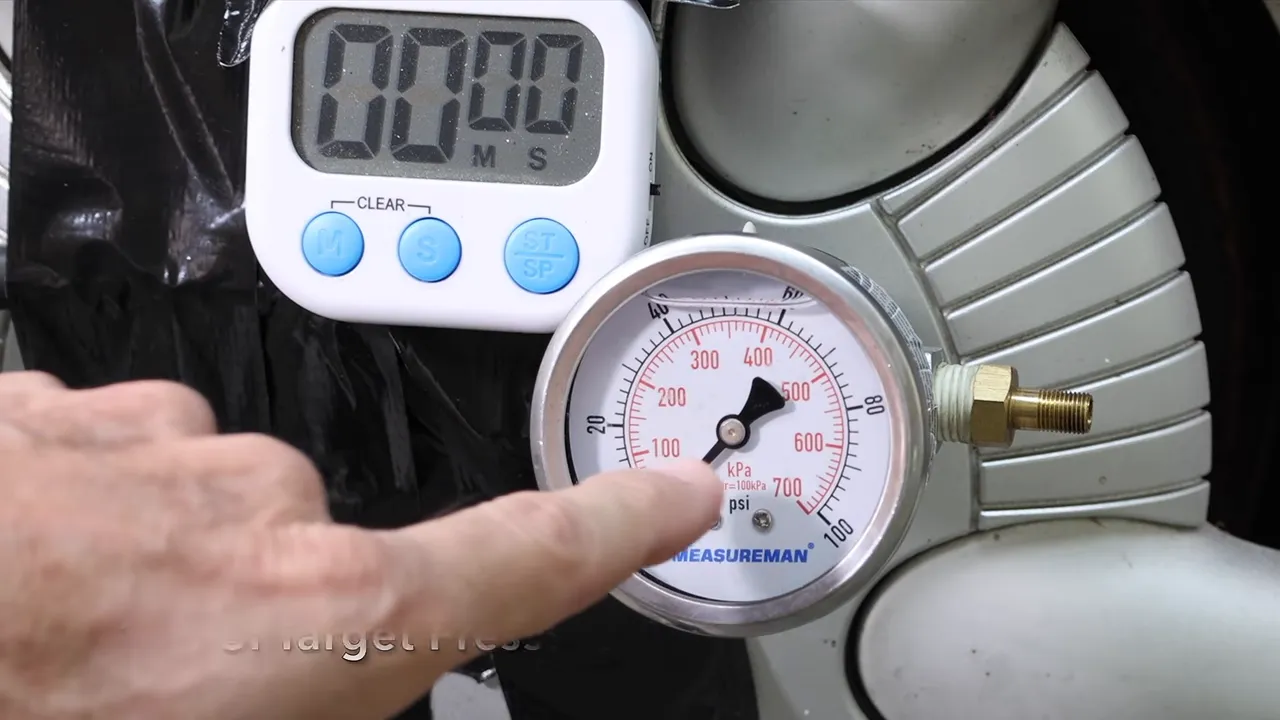
The first test was inflating the same 15-inch car tire from 0 to a target of 35 PSI. All the inflators started that test with fully charged batteries, and an inline pressure gauge provided a check separate from the pump’s display. I also measured weight, operating noise, and air-hose temperature.
For the second test, I used a three-quarter-ton pickup with 17-inch, load range E tires capable of handling up to 80 PSI. Each pump had to increase pressure from approximately 75 to 80 PSI. A JACO digital tire pressure gauge, which performed very well in my earlier gauge comparison, checked the starting and ending pressures.
Finally, for the inflators that could charge electronic devices, I used a battery tester with approximately a 7-watt load to measure delivered energy in watt-hours.
One important distinction: a claim such as “inflates a tire in 45 seconds” often refers to a small pressure top-off, not filling a completely flat tire. The 0-to-35-PSI test made those differences much easier to see.
Flat-Tire Test: What Each Inflator Delivered
Prices below are what the products cost for this comparison. These results apply to the specific inflators tested, not every model sold under each brand.
AIRSURE: $21
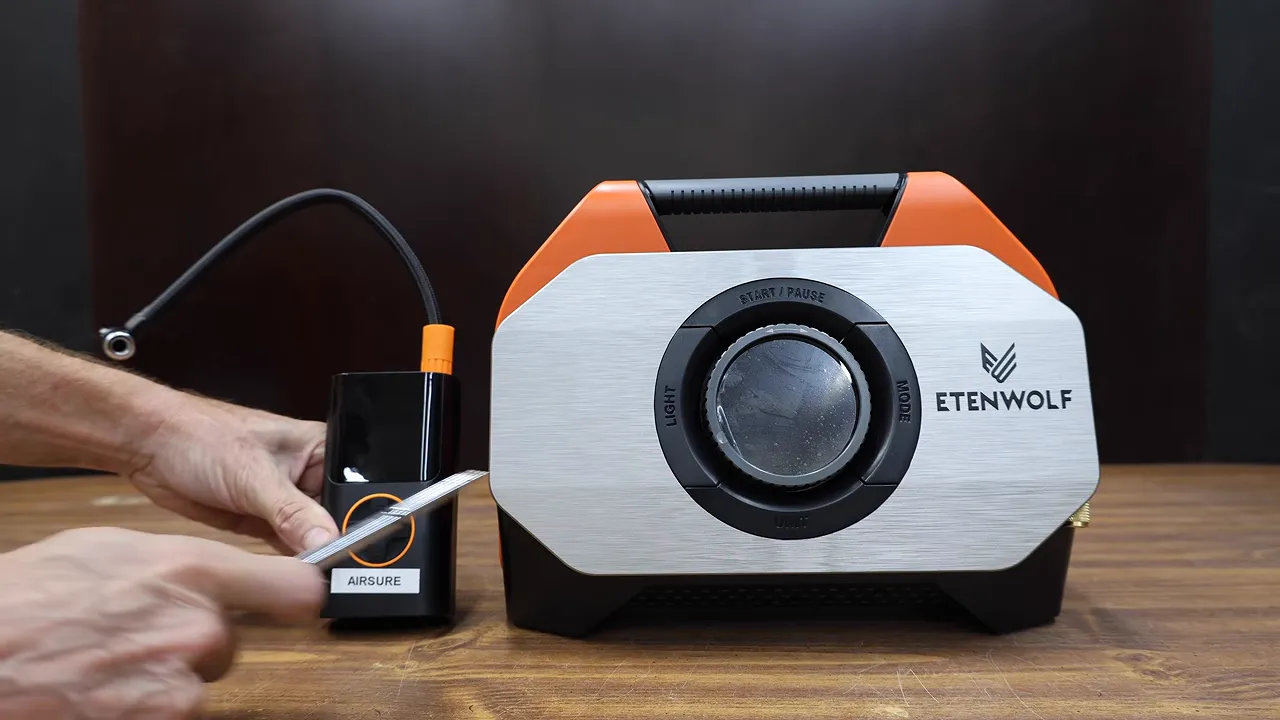
The least expensive inflator claimed up to 150 PSI and inflation three times faster than a standard pump. It included four additional nozzles, a storage bag, and a charging cable. At about 0.89 pound and 82 decibels, it was both light and among the quieter options.
The AIRSURE reached only 13.9 PSI after five minutes and 25.8 PSI after about ten minutes. It finally completed the test in 15 minutes, 4 seconds, with the independent gauge appearing very close to 35 PSI. Three battery bars remained, but the hose reached approximately 195°F. Not fast, but it did finish the job for very little money.
Powools: $22
Powools advertised a 4,000 mAh battery, up to 25 minutes of continuous operation, and a 30-to-36-PSI top-off in less than a minute. It weighed approximately 0.95 pound and measured 82.1 decibels.
It outpaced the AIRSURE, reaching 15 PSI in five minutes and 28 PSI in ten minutes. It shut off at approximately 12 minutes, 53 seconds, with pressure around 34.5 PSI. The battery indicator was down to one bar, and the hose reached approximately 195°F.
AstroAI: $24
The AstroAI included two different inflator hoses, a claimed 4,000 mAh battery, and USB charging capability for a phone. Its advertised top-off performance was 30 to 36 PSI in 1.5 minutes, with enough battery for eight such refills.
At 1.02 pounds, it was still very portable, although louder than the first two pumps at 87.3 decibels. It completed the flat-tire test in 13 minutes, 4 seconds. Two of its three battery bars remained, and its approximately 148°F hose temperature was much cooler than either of the cheapest competitors.
OlarHike PWR3: $30
The PWR3 offered a large display, automatic shutoff, a claimed 6,000 mAh battery, and a useful backup option: operation from a vehicle’s 12-volt outlet. Its hose was just over 24 inches long. OlarHike claimed enough battery to top off 11 SUV tires from 30 to 35 PSI.
The measured weight was 1.3 pounds, with noise at 82.7 decibels. It reached about 20 PSI in five minutes and finished in 9 minutes, 48 seconds. Two of four battery bars remained, and the hose reached approximately 194°F. That was a substantial speed improvement over the three least expensive pumps.
Lamicall: $35
Lamicall claimed four-times-faster inflation, up to 150 PSI, automatic shutoff, and a 28-to-36-PSI top-off on a 15-inch tire in one minute. It weighed just 1.18 pounds and measured 83.4 decibels.
It was around 20 PSI after five minutes, then finished in 8 minutes, 52 seconds. That is very good performance for the price and size. The battery indicator still showed all its bars, although the hose reached approximately 218°F, the hottest reading in this comparison. It can also charge electronic devices.
Craftsman: $39
The Craftsman included a claimed 6,000 mAh battery, an LED light, a power-bank output, and a 12-volt DC cord. Its advertised 30-to-36-PSI top-off time was 45 seconds.
It weighed approximately 1.3 pounds, but its 92.6-decibel reading made it considerably louder than the similarly sized budget pumps. It completed the test in 9 minutes, 47 seconds, essentially matching the less expensive OlarHike PWR3. Two of three battery bars remained, and the hose temperature was approximately 173°F.
ETENWOLF S1: $60
The S1 claimed a maximum pressure of 160 PSI, airflow of 20 liters per minute, and a 5,200 mAh battery. The manufacturer also advertised up to 17 car-tire inflations per charge, although that claim should not be confused with this full flat-tire test.
The S1 weighed 1.15 pounds and measured 87.3 decibels. It trailed several cheaper pumps, reaching only 16.9 PSI in five minutes and finishing in approximately 12 minutes, 5 seconds. One battery bar remained, with the hose around 182°F.
Fanttik X10 Pro: $60
The X10 Pro claimed a 3-to-150-PSI operating range, automatic shutoff, and the ability to add 5 PSI to a 15-inch tire in 35 seconds. At just under a pound, it was genuinely compact. However, it was also loud at 90.6 decibels.
For such a small pump, it held its own: 18 PSI after five minutes and a finish time of 10 minutes, 18 seconds. Two of four battery bars remained, and the hose reached approximately 178°F.
Velking: $60
The Velking advertised a large 12,000 mAh battery, a 20-inch hose, two-times-faster inflation, and up to 56 car-tire inflations on one charge. It weighed 1.84 pounds and measured 92.9 decibels.
Unfortunately, the tested unit stopped after approximately two and a half minutes. I recharged it and repeated the test, and the same thing happened again. The battery appeared defective, so it did not produce a usable completion result. A large advertised battery capacity did not help this particular unit.
NOCO: $70
NOCO claimed up to 130 PSI, a 90-minute recharge time, and enough battery for 14 top-offs or two full inflations from flat. It also doubled as a power bank. The unit weighed 1.87 pounds and measured 89.3 decibels. Unlike the other compact models identified as made in China, this NOCO was made in Thailand.
It reached 23 PSI in five minutes and finished in 8 minutes, 20 seconds, making it the fastest of the smaller pumps tested up to that point. Two battery bars remained. The trade-off was heat: its hose reached approximately 217°F.
Fanttik APEX: $70
The APEX claimed a 28-to-33-PSI top-off on a 17-inch tire in 56 seconds, along with up to 40 minutes of continuous operation. It weighed 1.84 pounds and measured 91.3 decibels.
It completed the flat-tire test in 8 minutes, 46 seconds, with three of four battery bars remaining. Its approximately 141°F hose temperature was a standout result, especially compared with the similarly fast NOCO and Lamicall.
Airmoto: $70
The Airmoto was the most compact inflator in the lineup, weighing just 0.91 pound. It claimed a 120-PSI maximum and a 2,000 mAh battery, and included three attachments. At 81.2 decibels, it was also the quietest measured pump.
Unfortunately, the small size came with a big speed penalty. It reached only 8.5 PSI after five minutes and 17.5 PSI after ten minutes. The battery ran out after just over 20 minutes at approximately 32.5 PSI, short of the target. Its hose was around 178°F.
GOOLOO: $70
GOOLOO advertised up to 160 PSI, a 10,000 mAh battery, 24 top-offs from 30 to 35 PSI, or four full inflations from 0 to 36 PSI per charge. It weighed 2.13 pounds, making it heavier than most of the compact pumps, but its 85.1-decibel reading was relatively restrained.
This thing was fast. It finished in 4 minutes, 58 seconds, with three of four battery bars remaining. The hose reached approximately 194°F. It was only modestly larger than the Fanttik APEX, yet delivered a major improvement in inflation speed.
OlarHike HD: $80
The OlarHike HD included a carrying case, two air hoses, a claimed 12,000 mAh battery, 45-watt device charging, and a 12-volt vehicle adapter. It was marketed for cars, trucks, and RVs, with a claimed 30-to-35-PSI top-off time of just 20 seconds.
At 2.36 pounds and 92.3 decibels, it was neither the lightest nor the quietest. It completed the test in approximately 4 minutes, 37 seconds, but there was a significant catch: the independent gauge showed about 40 PSI instead of 35. Three of four battery bars remained, and the hose was around 179°F.
DeWalt: $90
The DeWalt claimed up to 150 PSI and included a cooling fan, power-bank capability, and a 12-volt vehicle adapter. Its advertised 30-to-36-PSI top-off time was less than one minute.
It weighed 1.45 pounds and measured 87.8 decibels. However, the higher price did not translate into class-leading speed. It finished in 8 minutes, 55 seconds, considerably behind the less expensive GOOLOO. Three of four battery bars remained, and the hose reached approximately 197°F.
ETENWOLF Vortex: $130
The Vortex was the exception to the compact theme. At just under 6 pounds, it had an enormous size advantage. I included it because of its bold claims: up to 160 PSI, a 100% duty cycle, 45-watt bidirectional USB-C charging, and a 1,000-lumen light. ETENWOLF also claimed enough battery for 18 F-150 tire top-offs from 30 to 35 PSI.
It was the loudest at 94.4 decibels, but it also delivered the fastest result: 4 minutes, 8 seconds. All four battery bars remained, and the hose reached only approximately 132°F, the coolest result in the lineup. Very impressive performance, but definitely not a pocket-sized inflator.
The Fastest Inflators and the Heat Trade-Off
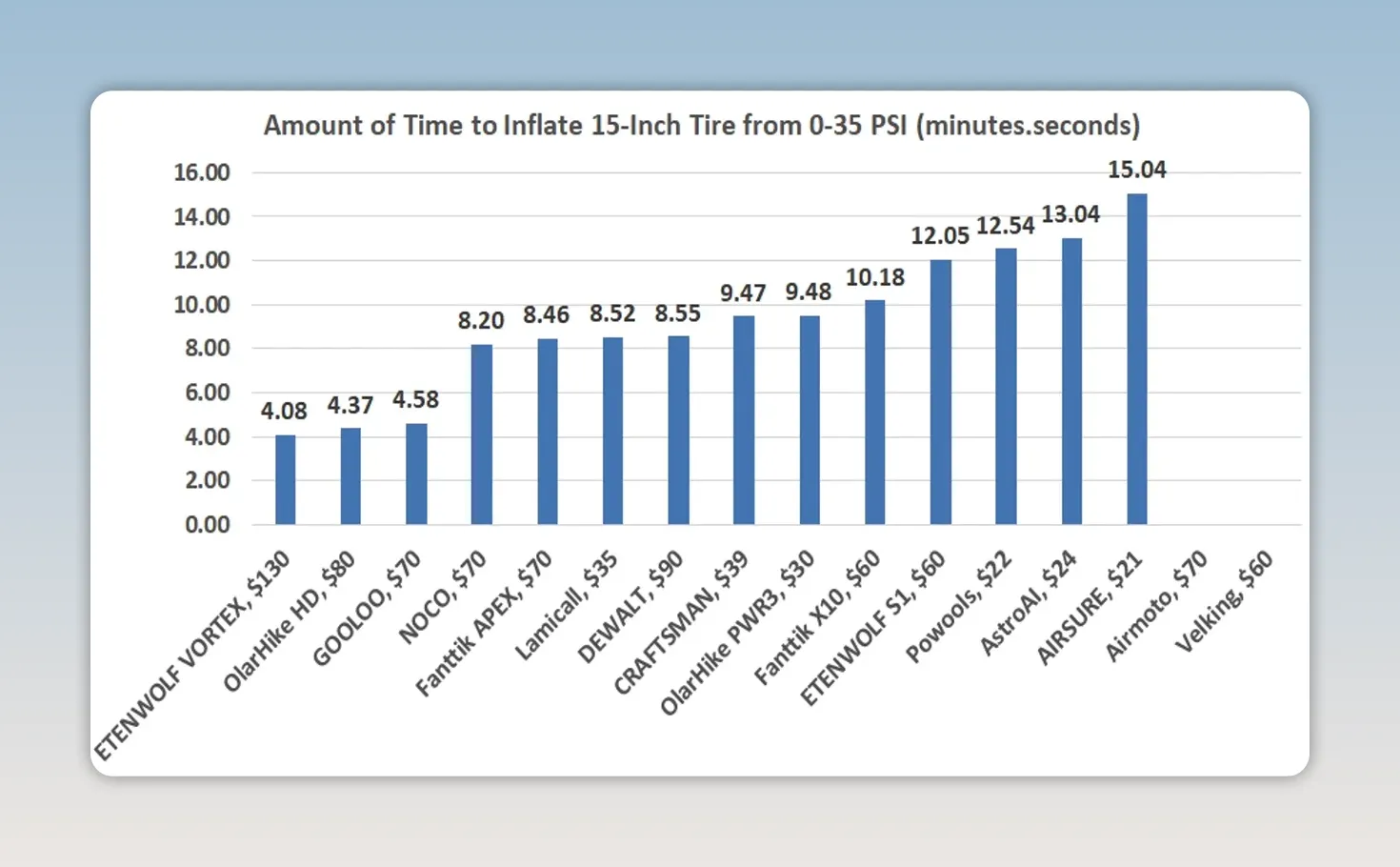
The flat-tire test produced a clear leading group:
- ETENWOLF Vortex: 4 minutes, 8 seconds.
- OlarHike HD: approximately 4 minutes, 37 seconds, but with substantial pressure overshoot.
- GOOLOO: 4 minutes, 58 seconds.
After those three, the next finisher was NOCO at 8 minutes, 20 seconds. That is a pretty large gap. GOOLOO delivered particularly strong performance without moving all the way up to the Vortex’s size.
Hose temperature matters, too. Repeated high-temperature exposure can contribute to hose deterioration, so cooler operation is a worthwhile advantage. The Vortex stayed coolest at approximately 132°F, followed by the Fanttik APEX at 141°F and AstroAI at 148°F.
At the other end, NOCO reached approximately 217°F and Lamicall approximately 218°F. Both were quick among the smaller pumps, but they generated considerably more hose heat. This was a temperature comparison, not a long-term hose durability test.
Pickup-Tire Test: Which Pumps Could Handle 80 PSI?
A high maximum-pressure rating is one thing. Actually moving air into a truck tire near 80 PSI is another. The pickup test showed that even several inexpensive compact inflators could do the job, although some took much longer than others.
Where a pump’s starting display differed from the reference gauge, I adjusted its target to try to add approximately 5 PSI of actual pressure. The results below include the independent ending-pressure checks wherever available.
- ETENWOLF Vortex: 1 minute, 27 seconds; ended at 80.1 PSI.
- GOOLOO: 1 minute, 40 seconds; ended at 80.7 PSI.
- OlarHike HD: 2 minutes, 9 seconds; ended too high at 82.8 PSI.
- NOCO: 2 minutes, 22 seconds; ended at 80.2 PSI.
- DeWalt: 2 minutes, 46 seconds of combined running time after a restart; ended at 79.6 PSI.
- Lamicall: 2 minutes, 48 seconds; ended at 80.5 PSI.
- Fanttik APEX: 3 minutes, 2 seconds; ended at 80.8 PSI.
- Fanttik X10 Pro: 3 minutes, 27 seconds; ended at 80.6 PSI.
- OlarHike PWR3: 3 minutes, 36 seconds; ended approximately 0.6 PSI below the 80-PSI goal.
- Craftsman: 3 minutes, 57 seconds; the reference gauge showed 80.1 PSI after setting an adjusted 80.5-PSI target.
- ETENWOLF S1: 4 minutes, 23 seconds; ended at 80.8 PSI.
- AstroAI: 4 minutes, 27 seconds; ended at 80.2 PSI.
- Powools: 4 minutes, 29 seconds; stopped short at 79.4 PSI.
- AIRSURE: approximately 7 minutes; ended at 80.2 PSI.
- Airmoto: approximately 7 minutes, 37 seconds; ended at 81.2 PSI.
The Velking did not have a usable result following its repeated battery problem.
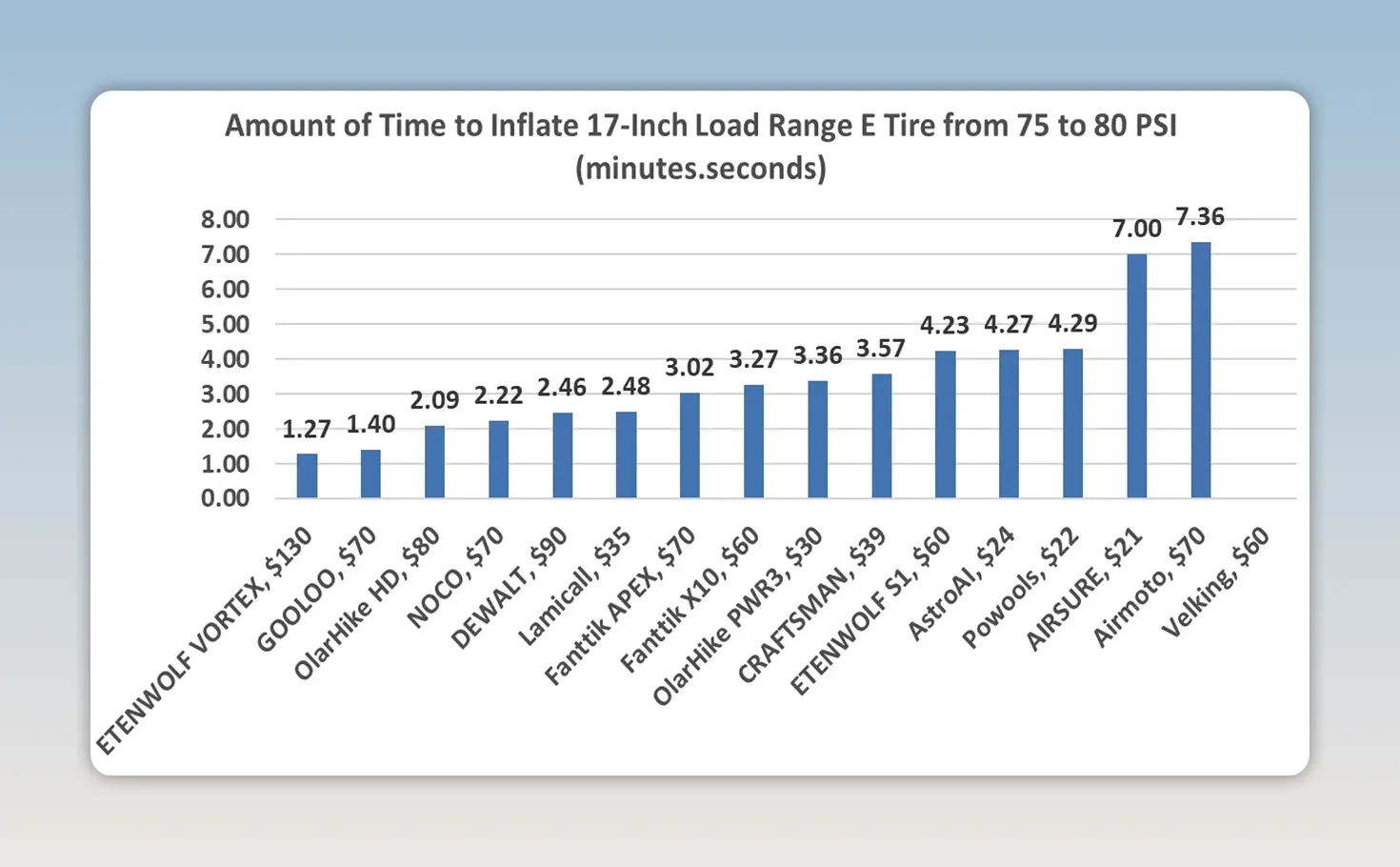
The Vortex won again, with GOOLOO only 13 seconds behind. Lamicall also deserves credit: a $35, 1.18-pound pump completing this test in less than three minutes is pretty impressive.
Automatic Shutoff Does Not Guarantee Accurate Pressure
The largest concern was not whether the pumps could generate pressure, but whether they stopped at the right pressure.
The OlarHike HD overshot in both tests. It put approximately 40 PSI into the passenger-car tire during the 35-PSI test, then finished the truck test at 82.8 PSI. Its speed is real, but those ending pressures make a separate gauge especially important.
The DeWalt had a different problem. Its first truck-tire run stopped after only 1 minute, 1 second, but the reference gauge showed just 77.2 PSI. I raised the target to 83.5 PSI and ran it for another 1 minute, 45 seconds. The actual ending pressure was 79.6 PSI.
Some smaller discrepancies were easier to compensate for. AstroAI and NOCO initially displayed approximately 1 PSI above the reference reading, so their targets were increased to 81 PSI. Both finished at an actual 80.2 PSI.
The practical lesson is simple: check actual tire pressure rather than relying entirely on the inflator’s display. For normal vehicle use, follow the recommended cold inflation pressure on the vehicle placard or in the owner’s manual, not these test targets. The NHTSA tire-safety guide provides additional guidance on checking and maintaining tire pressure.
Battery Capacity: Which Inflator Makes the Best Power Bank?
Several pumps can also charge a phone or another electronic device. To compare that function, I drained their batteries through the output at approximately a 7-watt load and measured the energy delivered.
These are usable output measurements under that test load, not a count of how many tires each pump can inflate. Battery bars and advertised mAh figures do not provide the same information.
- ETENWOLF Vortex: 55.58 watt-hours.
- OlarHike HD: 34.88 watt-hours.
- GOOLOO: 32.25 watt-hours.
- Fanttik APEX: 21.60 watt-hours.
- DeWalt: 20.58 watt-hours.
- Craftsman: 18.73 watt-hours.
- NOCO: 18.15 watt-hours.
- Lamicall: approximately 17.98 watt-hours.
- OlarHike PWR3: 16.34 watt-hours.
- AIRSURE: 11.78 watt-hours.
- AstroAI: 11.22 watt-hours.
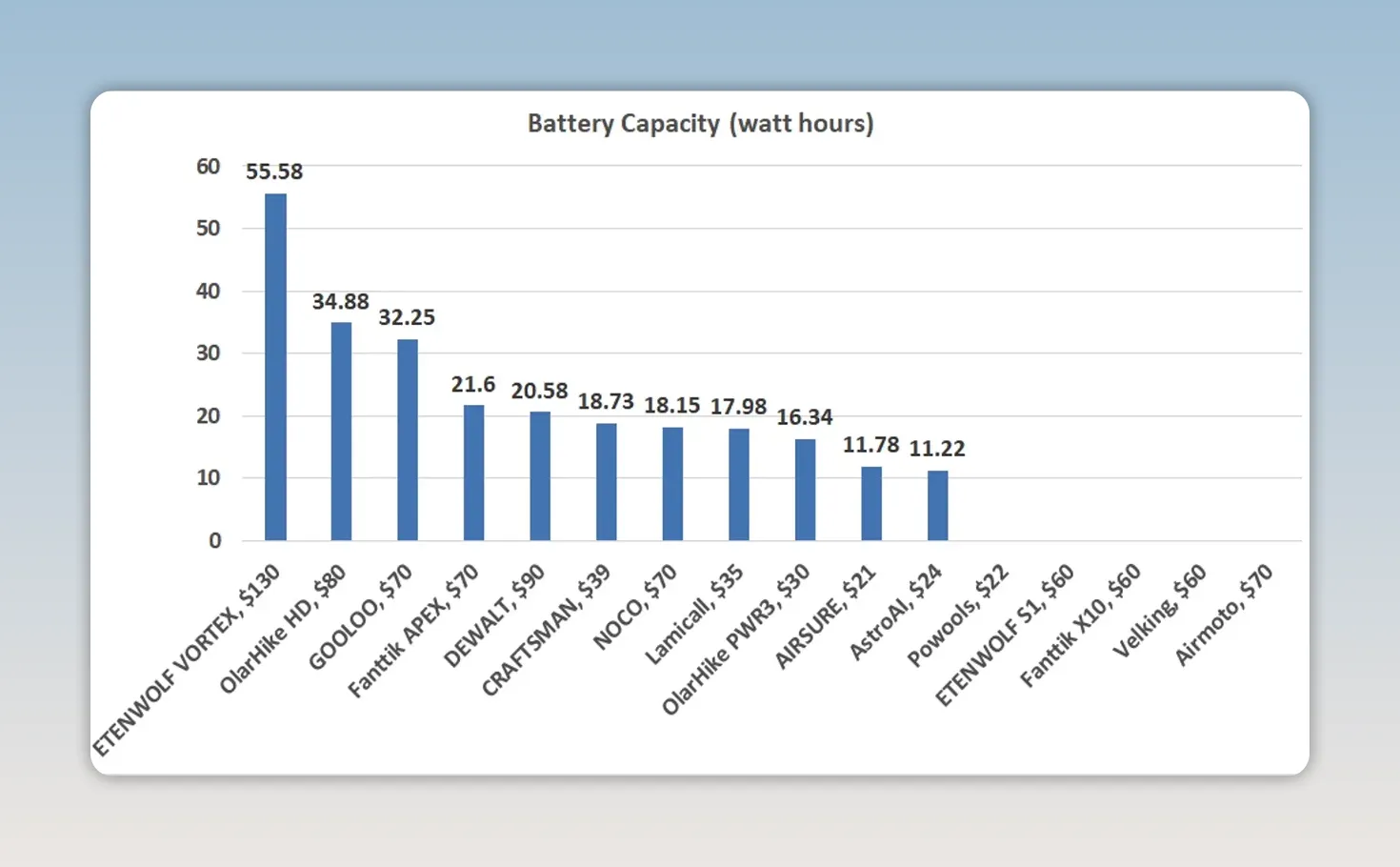
The Vortex’s large battery gave it a clear win. Among the smaller options, the OlarHike HD and GOOLOO stood well ahead of the rest. GOOLOO delivered substantially more energy than the similarly priced Fanttik APEX while also inflating both tires faster.
Which Tire Inflator Would I Choose?
To compare overall performance, I converted the measured results into first-through-last rankings and averaged the finishes. Basic information such as price, weight, size, noise, and 12-volt backup capability was listed separately rather than included in the winning average.
Best Overall Performance: ETENWOLF Vortex
The ETENWOLF Vortex had the best average finish at 1.5. It won both inflation tests, delivered the most usable battery energy, and kept its hose coolest.
However, it is a very large inflator. At nearly 6 pounds, it seems like a great choice for around the house, but it would be more size and weight than I would want for a compact car-storage solution.
Best Balance of Size, Capability, and Price: GOOLOO
The GOOLOO finished second overall with an average ranking of 4.3. I would call it “compact plus” rather than truly tiny, based on its size and 2.13-pound weight.
It would definitely be my top pick for a relatively small inflator with a lot of capability at a pretty good price. For around $70, it delivered sub-five-minute flat-tire inflation, a very quick high-pressure truck top-off, and useful power-bank capacity.
Best Affordable Small Option: Lamicall
If GOOLOO is too large or too expensive, the Lamicall makes a lot of sense. At approximately $35 and 1.18 pounds, it offers very good performance for a smaller vehicle where storage space is limited. It can also charge electronic devices.
The biggest trade-off is its hot hose after a full flat-tire inflation. Even so, its combination of price, compact size, and inflation speed made it one of the strongest values in the comparison.
Compared with the compact tire inflators I tested previously, this group showed quite a bit of improvement. The least expensive pumps could still get useful work done, but the strongest choices were not simply the smallest, the most expensive, or the most familiar brand. Matching inflation speed, actual pressure accuracy, battery capacity, and storage space is what makes a good choice.
I purchased all the products for this comparison and do not accept free review items or manufacturer sponsorships. The goal is to keep these comparisons as unbiased as possible.


