Even a brand-new car battery can fail without much warning. That’s why I keep a jump starter handy. But can a $70 jump starter with a built-in tire inflator perform as well as one costing $140? And how do those combination units compare with a much larger, $375 dedicated jump starter?
Big numbers on the packaging don’t start an engine. To find out what these jump starters can actually do, I tested them on gasoline and diesel engines, measured their electrical output with a carbon pile tester, inflated a flat tire, and drained their batteries to measure usable capacity.
The NOCO GBX155 delivered the strongest jump-starting performance, while the VTOMAN X7 and GOOLOO finished tied as my favorite combination units. Some of these tire inflators were very impressive, too.
I purchased all the jump starters and supplies used for this comparison. Prices below are what they cost at the time of testing.
Quick Summary
- NOCO GBX155 delivered the strongest jump-starting performance and highest measured battery capacity.
- VTOMAN X7 and GOOLOO tied as the best overall combination jump starters and tire inflators.
- GOOLOO inflated the test tire fastest, reaching 35 PSI in 4 minutes, 27 seconds.
- Advertised peak amperage did not reliably predict measured power or engine-starting performance.
Table of Contents
- The Lineup: What the Manufacturers Claim
- First Test: Cranking a Gasoline Engine With a Completely Drained Battery
- Tire Inflator Test: From Flat to 35 PSI
- Starting a 5.7-Liter V8 Three Times Back-to-Back
- Measured Electrical Output: Amps Are Only Part of the Story
- Diesel Test: Three Starts With a 5.9-Liter Engine
- Battery Capacity: How Much Energy Is Actually Available?
- Which Jump Starter Would I Buy?
The Lineup: What the Manufacturers Claim
Twelve of these products combine a jump starter, tire inflator, light, and power-bank capability. The NOCO is the exception: it’s a dedicated jump starter without a compressor.
The following specifications are manufacturer claims, not measured results. That distinction becomes pretty important once the testing gets underway.
- HPBS, $70: Advertised at 5,000 amps, with support for a 10-liter gasoline engine or 8-liter diesel. It claims 59.2 Wh of battery capacity and a 150 PSI compressor that can take a 15-inch tire from 29 to 36 PSI in about a minute. Measured weight: 1.42 pounds.
- BRPOM, $70: Claims 8,000 peak amps, support for a 12-liter diesel, 26.64 Wh of capacity, a 160 PSI inflator, and a 600-lumen light. Measured weight: 1.49 pounds.
- ACMOUNT, $85: Claims 5,000 amps, a 150 PSI compressor, and a 12,000 mAh battery. It also advertises as many as 60 starts of an 8-liter engine on one charge. Measured weight: 1.73 pounds.
- HDFLU, $86: Advertised at 7,500 peak amps, with a 180 PSI compressor, 65-watt charging capability, and a 24,000 mAh battery. Measured weight: 1.85 pounds.
- ANFLAG, $90: Claims 8,000 amps, support for a 14-liter diesel, 59.2 Wh of capacity, and inflation from 25 to 36 PSI in one minute. Its advertised weight was around 5 pounds, but the unit weighed 2.84 pounds.
- VTOMAN X7, $93: Claims 4,250 amps, support for a 10-liter diesel, up to 70 starts per charge, and an 88.8 Wh battery. It advertises 18-watt charging and tire inflation from 30 to 35 PSI in about a minute. Measured weight: 3.40 pounds.
- JOLTEKON, $100: Claims 6,000 amps, support for a 12-liter diesel, a 10,000 mAh battery, and an 800-lumen light. Measured weight: 2.18 pounds.
- NNUTROMO, $100: Advertised at 4,000 amps, with a 24,000 mAh battery, support for a 10-liter diesel, and up to 50 starts per charge. It claims a full recharge in about 1.5 hours, 65-watt USB-C output, and inflation of a 15-inch tire from 29 to 36 PSI in about 40 seconds. Measured weight: 3.51 pounds.
- Povasee, $109: Claims 5,000 amps, support for a 9-liter gasoline engine or 8-liter diesel, 44.4 Wh of capacity, and a 150 PSI compressor. Measured weight: 1.43 pounds.
- OlarHike, $110: Advertised at 3,000 amps, with support for a 6-liter engine and 45-watt two-way USB-C charging. Its compressor uses an advertised 20,000 RPM motor and all-metal cylinder, with a claimed two-minute top-off of an LT275 truck tire from 45 to 51 PSI. Measured weight: about 2.60 pounds.
- GOOLOO, $120: Claims 4,000 amps and 45-watt USB-C input and output. It advertises inflation from 30 to 36 PSI in 30 seconds for a 15-inch car tire or two minutes for a 17-inch pickup tire. Measured weight: 3.14 pounds.
- YaberAuto, $140: Claims 8,000 amps, support for a 14-liter diesel, a 160 PSI compressor, and a 26,800 mAh battery. It also advertises 65-watt input and output, 160-watt continuous DC output, and inflation from flat to 35 PSI in two minutes. Measured weight: 2.84 pounds.
- NOCO GBX155, about $375: A dedicated jump starter I’ve owned for roughly four to five years. It has held up very well and weighs 5.61 pounds, considerably more than any combination unit here.
Weight has often been a useful clue in my jump starter testing. It isn’t a guarantee of quality, but several of the heavier units in this comparison had a lot more power and capacity than the lightweight competition.
First Test: Cranking a Gasoline Engine With a Completely Drained Battery
The first challenge used a six-cylinder Ford Ranger with a completely drained battery. I disabled the ignition so the engine would crank without starting. This exposed differences in cranking speed and how long each jump starter could keep working.
This was a demanding comparison, not a recommended cranking procedure. I stopped several of the stronger units to avoid damaging the jumper cables, so their recorded run times don’t necessarily represent their limits.
The Lightweight Units Struggled
The HPBS and BRPOM both had a very hard time turning the engine over. The ACMOUNT was a noticeable improvement, keeping it cranking for about 2.5 seconds. The HDFLU lasted roughly 3.5 seconds.
The Povasee struggled despite a full charge and lasted less than two seconds. The JOLTEKON managed just over three seconds. Those large advertised amperage numbers certainly weren’t translating into equally strong performance.
The Stronger Combination Units Pulled Ahead
The ANFLAG was the first to spin the engine over quickly and keep going for close to eight seconds. Then the VTOMAN made the challenge look much easier, cranking faster and completing the full eight-second test.
The NNUTROMO cranked about as enthusiastically as the VTOMAN. I ended its test at close to ten seconds to protect the cables. The OlarHike wasn’t quite as fast, but it kept working for just over ten seconds before sounding an overheating alarm.
The GOOLOO delivered a strong cranking speed and lasted a little over eight seconds. The YaberAuto was slower but still better than average, continuing through the eight-second mark before I stopped the test at around ten seconds.
The NOCO was in a different league. It spun the engine faster than anything else, and I finally ended the test at about 13 seconds. Very impressive.
Cranking speed involves some subjective judgment. On my scale of 1 for excellent to 5 for poor, the NOCO earned a 1. The VTOMAN, NNUTROMO, and GOOLOO each earned a very good 1.5.
Tire Inflator Test: From Flat to 35 PSI
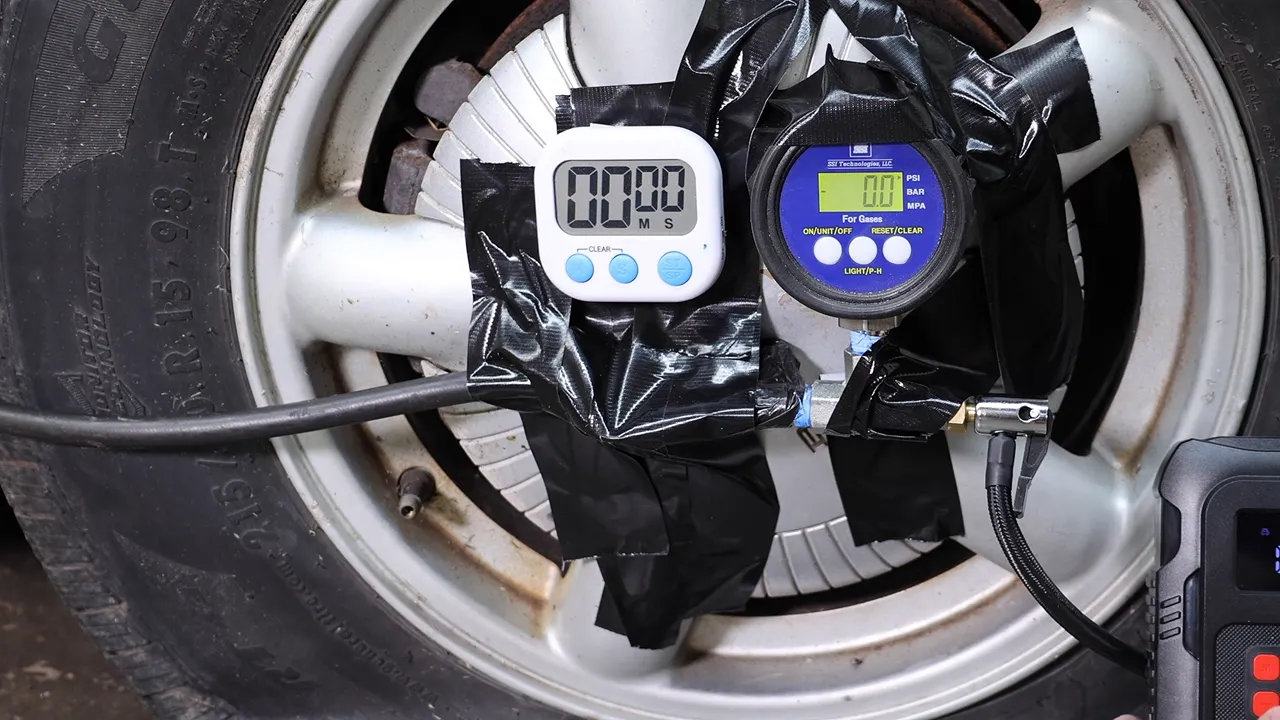
Every combination unit started this test fully charged. I used the same 15-inch tire, a timer, and a calibrated inline pressure gauge to compare inflation speed and pressure accuracy. I also measured compressor noise.
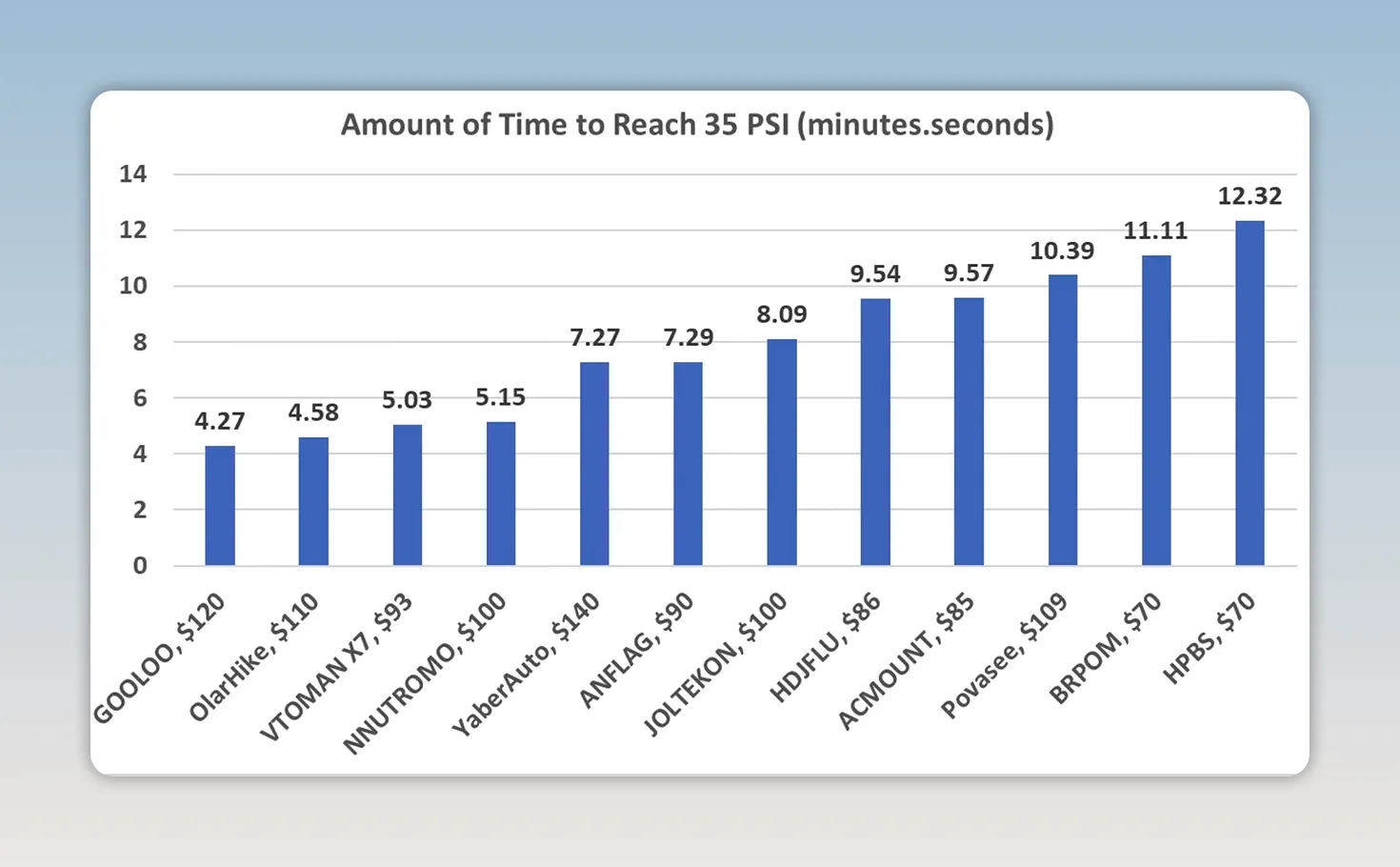
Here are the inflation times, fastest to slowest:
- GOOLOO: 4 minutes, 27 seconds.
- OlarHike: 4 minutes, 58 seconds.
- VTOMAN: 5 minutes, 3 seconds.
- NNUTROMO: 5 minutes, 15 seconds.
- YaberAuto: 7 minutes, 27 seconds.
- ANFLAG: 7 minutes, 29 seconds.
- JOLTEKON: 8 minutes, 9 seconds.
- HDFLU: 9 minutes, 54 seconds.
- ACMOUNT: Just under 10 minutes.
- Povasee: 10 minutes, 39 seconds.
- BRPOM: 11 minutes, 11 seconds.
- HPBS: 12 minutes, 32 seconds.
The GOOLOO finished almost three times as quickly as the HPBS. The VTOMAN and NNUTROMO were also very competitive, finishing only 12 seconds apart.
Pressure Accuracy and Noise Matter, Too
The HPBS was slow, but its pressure error was only 0.3 PSI. YaberAuto was off by 0.4 PSI, VTOMAN by 0.7 PSI, and ANFLAG and GOOLOO by 0.8 PSI. HDFLU stayed within 1 PSI.
NNUTROMO was off by 1.1 PSI. BRPOM, ACMOUNT, and JOLTEKON each differed by about 1.2 PSI. Povasee overinflated the tire by 0.7 PSI.
The OlarHike’s speed came with the largest pressure error: it overinflated the tire by 2.5 PSI. That’s worth keeping in mind when comparing its finish time with the others.
The fastest pumps weren’t necessarily quiet. GOOLOO measured 95.8 decibels and VTOMAN 94.7. YaberAuto was the loudest at 96 decibels despite taking considerably longer. HDFLU measured 87.4 decibels, OlarHike 88.5, Povasee 88.7, NNUTROMO 89.4, HPBS 89.5, ANFLAG 89.8, ACMOUNT 91.5, and JOLTEKON 92.6.
Most units still displayed a full charge after inflating one tire. HPBS, BRPOM, HDFLU, and JOLTEKON showed three of four bars, while NNUTROMO showed 95%. Those indicators are useful, but they don’t replace a measured capacity test.
For normal tire maintenance, use the vehicle’s recommended pressure rather than treating 35 PSI as a universal target. The NHTSA tire safety guide provides additional guidance on finding and checking the correct pressure.
Starting a 5.7-Liter V8 Three Times Back-to-Back
The next test used a 5.7-liter gasoline engine and a severely depleted vehicle battery. Each jump starter had to attempt three starts in succession.
A drained battery can act like an electrical sponge, pulling down the jump starter’s voltage. That means the jump starter has to support more than the starter motor. The rest of the vehicle’s electrical system needs adequate voltage, too.
The HPBS struggled, with uneven starting and poor running after the engine fired. The BRPOM completed all three starts, but the engine also ran poorly. Low system voltage appeared to be contributing to those problems.
The ACMOUNT and HDFLU both completed three starts with much more convincing performance. ANFLAG also fired the engine successfully on all three attempts.
The VTOMAN and NNUTROMO were especially strong, bringing the engine to life quickly. JOLTEKON completed all three starts but wasn’t as enthusiastic as the VTOMAN.
Povasee completed the three starts, although the second was weaker than the first and I had to reset the jump starter before the third attempt.
OlarHike and GOOLOO both made easy work of the V8. YaberAuto took a fraction longer but still performed well on all three attempts. As expected, the NOCO fired the engine up very quickly every time.
Successful starts alone don’t tell the entire story. Several products started the engine, but the stronger units did it more quickly and with less struggle.
Measured Electrical Output: Amps Are Only Part of the Story
To compare electrical output, I used a carbon pile load tester with separate digital instruments for current and voltage. Multiplying amps by volts gives watts, providing a way to compare both measurements together.
For example, the HPBS delivered 387 amps at 7.30 volts, or about 2,825 watts. The BRPOM’s advertised 8,000 peak amps didn’t help it here: it produced 274 amps at 7.25 volts, or about 1,987 watts.
These are measured results under this particular load test, not a standardized verification of every manufacturer’s advertised peak-current rating.
- NOCO: 890 amps at 7.27 volts, approximately 6,470 watts.
- VTOMAN: 542 amps at 9.64 volts, approximately 5,225 watts.
- GOOLOO: 530 amps at 9.73 volts, approximately 5,157 watts.
- NNUTROMO: 589 amps at 8.14 volts, approximately 4,794 watts.
- OlarHike: 510 amps at 7.13 volts, approximately 3,636 watts.
- ANFLAG: 438 amps at 8.26 volts, approximately 3,618 watts.
- YaberAuto: 484 amps at 7.36 volts, approximately 3,562 watts.
- ACMOUNT: 399 amps at 8.22 volts, approximately 3,280 watts.
- JOLTEKON: 370 amps at 7.81 volts, approximately 2,890 watts.
- HPBS: 387 amps at 7.30 volts, approximately 2,825 watts.
- HDFLU: 378 amps at 7.10 volts, approximately 2,684 watts.
- Povasee: 314 amps at 7.78 volts, approximately 2,443 watts.
- BRPOM: 274 amps at 7.25 volts, approximately 1,987 watts.
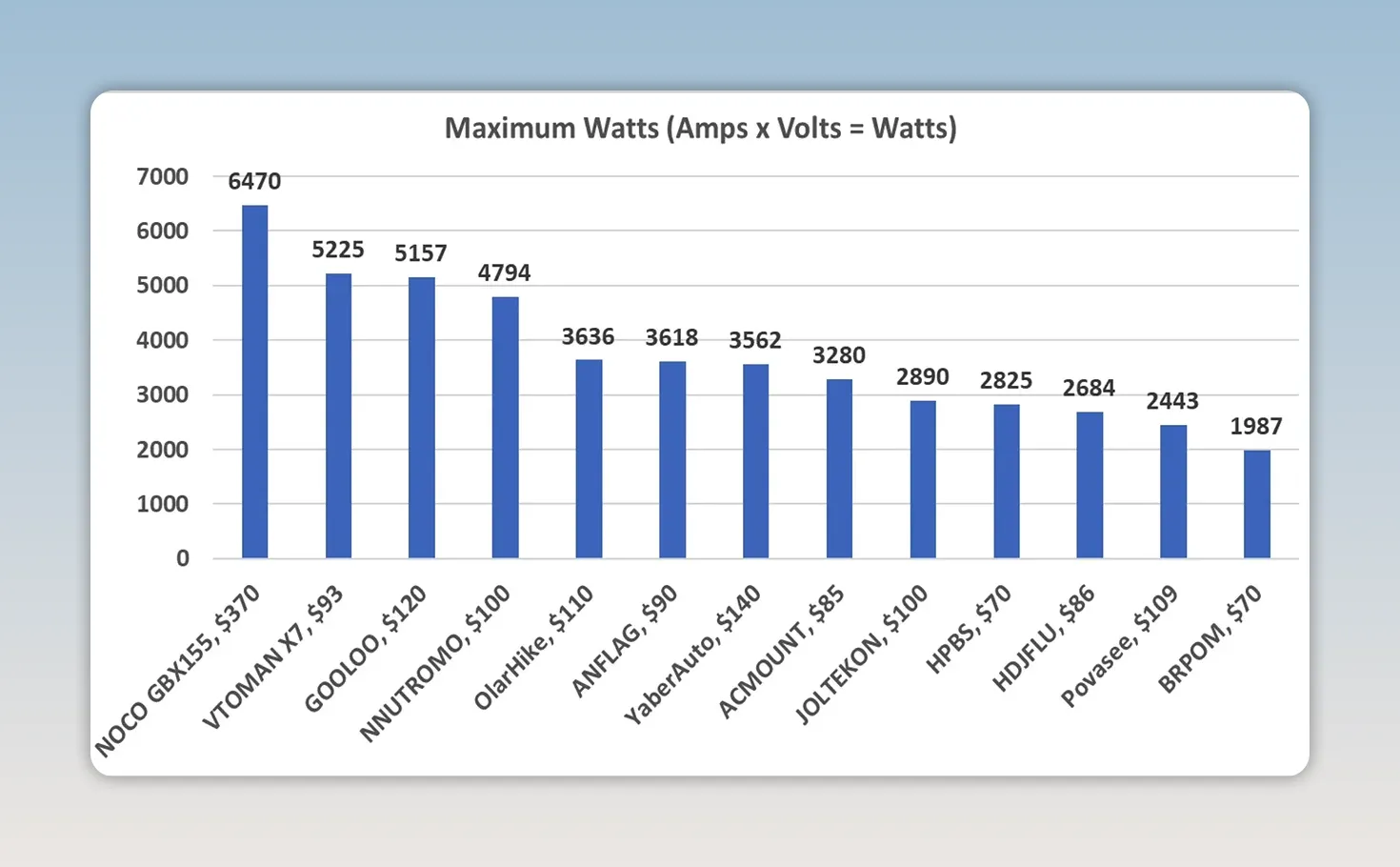
The NNUTROMO delivered more current than the VTOMAN, but the VTOMAN maintained higher voltage and produced more power. That’s exactly why comparing amperage alone can be misleading.
Once again, the heavier products generally performed better. The 5.61-pound NOCO led comfortably, while the VTOMAN and GOOLOO were very close to each other.
Diesel Test: Three Starts With a 5.9-Liter Engine
The diesel normally uses two batteries. For this test, I replaced one with Cousin Eddie’s wooden battery substitute and installed the depleted Ford Ranger battery in the other position. The jump starters then faced three back-to-back starting attempts.
This was a much tougher challenge than starting the gasoline engines, and it separated the weakest products from the rest.
- HPBS and BRPOM: Neither successfully started the diesel.
- ACMOUNT: Completed one successful start.
- HDFLU: Completed two starts, then nearly managed a third before overheating and shutting down.
- ANFLAG: Completed all three starts with very good performance.
- VTOMAN: Made all three starts look easy, including the final attempt.
- JOLTEKON: Completed three starts, though it cranked more slowly than the VTOMAN.
- NNUTROMO: Cranked quickly and completed all three starts easily.
- Povasee: Completed three starts, although the first attempt involved visible sparking.
- OlarHike: Turned the engine over faster than the Povasee and completed all three starts.
- GOOLOO: Delivered strong cranking performance and three easy starts.
- YaberAuto: Wasn’t as powerful as the GOOLOO but still completed all three starts.
- NOCO: Was clearly the strongest and completed all three starts with very little effort.
Nine of the thirteen jump starters completed all three diesel starts. A few years ago, this would have been a very difficult task for most portable jump starters I tested. These products have definitely improved.
However, a successful test on this 5.9-liter diesel doesn’t establish that a unit can start every larger engine advertised on its packaging.
Battery Capacity: How Much Energy Is Actually Available?
A jump starter needs enough power to crank an engine, but reserve capacity matters when that engine is stubborn. I used a battery tester to drain each unit at approximately 7 watts and measure the delivered energy in watt-hours.
This measures usable energy through the tested output, rather than simply repeating the internal battery capacity printed on the case.
- NOCO: 77.28 Wh.
- NNUTROMO: 71.59 Wh.
- VTOMAN: 65.03 Wh.
- GOOLOO: 58.11 Wh.
- OlarHike: 53.85 Wh.
- YaberAuto: 43.59 Wh.
- ANFLAG: 38.26 Wh.
- HDFLU: 36.06 Wh.
- JOLTEKON: 29.02 Wh.
- ACMOUNT: 28.44 Wh.
- Povasee: 23.79 Wh.
- HPBS: 22.17 Wh.
- BRPOM: 20.71 Wh.
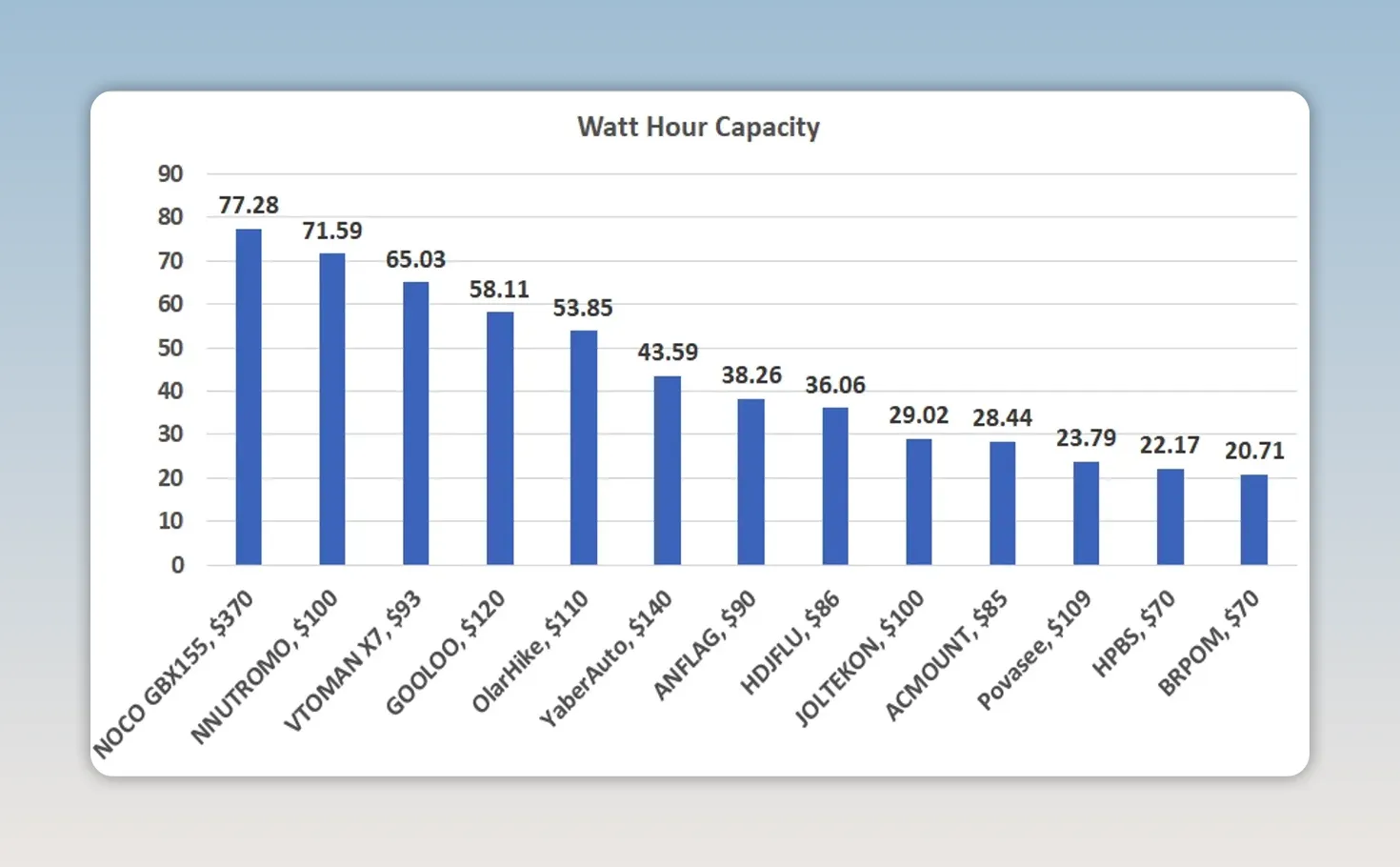
The NOCO finished first again, but the NNUTROMO was close behind. That’s a very strong result for a $100 combination unit.
The capacity spread was substantial. NNUTROMO delivered more than three times the measured energy of either $70 unit. The VTOMAN and GOOLOO also combined strong starting power with useful reserves.
Which Jump Starter Would I Buy?
For the overall comparison, I converted the performance results into first-through-last rankings and averaged those finishes. Basic information such as price, weight, noise, and pressure-gauge error was listed separately rather than included in the overall score.
The engine-cranking assessments include subjective judgment, and the NOCO has no tire inflator to evaluate. With those differences in mind, here are my picks.
Best Dedicated Jump Starter: NOCO GBX155
The NOCO GBX155 finished first overall. It cranked the engines fastest, delivered the most measured electrical power, and had the highest measured battery capacity. My unit has also held up well over roughly four to five years.
The downsides are pretty clear: it costs about $375, it’s large and heavy, and it doesn’t include a tire inflator. If maximum jump-starting performance is the priority, it’s an absolutely fantastic option.
Best Combination Units: VTOMAN X7 and GOOLOO
The VTOMAN X7 and GOOLOO tied for second overall with an average finishing position of 2.0.
Both delivered excellent jump-starting performance and very good tire inflation. The VTOMAN had a slight advantage in measured peak power and more usable battery capacity. The GOOLOO had the fastest compressor in the entire comparison.
At the prices I paid, the $93 VTOMAN offered a particularly strong value against the $120 GOOLOO. But if prices change, I’d seriously consider buying whichever costs less. Both are very impressive.
Another Strong Choice: NNUTROMO
The NNUTROMO finished fourth overall with an average finishing position of 2.3. It was a strong engine starter, had a fast compressor, and delivered the most usable battery capacity of any combination unit.
I slightly prefer the VTOMAN and GOOLOO overall, but at the right price I would definitely consider the NNUTROMO.
The biggest lesson is simple: buy demonstrated performance, not the largest number printed on the box. The $140 combination unit didn’t beat the less expensive leaders, and the two $70 products struggled badly in the tougher starting tests. Meanwhile, several reasonably priced combination units handled a diesel engine three times in a row and inflated a flat tire in around five minutes. That’s real progress.


