A Honda generator costs around $1,200. But can a $300 inverter generator deliver performance that's just as good, or possibly even better? That's a pretty big price difference, so I put five brands through a series of tests to find out where the extra money goes.
Oxseryn, Ford, Champion, Generac, and Honda competed on voltage stability, recovery after a sudden load, noise, electricity waveform quality, fuel efficiency, and carbon monoxide shutdown protection. I also checked starting effort, service access, and spark plug condition after approximately 24 hours of operation.
The Honda finished first overall, but it didn't win everything. The inexpensive Oxseryn was almost exactly as quiet and used the least fuel at a light load. Champion offered a strong middle ground with carbon monoxide protection at a much lower price than the Honda.
I purchased the products for these comparisons and do not accept manufacturer sponsorships. Prices below are what the units cost for this test, not guarantees of current pricing.
Quick Summary
- Honda delivered the best voltage stability and fastest recovery after a sudden electrical load.
- The $300 Oxseryn nearly matched Honda's noise level and won the light-load fuel-efficiency test.
- Champion combined competitive performance, tool-free maintenance access, and carbon monoxide shutdown at a midrange price.
- Generac used the least fuel under heavy load but offered no manual economy-mode override.
Table of Contents
- The Generator Lineup: What You Get for the Money
- Voltage Stability: The Honda Earns Its Keep
- Which Generator Is the Quietest?
- Clean Electricity: Inverter Versus Conventional Output
- Fuel Efficiency: The Winner Depends on the Load
- Carbon Monoxide Shutdown: An Important Difference
- What Happened After Approximately 24 Hours?
- Which Generator Would I Buy?
The Generator Lineup: What You Get for the Money
Oxseryn: $300
The Oxseryn advertises 2,800 surge watts and 2,000 running watts from a 79.8 cc four-stroke engine. Its 1.1-gallon fuel tank is advertised to provide nine hours of operation at a 25% load.
For the least expensive inverter generator in this comparison, it includes quite a few useful features:
- Two 120-volt AC receptacles.
- A 12-volt DC socket, USB port, and USB-C port.
- A fuel gauge.
- A selectable economy mode.
- Parallel capability with a separately purchased cable.
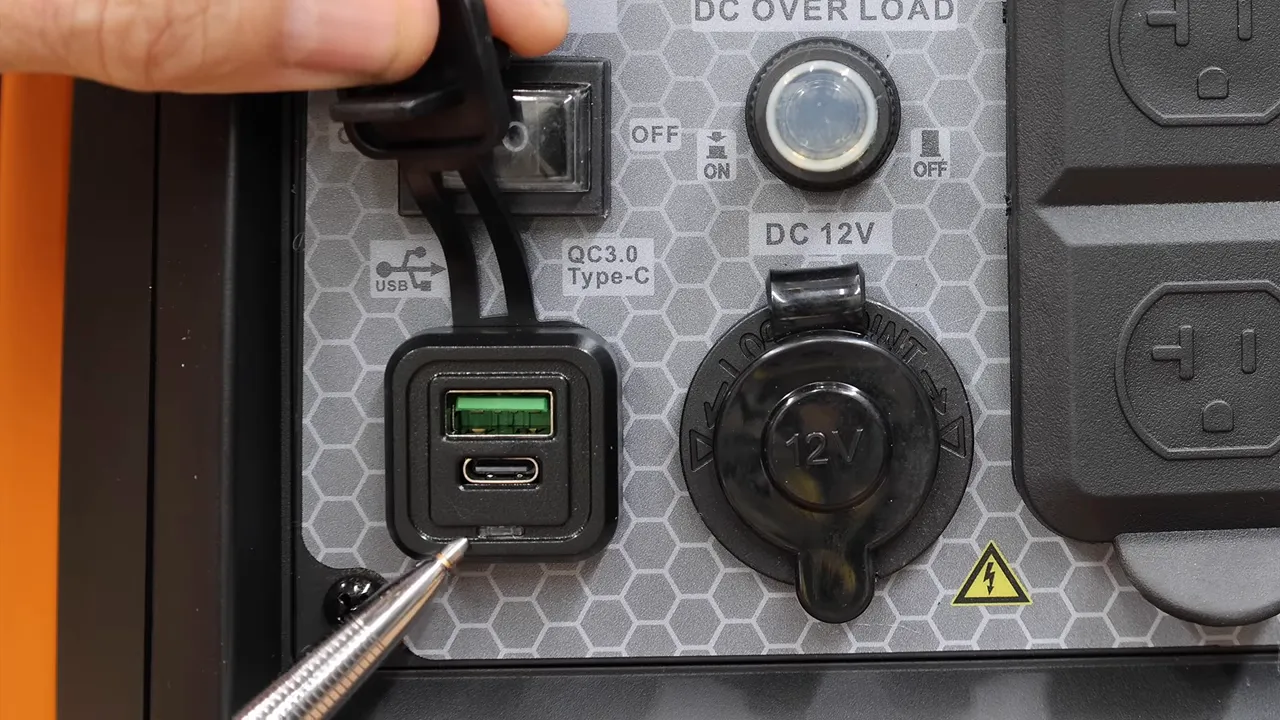
The China-made Oxseryn requires a Phillips screwdriver to remove its side panel for oil and air filter maintenance. It uses a foam air filter and holds only about 12 ounces of engine oil. The LG spark plug arrived correctly gapped at 0.028 inch. Removing the side panel makes plug access easier, although it can also be reached through the top access opening.
At 39.48 pounds, it was the lightest of the five inverter generators. It also required the least recoil-starting effort: just 18.7 pounds of peak pull force. On its initial start, it fired on the first pull but stalled. The second attempt kept it running.
Ford: $400
The Ford is rated for 2,300 surge watts and 2,000 running watts. It has an approximately 80 cc overhead-valve engine, a 1.2-gallon tank, two 120-volt outlets, a 12-volt DC 8-amp outlet, and an integrated USB port. Battery-charging cables are included.
Unlike most of the lineup, the Ford offers three operating settings: economy, standard, and turbo. That third setting turned out to be important in the voltage test.
The Vietnam-made Ford does not have a fuel gauge. A screwdriver is needed for both the side cover and air filter access. Oil access is good with the cover removed, but reaching the spark plug is a little more difficult than on the Oxseryn. Its Torch plug was properly gapped at 0.025 inch, within the specified 0.024 to 0.028-inch range.
The Ford weighed 47.3 pounds and needed 31 pounds of peak pull force. It started on the first attempt, even though this was its first startup.
Champion: $470
The Champion advertises 2,500 starting watts and 1,850 running watts from an 80 cc engine, with up to 11.5 hours of runtime. It includes a carbon monoxide automatic shutdown system, a fuel gauge, and a load indicator to show how close the generator is to its rated output. It does not have a USB port.
What I really like is the maintenance access. No tools are needed to remove the side cover or service the air filter. That's a nice advantage when it's time for routine maintenance. The Champion comes with oil, but I used the same Honda 10W-30 oil across all five inverter generators to keep that variable consistent.
The Vietnam-made Champion had a correctly gapped Torch spark plug at 0.025 inch. It weighed 42.3 pounds and required 34.7 pounds of peak starting force.
It fired on the first pull, but it smoked heavily at first. Fortunately, the smoke cleared after several minutes. Some startup smoke returned occasionally during the testing.
Generac: $485
The Generac advertises 2,500 starting watts and 2,200 running watts, the highest continuous rating among these five units. Its 98 cc engine draws from a tank holding nearly one gallon, with an advertised eight-hour runtime at 25% load.
It includes carbon monoxide shutdown protection and 12-volt charging cables, but no fuel gauge. Its economy control is fully automatic. There is no switch to disable economy operation, which became a disadvantage when applying a sudden electrical load.
The Vietnam-made Generac was the heaviest inverter generator at 49.2 pounds. A screwdriver is needed for the side cover, but oil service access is good once the cover is removed. The spark plug opening is also large enough to get a hand inside.
The Torch spark plug arrived at 0.026 inch, narrower than its specified 0.028 to 0.031-inch range, so I corrected the gap before testing. Starting effort measured 32.6 pounds, and the engine needed four pulls to get going. It continued to require more starting effort than the others during subsequent tests.
Honda: Around $1,200
The Honda EU2200i was the same generator I had tested about three years earlier. It already had approximately 100 hours on the engine and had spent most of the intervening time stored in its box.
It is rated for 2,200 maximum watts and 1,800 running watts. Its approximately 120 cc engine is the largest in this inverter lineup. It includes selectable economy operation and carbon monoxide shutdown protection, but it lacks a fuel gauge, USB-C port, and 12-volt socket.
The Thailand-made Honda requires a screwdriver for the side cover. Its air filter is larger and thicker than the others, and its spark plug is the easiest to access. I changed the oil and installed a fresh, correctly gapped spark plug before testing.
The Honda weighed 48.13 pounds and required the most recoil effort among the inverter generators at 36.8 pounds. Even after several years of storage, it started on the first pull. Very impressive.
The $109 Alternative: Harbor Freight Tailgator
I also brought out an older Harbor Freight Tailgator to see what a much cheaper conventional generator gives up. This China-made unit uses a 63 cc engine and premixed fuel, with ratings of only 900 peak watts and 700 running watts.
After installing a new spark plug, it started on the second attempt despite sitting for several years. However, it required 41.3 pounds of pull force, more than any of the inverter generators. It also made plenty of smoke. “Smokenator” might be a better name for it.
The Tailgator's much lower output means it isn't a direct substitute for the larger inverter units. It was included mainly to compare noise and electricity quality.
Voltage Stability: The Honda Earns Its Keep
A generator can hold a steady voltage once an appliance is running and still struggle badly when that appliance switches on. To test that response, I applied a space heater load of approximately 1,500 watts and measured how far the voltage dropped and how quickly it recovered.
Economy mode allows the engine to slow down when demand is low. That saves fuel, but the generator then has to respond when a large load arrives.
Sudden Load in Economy Mode
- Honda: Dropped to 108.8 volts and recovered in approximately 0.7 second.
- Champion: Dropped to 90.7 volts, with the comparison chart showing approximately 1.3 seconds of recovery.
- Generac: Dropped to 87.8 volts and recovered in approximately 1.3 seconds.
- Oxseryn: Dropped to 82.9 volts and needed approximately 2.5 seconds to recover.
- Ford: Dropped to 70.5 volts and needed approximately three seconds to recover.
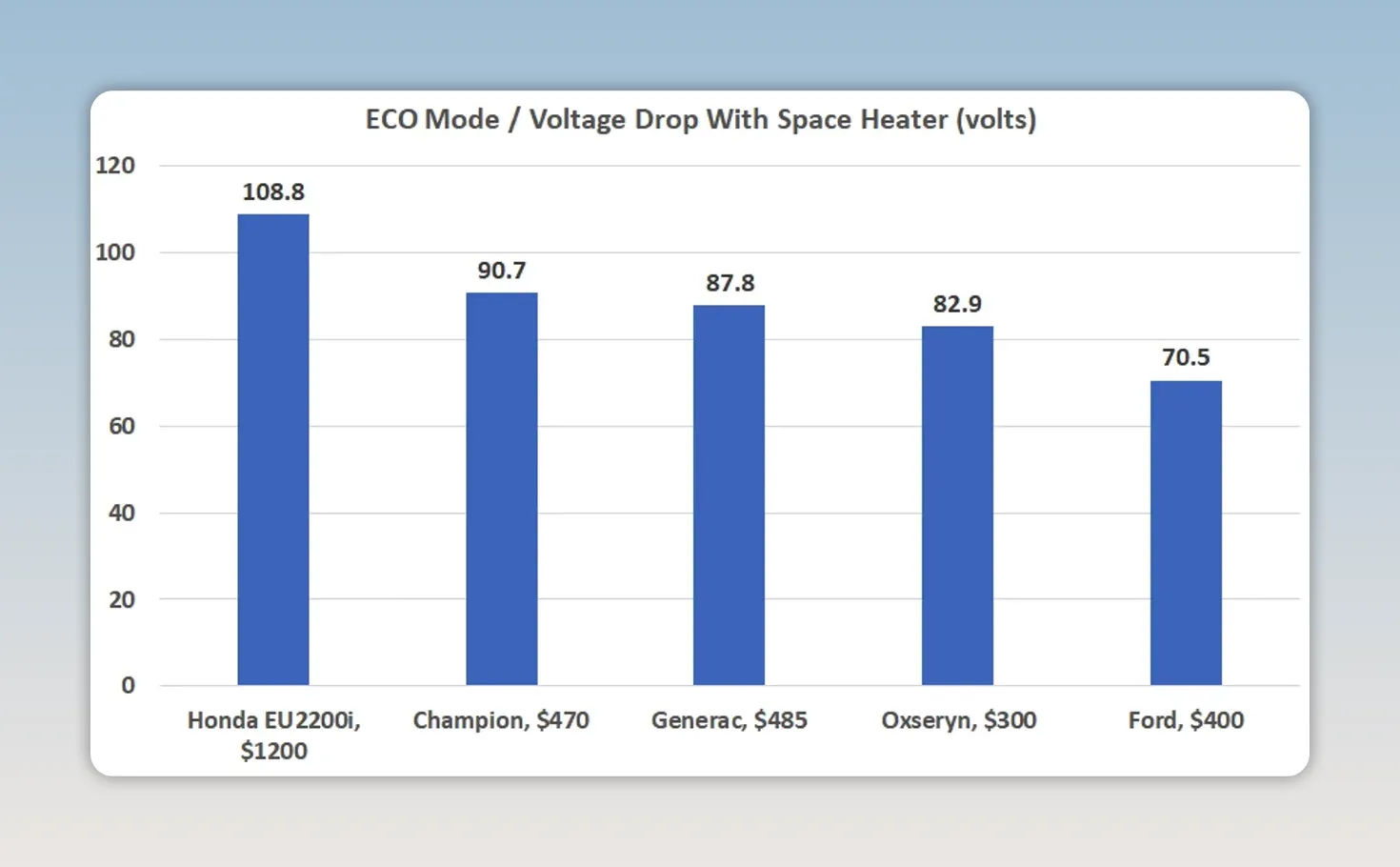
The Honda was clearly ahead in this test. A brief voltage dip isn't the same thing as a long-term undervoltage condition, but deep or prolonged sags can be a concern for connected equipment. Recovery time matters along with the lowest reading.
Disabling Economy Mode Changes the Results
The Oxseryn improved dramatically with economy mode off. Its minimum voltage rose to 118.4 volts, and it recovered to 120.6 volts in a fraction of a second.
The Champion also improved, dropping to 116.6 volts and recovering to 119.1 volts in less than a second.
The Ford still struggled in standard mode, falling to 92 volts and taking about 1.8 seconds to recover. Turbo mode was much better: a minimum of 117.5 volts, followed by recovery in less than a second.
The Honda was the only generator that never dropped below 120 volts with economy mode disabled. The Generac couldn't be retested with economy control off because its automatic system has no override. In my opinion, that's a significant limitation for sudden-load situations.
Steady Heavy-Load Performance
Once the engines had responded, all five inverter generators maintained reasonably close to 120 volts under a heavy resistive load:
- Oxseryn: Approximately 120 volts at about 1,800 watts.
- Ford: Just over 120 volts at slightly over 1,800 watts.
- Champion: 118.8 volts near 1,800 watts.
- Generac: 120.7 volts near 1,800 watts.
- Honda: 121.9 volts during a brief check near 1,900 watts.
The Honda's 1,900-watt result was a test observation, not a recommendation to exceed its 1,800-watt continuous rating. The Oxseryn also vibrated enough to move around noticeably under load, something worth considering when choosing a stable outdoor operating location.
Which Generator Is the Quietest?
For the noise comparison, I positioned the generators 25 feet from the sound meter. Background noise was approximately 42 to 43 decibels. I measured each unit in economy mode without a load, then took loaded readings with the generator facing several directions.
Without a load, the Honda was quietest at 52.1 dB, followed closely by the Oxseryn at 52.9 dB. Ford and Champion were both around 55.7 to 55.8 dB, while the Generac measured 57.7 dB. The little Tailgator was already at 62.5 dB without powering anything.
The reported averages across the five measurements were:
- Honda: 58.98 dB.
- Oxseryn: 59.02 dB.
- Champion: 61.52 dB.
- Ford: 61.86 dB.
- Generac: 62.36 dB.
- Tailgator: 62.90 dB.
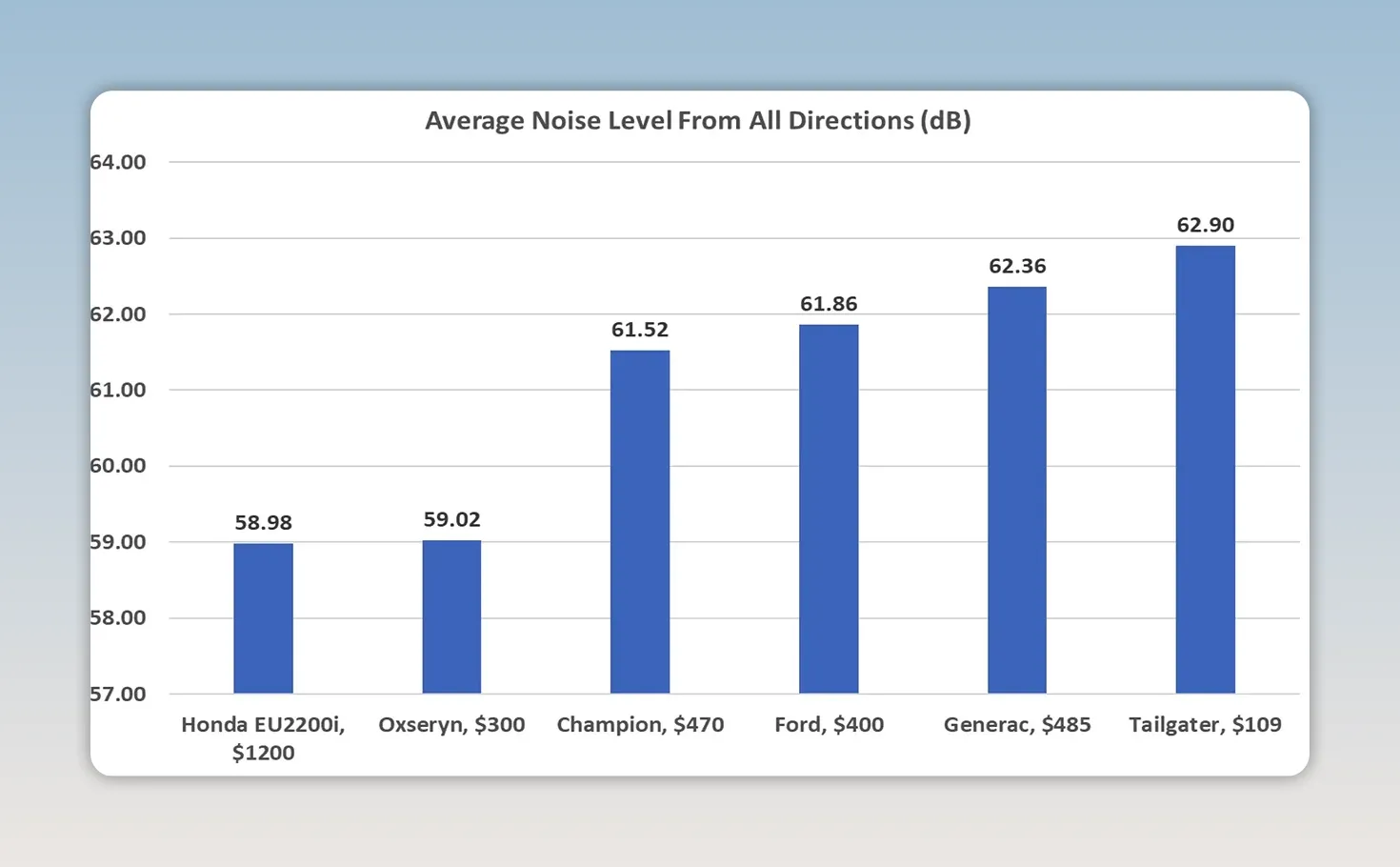
For practical purposes, the Honda and Oxseryn were tied. The 0.04 dB difference in their calculated averages is not a meaningful reason to choose one over the other.
Direction also made a difference. Under load, the Honda ranged from 58.3 to 62.2 dB depending on orientation. The Oxseryn's loaded readings ranged from 59 to 62 dB. Neither unit was the quietest from every direction.
These averages combine an unloaded reading with loaded readings, so they are best used for comparing this particular test rather than treating them as a universal loaded-noise specification.
Clean Electricity: Inverter Versus Conventional Output
Why spend more on an inverter generator when a conventional generator is cheaper? Electricity quality is one important reason.
The Tailgator produced a visibly unstable, distorted waveform on the oscilloscope. It improved somewhat under heavier load, but it still wasn't a clean sine wave. That kind of output can be a concern for sensitive electronic equipment.
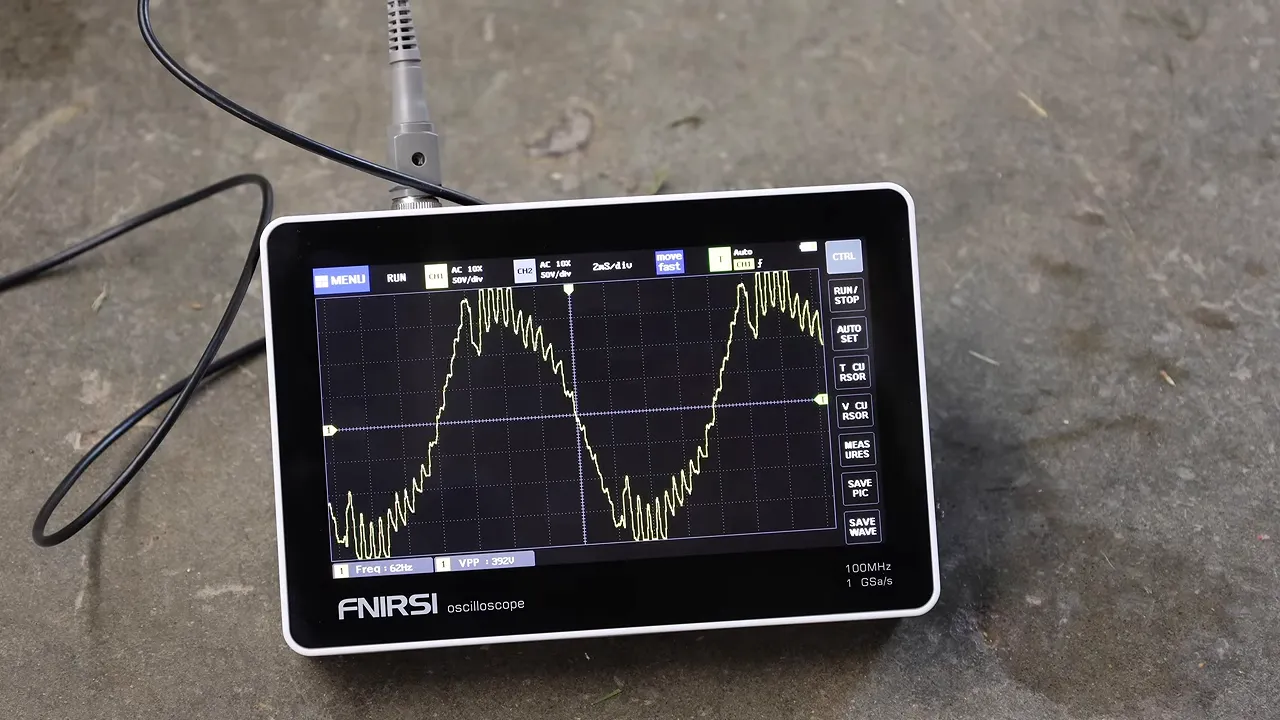
All five inverter generators produced clean-looking sine waves. The Oxseryn performed very well, and the Ford, Champion, Generac, and Honda looked similarly good. Each showed only a small amount of distortion during a sudden increase in power demand.
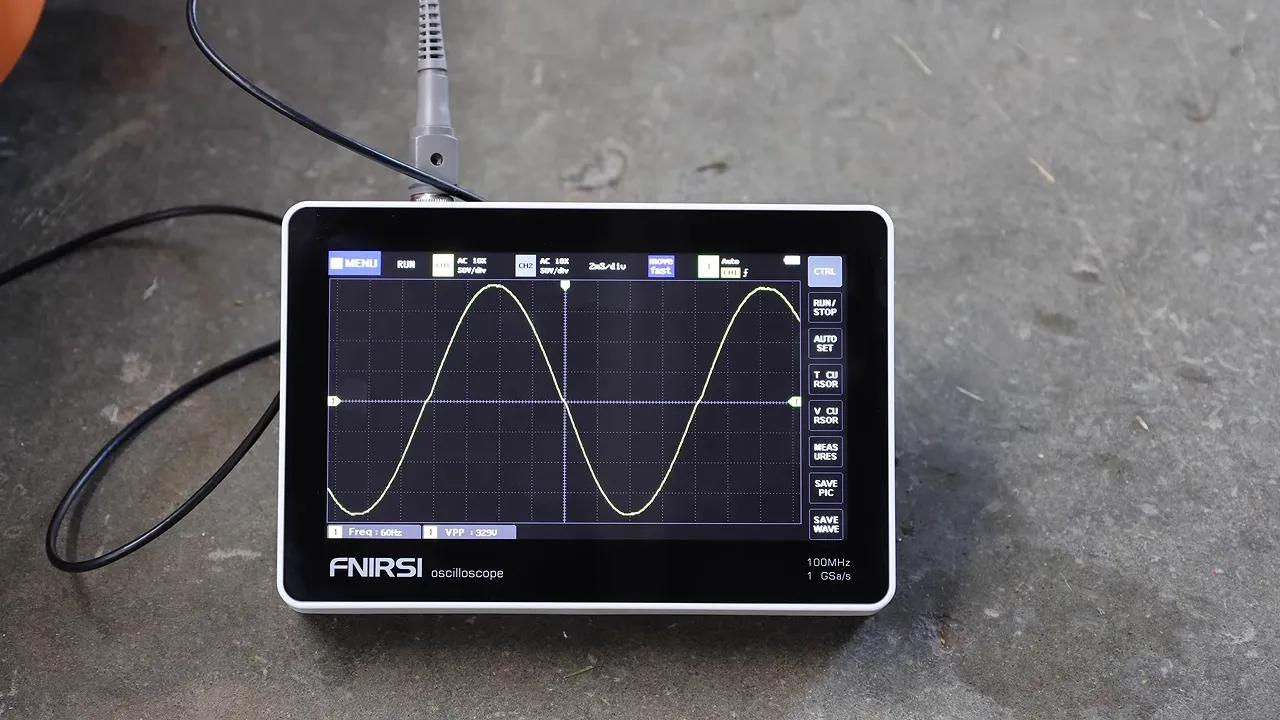
This was a visual waveform comparison, not a numerical total harmonic distortion measurement. Still, the distinction was clear: the inexpensive Oxseryn delivered clean-looking electricity, just like the premium inverter generators.
Fuel Efficiency: The Winner Depends on the Load
Advertised runtimes are difficult to compare when fuel tank sizes and test loads differ. For this test, I gave each generator the same measured portion of ethanol-free gasoline, approximately 15 ounces, then timed how long it could keep a load powered.
I also included a much larger, fuel-injected 7,000-watt Ryobi conventional generator. It wasn't a direct competitor for size or capacity, but it showed the fuel penalty of using a large generator for relatively small electrical demands.
Approximately 1,500 Watts: Generac Wins
With a space heater on its highest setting and a light to make shutdown easy to identify, the runtime order was:
- Generac: 26 minutes, 4 seconds.
- Champion: 25 minutes, 24 seconds.
- Oxseryn: 24 minutes, 25 seconds.
- Honda: Just under 23 minutes.
- Ford: 22 minutes, 3 seconds.
- Ryobi 7,000-watt: 13 minutes, 13 seconds.
The Generac's larger continuous-output rating didn't prevent it from being the most efficient at this load. Champion was close behind, and the $300 Oxseryn finished third.
500 Watts in Economy Mode: Oxseryn Wins
I repeated the test with the same amount of fuel and a 500-watt load, using selectable economy mode where available. The Generac continued to manage its engine speed automatically.
- Oxseryn: Just under 62 minutes.
- Champion: 54 minutes, 56 seconds.
- Generac: 54 minutes, 54 seconds.
- Ford: 53 minutes, 11 seconds.
- Honda: Almost 49 minutes.
- Ryobi 7,000-watt: 17 minutes, 44 seconds.
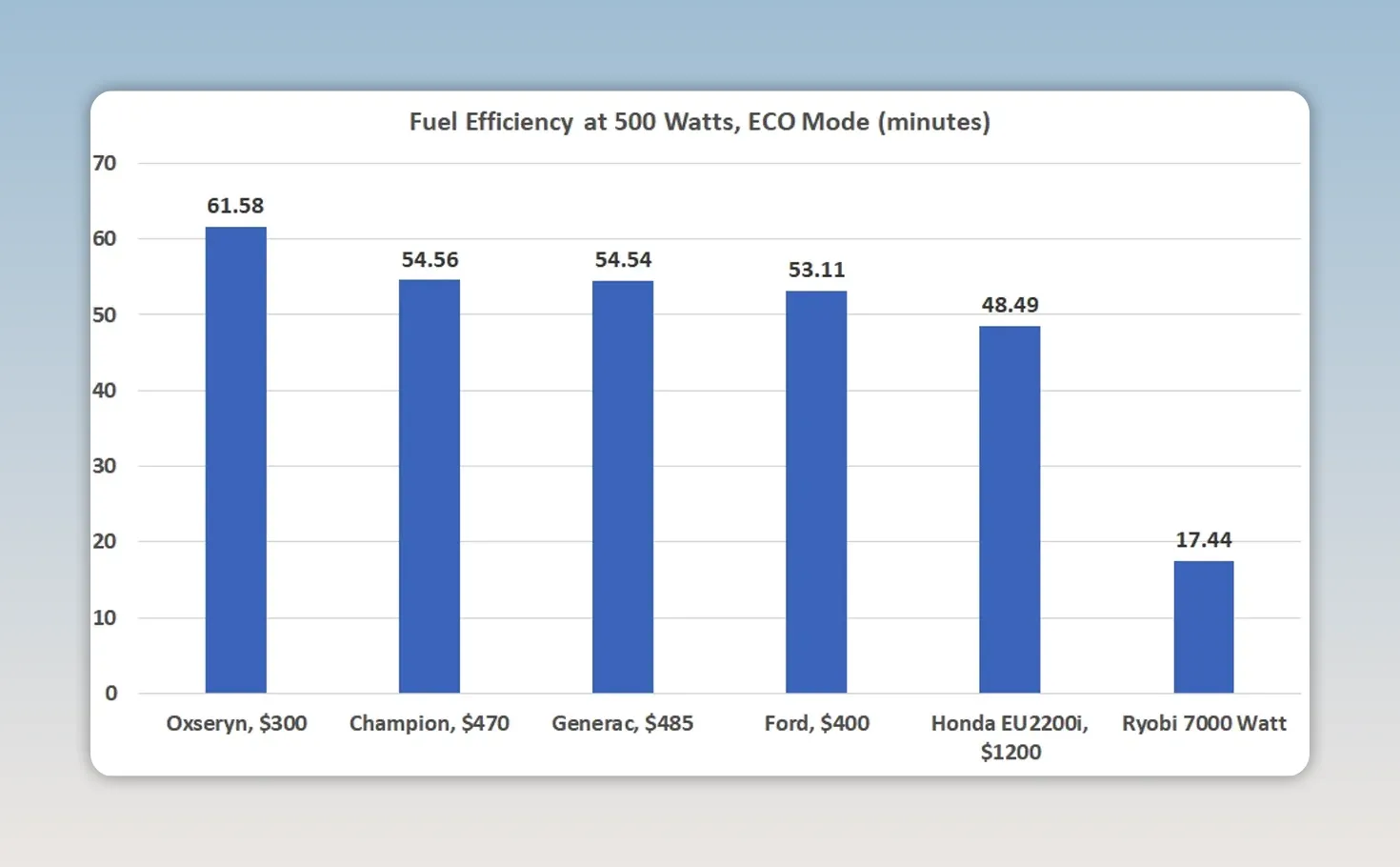
The Oxseryn was extremely efficient at this lighter load. Champion and Generac were effectively tied behind it. The Honda's larger engine and excellent voltage response came with a fuel-efficiency tradeoff in these tests.
The big Ryobi had no economy mode and used considerably more fuel for the same small load. Several of the compact inverter units ran more than three times as long at 500 watts. Matching generator size to the power you actually need can make a substantial difference in fuel consumption.
Carbon Monoxide Shutdown: An Important Difference
No portable gasoline generator is safe to operate indoors, in a garage, or in another enclosed or partially enclosed space. Carbon monoxide shutdown is backup protection, not permission to operate a generator in an unsafe location.
The U.S. Consumer Product Safety Commission's generator safety guidance calls for outdoor operation at least 20 feet from the home, with exhaust directed away from buildings. Follow the manufacturer's instructions and use working carbon monoxide alarms indoors.
To compare shutdown behavior, I used a temporary test enclosure and a separate carbon monoxide meter. This was a hazardous test setup, not an operating arrangement to reproduce.
- Oxseryn: No carbon monoxide shutdown system. It kept running and required manual shutdown.
- Ford: No carbon monoxide shutdown system. It also required manual shutdown.
- Champion: Shut itself down in just under 18 seconds.
- Generac: Shut itself down in approximately 11 seconds.
- Honda: Shut itself down in approximately 11.5 seconds.
The three equipped units all responded. Those times describe this enclosure test, not a guaranteed response time in every environment or a formal safety certification.
The absence of carbon monoxide shutdown is the biggest drawback of the Oxseryn's low price. Ford also lacked that protection. Champion offered it for considerably less money than the Honda.
What Happened After Approximately 24 Hours?
I ran the inverter generators for approximately 24 hours and then checked their spark plugs for carbon buildup. Fortunately, none required additional engine oil during that period.
- Oxseryn: Minimal carbon buildup, with the plug still in good condition.
- Ford: A little more buildup than the Oxseryn, but nothing concerning.
- Champion: The most buildup, consistent with its occasional startup smoke, although the plug remained serviceable.
- Generac: Less buildup than the Champion and still suitable for continued use.
- Honda: An extremely clean plug, despite the engine itself having approximately 100 more hours than the newer competitors.
The Honda received a new plug at the beginning, so the plug comparison covered this test period rather than its entire service history. Twenty-four hours is useful for spotting early issues, but it doesn't establish how long any of these generators will last.
Which Generator Would I Buy?
I converted the scored performance results into first-through-last rankings and averaged those finishes. Basic specifications and convenience features were listed separately rather than included in that calculation.
Honda finished first with an average placement of 2.0. Oxseryn and Champion tied for second with average placements of 2.6. The right purchase still depends on which results matter most to you.
Best Overall Performance: Honda
The Honda justified its premium most clearly in voltage control. It had the smallest economy-mode voltage dip, the quickest recovery, and the best response with economy mode disabled. It was also fractionally the quietest and included carbon monoxide shutdown protection.
It isn't the most fuel-efficient option, and at around $1,200, it is expensive. It also leaves out convenience features available on much cheaper units. Even so, if I were prioritizing voltage stability and buying with long-term ownership in mind, the Honda would be a strong investment candidate with proper maintenance. Its performance here supports that choice, although this wasn't a multi-year durability test.
Best Strict-Budget Choice: Oxseryn
At $300, the Oxseryn delivered a lot of performance for the money. It was nearly indistinguishable from the Honda in average noise, won the 500-watt fuel-efficiency test, produced a clean-looking waveform, and included a fuel gauge, USB, USB-C, and a 12-volt socket.
It was also the lightest and easiest to pull-start. Disable economy mode and its sudden-load voltage response improved substantially.
The tradeoffs are its lack of carbon monoxide shutdown, significant economy-mode voltage sag, and noticeable movement under load. If the decision is strictly about budget, the Oxseryn would be my choice from this test, with those limitations understood and safe outdoor placement treated as nonnegotiable.
Best Middle Ground With CO Protection: Champion
The Champion costs more than the Oxseryn, but its carbon monoxide shutdown system may make that extra money worthwhile. It also offers tool-free service access, a fuel gauge, strong heavy-load fuel efficiency, and good voltage response with economy mode off.
It was louder than the Honda and Oxseryn, and its occasional startup smoke was a drawback. Overall, though, it offered a useful balance of price, performance, and safety equipment.
Where Generac and Ford Fit
The Generac earned its strongest result in heavy-load fuel efficiency and responded quickly in the carbon monoxide test. Its higher running-watt rating may also be useful. However, harder starting, higher noise, and the inability to turn economy control off held it back.
The Ford started readily and performed much better in turbo mode than in standard or economy mode. But its deep economy-mode voltage sag, shorter fuel-test runtimes, and lack of carbon monoxide shutdown made it less compelling against this particular group.
My bottom line: Honda for the strongest overall performance, Oxseryn for a strict budget, and Champion for an affordable step up that includes carbon monoxide shutdown. Decide before the blackout whether your priority is sudden-load response, quiet operation, fuel savings, or safety equipment. The most expensive generator won overall, but the least expensive inverter generator made a very strong showing.


