A step bit is one of those tools that earns its place in the toolbox pretty quickly. But is a bit costing less than $4 anywhere near as good as a $146 Blue Point sold by Snap-on? And does spending more actually buy better cutting speed and durability?
I purchased 19 different step bits and put them through mild steel, medium-hardness steel, stainless steel, and finally AR500 armor plate. The differences were enormous. Some bits couldn’t drill a pilot hole in mild steel. Four actually drilled through the armor plate, even though none were designed for that job. Very impressive!
The $34 TEMO was my overall winner, while the $16 OXMUL was my value pick. However, pilot-hole speed and the ability to finish a large hole weren’t always the same story. The Blue Point had a couple of strong finishes, and EZARC and Klein Tools delivered particularly good results in stainless steel.
Quick Summary
- TEMO delivered the best overall results, combining fast cutting with excellent edge durability.
- OXMUL was the value pick, outperforming many pricier bits and penetrating AR500 armor plate.
- EZARC and Klein Tools produced the largest holes in the stainless-steel test.
- Blue Point completed large holes in both steel rounds but couldn’t justify its premium price overall.
Table of Contents
- How I Tested the Step Bits
- The Step Bit Lineup: Prices and Construction
- Mild Steel: TEMO Takes the Speed Lead
- Medium-Hardness Steel: Greenlee Is Fastest, Blue Point Finishes
- Stainless Steel: Sharpness Makes the Difference
- AR500 Armor Plate: The Ultimate Torture Test
- Which Step Bit Would I Buy?
How I Tested the Step Bits
To keep the comparison consistent, I attached a wheel to the drill press feed mechanism and used a rope and weights to apply constant downward force. That removed the guesswork of trying to push equally hard on every bit by hand.
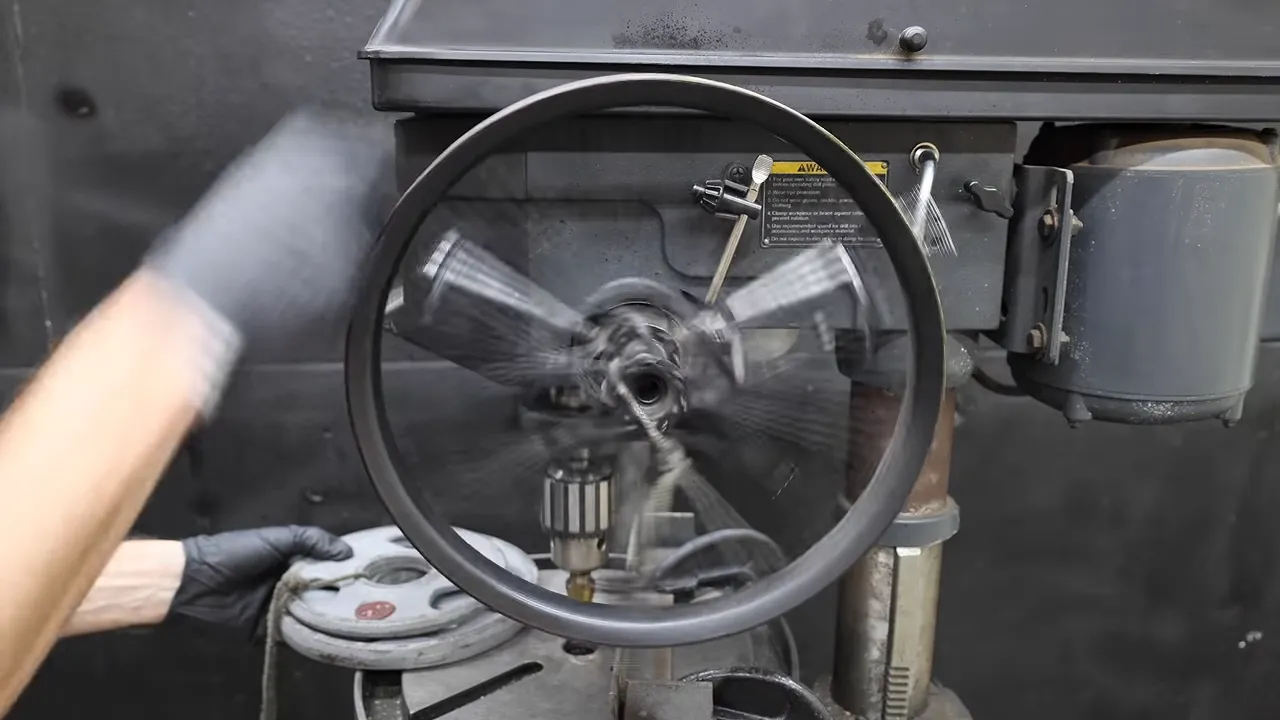
The first test used approximately 53 pounds of downward force. I set the drill press to 990 RPM using its speed chart for a 3/16-inch drill bit, then measured how long each bit took to break through 3/16-inch mild steel.
After the tip penetrated, I allowed each bit to continue enlarging the hole until it finished or stopped making progress. Those are two different measurements:
- Pilot-hole time: How quickly the small tip breaks through the material.
- Hole enlargement: How far the larger steps can continue cutting.
- Condition afterward: How much damage appears on the chisel point and leading cutting edges.
The same bits progressed through increasingly difficult materials, so the later tests also reflected accumulated wear. This wasn’t a fresh-bit comparison for every material.
I used Mohs scratch picks as a rough comparison between the steel samples, not as a precision metal-hardness measurement. The number-six pick scratched the mild steel deeply, while a number-seven pick produced deep scratches in the medium-hardness sample.
One other important limitation: several aggressive bits became stuck because the drill press couldn’t keep them turning. A stalled bit with an intact cutting edge is a different result from a bit that simply wore out.
The Step Bit Lineup: Prices and Construction
Prices below are what I paid for the products tested. For sets, the per-bit figure is simply the purchase price divided by the number of bits, even though the bits in a set vary in size.
Budget Bits Under $10 Each
- SEDIANAS, $19 for five, or $3.80 each: Advertised as titanium-coated 4241 high-speed steel. I tested the bit covering 3/16 through 7/8 inch.
- IRONANT, $20 for five, or $4 each: A 118-degree split point and dual-flute design. Its recommendations excluded stainless steel and wood.
- GMTOOLS, $21 for five, or $4.20 each: Titanium-coated bits with 118-degree split points. The set also included a center punch.
- NEIKO, $18 for three, or $6 each: Two spiral flutes and an impact-driver-compatible shank.
- THINKWORK, $31 for five, or $6.20 each: Spiral-flute bits with 1/4-inch hex shanks, advertised as impact ready.
- Warrior, $18 for two, or $9 each: Harbor Freight’s dual-straight-flute design, not intended for an impact driver.
- KSEIBI, $48 for five, or $9.60 each: Straight flutes and a conventional drill shank rather than an impact-driver shank.
All of those bits were made in China except the Warrior, which was made in Vietnam.
Midpriced and Premium Bits
- OXMUL, $16: Advertised as M35 cobalt, with straight flutes and a conventional drill shank. Made in China.
- Jerax, $17: M2 high-speed steel with double straight flutes, not intended for an impact driver. Made in China.
- MATEWORK, $23: Advertised as M35 cobalt, with four spiral flutes and an impact-compatible shank. Made in China.
- DeWalt, $72 for three, or $24 each: A 1/4-inch hex shank for impact-driver compatibility. Made in Taiwan and finished in China.
- EZARC, $24: M35 cobalt construction, three flutes, and a 1/4-inch hex shank. Made in China.
- Klein Tools, $25: A straight-flute design with a claimed fast-starting, non-walking tip. Not intended for an impact driver. Made in Thailand.
- TEMO, $34: M35 cobalt construction, spiral flutes, and an impact-compatible shank. The packaging didn’t identify its country of manufacture.
- Diablo, $36: A 1/4-inch hex shank for impact-driver compatibility. Made in Switzerland.
- Milwaukee, $125 for three, or about $42 each: High-speed steel bits optimized for impact drivers. Made in the USA.
- Irwin, $43: Cobalt-alloy steel, a single-flute design, a SpeedPoint tip, and a 3/8-inch conventional shank. Made in the USA.
- Greenlee, $52: A 3/8-inch conventional shank, not intended for an impact driver. Designed and manufactured in the USA.
- Snap-on Blue Point, $146 before shipping and tax: Straight flutes and a conventional drill shank. Made in China.
Impact-driver compatibility describes the intended tool connection. All the comparative drilling here took place on the drill press.
Mild Steel: TEMO Takes the Speed Lead
The mild-steel test immediately separated bits that could cut from bits that were mostly making heat and wearing themselves out.
The Cheapest Bits Had Some Serious Problems
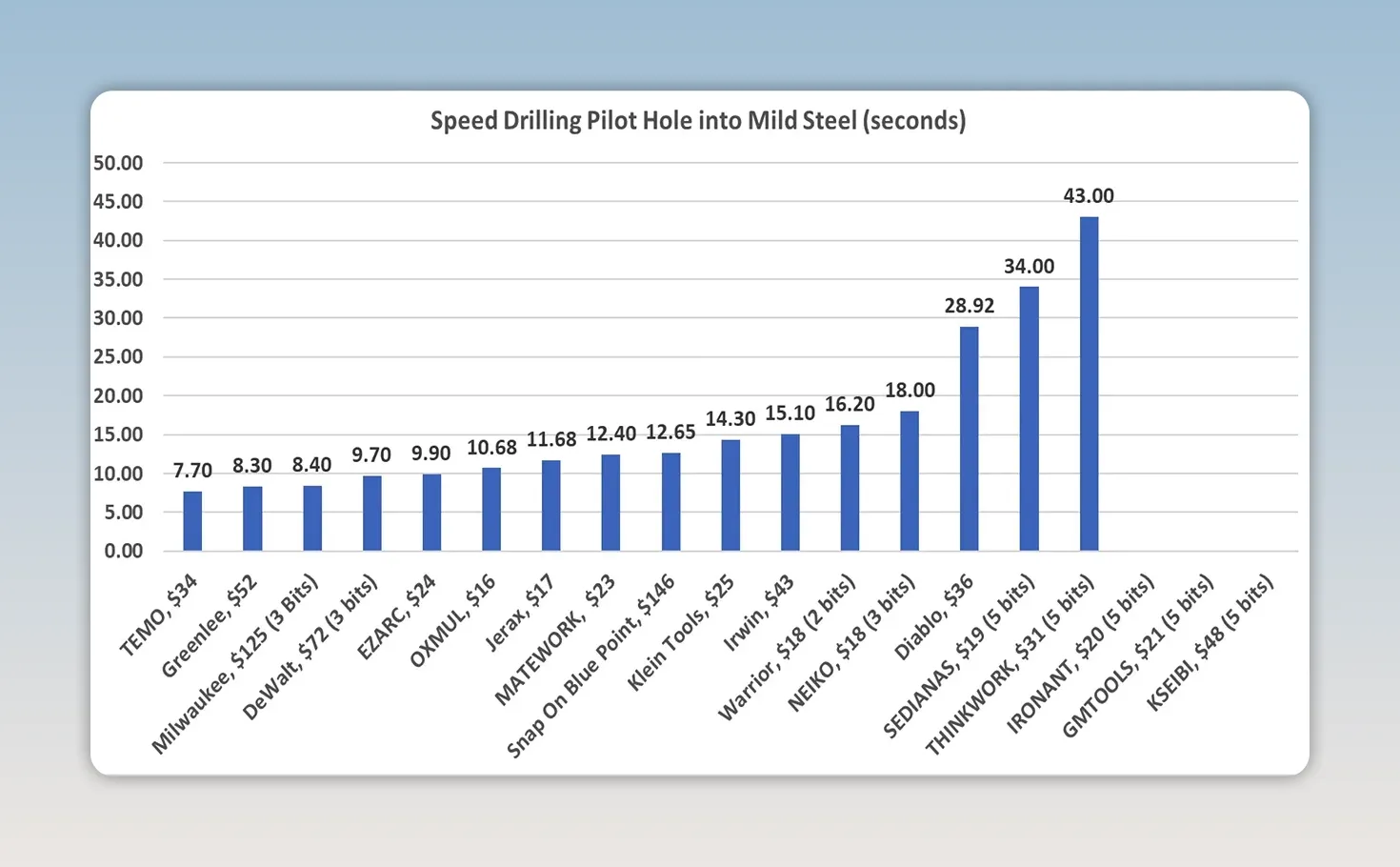
SEDIANAS eventually penetrated the steel in about 34 seconds. It enlarged the hole before stopping, and its cutting edges actually held up reasonably well.
IRONANT wasn’t nearly as fortunate. With a name like that, expectations were pretty big. Unfortunately, it couldn’t drill through the mild steel and suffered tremendous tip damage. GMTOOLS also failed to break through, made even less progress, and showed substantial chisel wear.
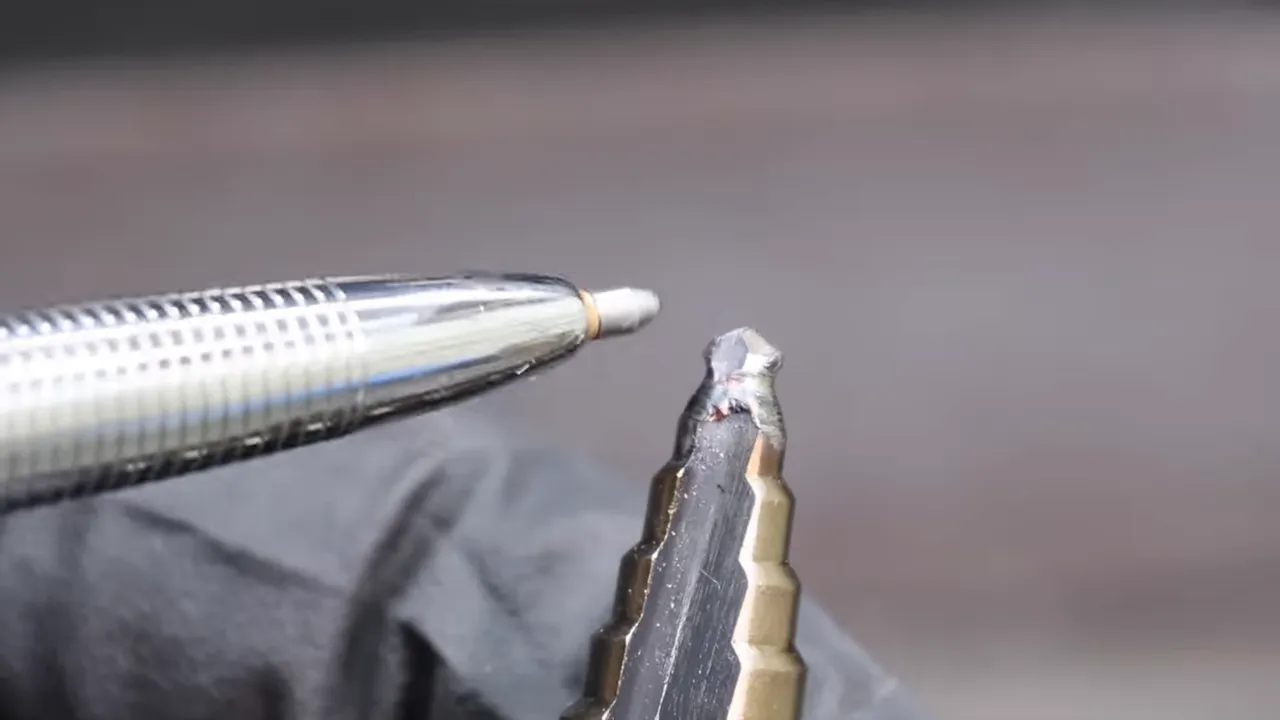
NEIKO was a much better performer at only $6 per bit. It completed the pilot hole in 18 seconds, enlarged it considerably, and remained in very good condition.
THINKWORK needed 43 seconds for its pilot hole. A little too much thinking and not enough work! Once through, though, it did a respectable job enlarging the hole, and the chisel remained in good shape.
Warrior beat both with a 16.2-second pilot hole, then stopped at approximately a 5/8-inch hole diameter. Its tip showed some wear, but the leading flute edges still looked pretty good.
KSEIBI had performed better than average in an earlier comparison, but this sample failed to break through. The chisel geometry didn’t appear suitable for efficient cutting. That’s exactly why I repeat tests from time to time: a previous result doesn’t guarantee the next sample will perform the same way.
The Faster Cutters
OXMUL completed its pilot hole in just 10.68 seconds. Jerax followed at 11.68 seconds, and MATEWORK took 12.4 seconds. All three made substantial progress enlarging the hole, although none finished. Their tips remained in good condition.
DeWalt was even more aggressive, completing the pilot hole in 9.7 seconds before eventually becoming stuck. EZARC was almost tied at 9.9 seconds and also retained a very good cutting edge.
Then TEMO finished its pilot hole in just 7.7 seconds. The drill press didn’t have enough torque to keep it going through the larger steps, but the bit still looked practically new afterward.
Greenlee followed at 8.3 seconds, and Milwaukee finished at 8.4 seconds. Both became stuck just before completing the larger hole, with very little visible damage.
Which Bits Finished the Large Hole?
Klein Tools needed 14.3 seconds for its pilot hole, but it kept cutting until it completed the 7/8-inch hole. Everything still looked very good afterward.
Diablo was much slower to start, taking just under 29 seconds, but it also completed the large hole and remained in great shape. Irwin took 15.1 seconds for the pilot hole and showed very little visible wear.
The $146 Blue Point completed its pilot hole in 12.65 seconds. That’s about five seconds slower than the $34 TEMO. However, Blue Point did finish the full 7/8-inch hole, which several faster-starting bits couldn’t manage under this setup.
Medium-Hardness Steel: Greenlee Is Fastest, Blue Point Finishes
The second steel sample was harder but thinner, measuring just under 1/8 inch. I reduced drill speed to 600 RPM.
SEDIANAS couldn’t make a pilot hole. IRONANT’s already-damaged tip and flute edges deteriorated even further, and GMTOOLS also failed after about a minute. An actual ant might have made faster progress than the IRONANT.
THINKWORK, Warrior, and KSEIBI couldn’t break through either. Warrior made a little more progress than THINKWORK, and KSEIBI made more progress than Warrior, but the chisel geometry remained a concern on both THINKWORK and KSEIBI.
NEIKO again stood out among the inexpensive bits. It completed a pilot hole in just over 20 seconds, although it stopped before finishing the larger hole. Its chisel and leading edges now showed visible wear.
Pilot-Hole Results
- Greenlee: 5.62 seconds.
- TEMO: 5.98 seconds.
- DeWalt: 6.44 seconds.
- EZARC: 7.53 seconds.
- OXMUL: 8.62 seconds.
- Blue Point: 10.12 seconds.
- Jerax and MATEWORK: About 11.1 seconds each.
- Klein Tools: 11.15 seconds.
- Milwaukee: 11.77 seconds.
- Irwin: Just under 22 seconds.
- Diablo: 22.77 seconds.
Greenlee took the pilot-hole win, but TEMO was very close and nearly completed the 7/8-inch hole before stopping. TEMO’s tip still looked as good as new.
OXMUL enlarged its hole to just under 19 mm, while Jerax reached 17.46 mm. Both retained very good chisel edges. MATEWORK didn’t enlarge its hole quite as much as Jerax.
DeWalt made a larger hole than EZARC but began showing wear on the leading edge of its chisel. Klein Tools reached 20.68 mm, substantially larger than EZARC’s result, with only a small amount of wear.
Diablo remained slow, and Irwin enlarged its hole more than Diablo but less than DeWalt. Milwaukee lost some of its earlier speed and didn’t make nearly as much progress enlarging the hole.
Blue Point wasn’t the fastest, but it kept cutting until it finished. Its tip remained in very good condition. That was a meaningful strength for the most expensive bit in the lineup.
Stainless Steel: Sharpness Makes the Difference
The stainless-steel sample was only 0.045 inch thick, but it presented a very different challenge. A worn tip that rubs instead of cutting can quickly leave a work-hardened area that’s much harder to penetrate.
SEDIANAS, IRONANT, and GMTOOLS were eliminated from this stage because of their earlier performance. I also skipped THINKWORK, KSEIBI, and Warrior after their problems with the previous steel samples.
NEIKO barely marked the stainless steel. Its chisel and flute edges showed substantial wear under magnification. Jerax, MATEWORK, DeWalt, Diablo, Irwin, Milwaukee, and Blue Point also couldn’t produce a pilot hole under the test’s downforce after the preceding rounds.
That’s important context: these results describe the bits after accumulated use, not what every brand might do with a brand-new bit in stainless.
The Five Bits That Broke Through
- EZARC: Fastest pilot hole at 3.6 seconds.
- TEMO: Second at 4.7 seconds.
- Greenlee: Third at 4.8 seconds.
- OXMUL: Fourth at 5.26 seconds.
- Klein Tools: Fifth at 7.7 seconds.
OXMUL cut the pilot hole easily, then became stuck while enlarging it. After releasing the bit and trying again, the stainless had become too difficult to cut. Its final hole measured 20.65 mm, and the chisel remained in very good condition.
EZARC needed releasing a couple of times, but it continued making progress and completed the largest hole size. Klein Tools also became stuck a couple of times and successfully finished the hole.
TEMO cut quickly, but I didn’t release it soon enough when it became stuck. The stainless work hardened before it could finish. It still reached 22.06 mm and retained a very good edge.
Greenlee reached 21.47 mm, with only minor chisel wear. For a bit that wasn’t advertised as M35 cobalt, that was another impressive performance.
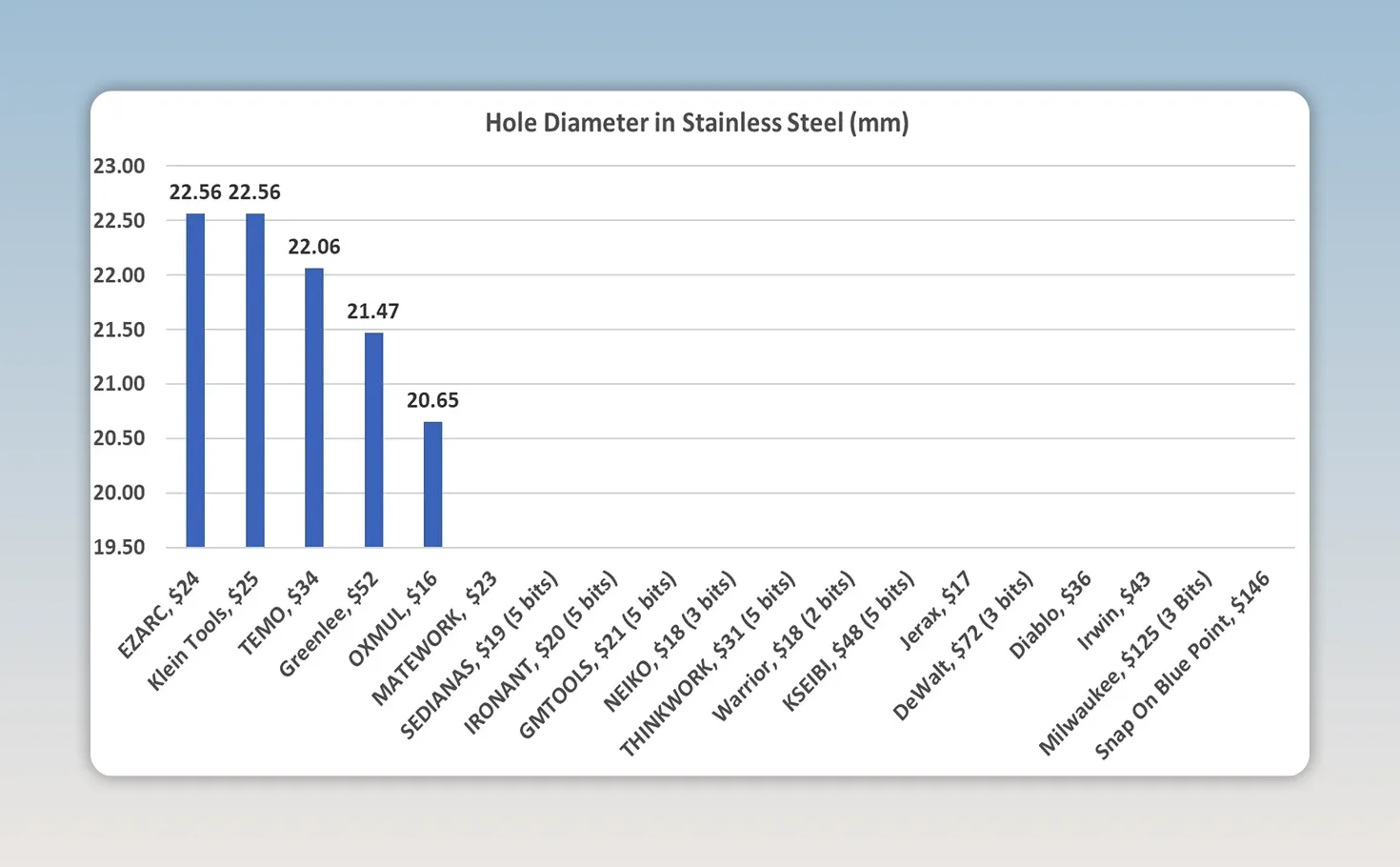
EZARC and Klein Tools tied at 22.56 mm, followed by TEMO at 22.06 mm. All the successful bits needed assistance during enlargement, so these weren’t completely hands-off finishes.
The lesson here isn’t simply to increase RPM. It’s to maintain effective cutting and avoid prolonged rubbing or stalling. A bit that starts quickly but gets trapped can still lose its opportunity to finish.
AR500 Armor Plate: The Ultimate Torture Test
None of these step bits were designed to drill AR500 armor plate. This was an extreme durability test, not a recommended everyday application.
I reduced drill speed to 250 RPM, increased downward force to approximately 200 pounds, and used cutting oil to help control heat. That’s nearly four times the pressure used earlier.
For ordinary drilling work, follow the equipment and bit manufacturers’ instructions. The CCOHS drill press safety guidance is also a useful reference. This weighted torture-test setup shouldn’t be treated as an operating recommendation.
Only Four Bits Drilled All the Way Through
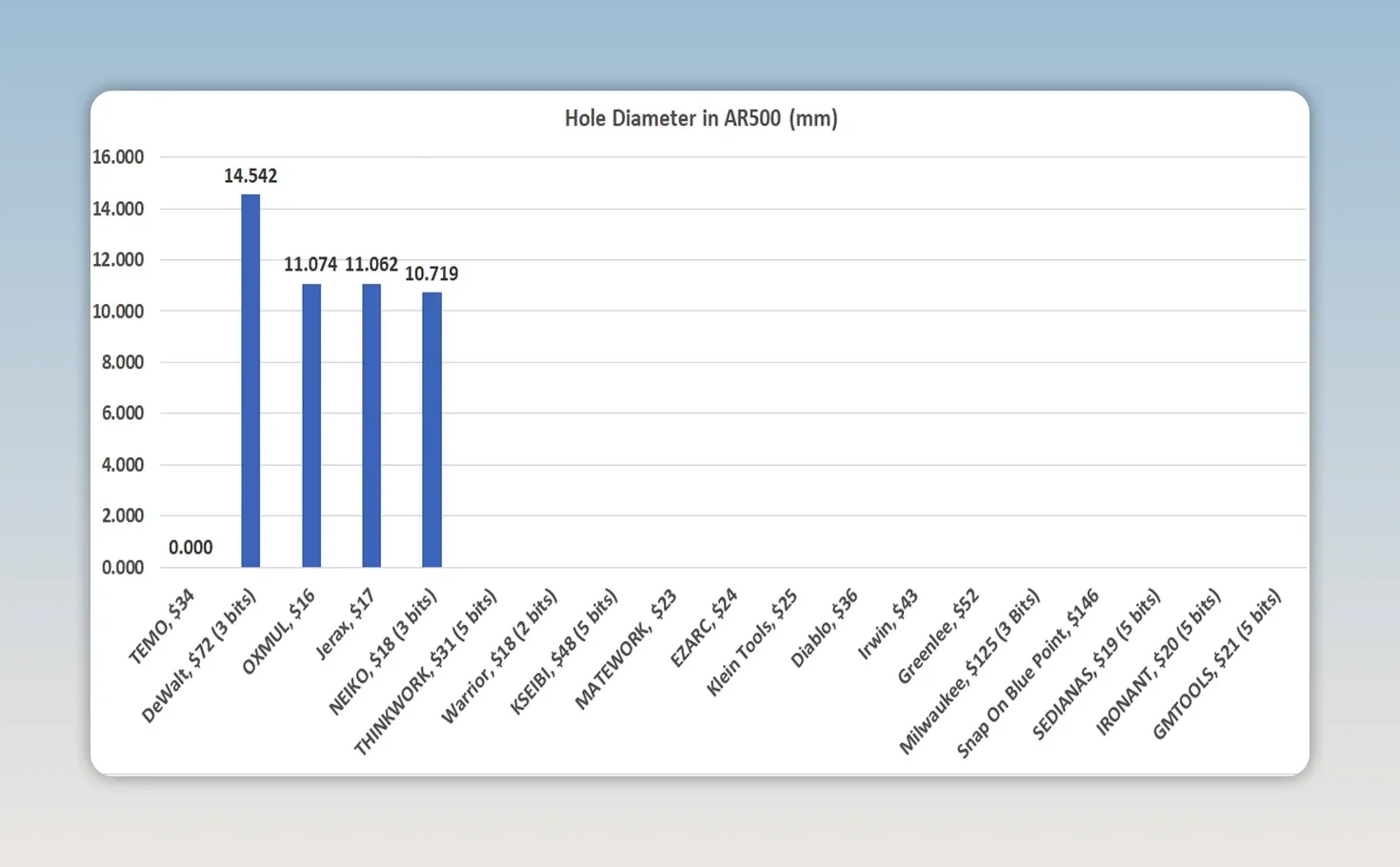
TEMO was absolutely chewing through the AR500. It became stuck a couple of times and needed releasing, but it produced the largest opening by a substantial margin.
- TEMO: Approximately 14.5 mm diameter at the top of the hole.
- DeWalt: 11.07 mm top-hole diameter.
- OXMUL: 11.06 mm top-hole diameter.
- Jerax: 10.71 mm top-hole diameter.
Those measurements are the openings at the top of the plate, not uniform hole diameters through its full thickness. A step bit leaves progressively smaller diameters farther down.
OXMUL needed releasing a couple of times but drilled through and remained in pretty good shape, with some visible wear. Jerax also broke through before it stopped progressing at roughly one minute and 20 seconds.
DeWalt couldn’t make a pilot hole in the stainless round, but the extra pressure helped it penetrate the armor plate. It stopped progressing after approximately one minute and 17 seconds and showed visible chisel wear.
TEMO had some wear afterward too, but it held up extremely well while making a much larger hole. A step bit drilling through AR500 is impressive. Doing it that well is even better.
How the Other Bits Held Up
For bits that didn’t penetrate, I measured hole depth instead of top-hole diameter. Those numbers shouldn’t be compared directly with the four successful bits’ opening sizes.
- Greenlee: Came very close to penetrating, reaching about 14.20 mm deep before stopping near the one-minute mark.
- NEIKO: Reached 11.36 mm deep before stopping after roughly a minute and a half. It was visibly worn.
- Blue Point: Reached 7.1 mm deep and stopped making progress after approximately 35 seconds.
- MATEWORK: Reached 6.6 mm deep after losing cutting effectiveness quickly. Its chisel had lost most of its edge.
- Diablo: Reached 6.37 mm deep, finally giving up after approximately one minute and 15 seconds.
- Klein Tools: Reached 5.39 mm deep and stopped after roughly 30 seconds.
- Milwaukee: Reached 5.32 mm deep. Its already-worn chisel suffered further damage.
- EZARC: Reached 5.23 mm deep despite its excellent stainless-steel performance.
- Irwin: Made less than 1 mm of progress. By this stage, the cutting edge was badly worn.
NEIKO deserves some credit here. It was far from the overall winner, but a $6 bit making that much progress in armor plate was better than I expected.
Which Step Bit Would I Buy?
I converted the graded test results into first-to-last rankings and averaged those finishes. A lower average means a better overall result. That gives a broader picture than selecting a winner from one fast pilot hole.
Best Overall: TEMO at $34
TEMO finished with the best average ranking at 1.5 and placed in the top three in every graded event. It was fastest in mild steel, second-fastest in medium-hardness steel and stainless steel, and produced the largest opening through AR500.
It also retained its cutting edges extremely well. Considering price, speed, and durability, TEMO would definitely be my choice.
Best Value: OXMUL at $16
If it’s all about value, I’m going with OXMUL. It wasn’t quite as strong overall as TEMO, but it outperformed many more expensive bits and held up very well.
It cut quickly in the first two materials, successfully drilled stainless steel, and went all the way through AR500. That’s a lot of performance for $16.
Other Strong Choices
DeWalt finished second overall with an average ranking of 3.3. It was very fast in the first two steel tests and penetrated AR500. However, it wasn’t constructed of cobalt and didn’t retain its edge nearly as well as TEMO.
Greenlee was another excellent bit. It won the medium-hardness pilot-hole test, performed well in stainless steel, and nearly penetrated the armor plate. At approximately $52, though, it was considerably more expensive than TEMO or OXMUL.
EZARC and Klein Tools deserve consideration when stainless-steel hole enlargement matters most. Both completed the largest opening in that round, and EZARC drilled the fastest stainless pilot hole.
Is the $146 Blue Point Worth It?
Blue Point’s strengths were steady cutting and completing the large holes in both mild and medium-hardness steel. It wasn’t a poor performer in those tests.
However, it couldn’t make a stainless-steel pilot hole after the earlier rounds, and it stopped well short of penetrating AR500. At $146, I’d want considerably more performance relative to the less expensive competition.
The most expensive bit wasn’t the best, and the very cheapest bits weren’t bargains in these steel tests. TEMO delivered the strongest overall combination, while OXMUL proved that a much smaller investment can still buy a very capable step bit.


