There’s nothing like a little rust and a rounded bolt head to bring a project to a stop. A pair of tongue-and-groove pliers might get the job done, but there’s definitely a better way. The question is whether an inexpensive extractor can grip just as well as a kit costing $263.
I tested universal sockets, dedicated rounded bolt extractors, nut splitters, and stud removers to find out. First, the tools had to deal with badly rounded fasteners. Then the successful extractors faced a tougher challenge: hold on until either the tool gave up or the bolt broke. Finally, the stud removers went through their own strength contest.
Price didn’t predict the outcome. Some affordable tools did a terrific job, while a few more expensive options needed considerable help getting a grip. All prices below are the prices paid for the tools at the time of testing.
Key Takeaways
- Amartisan, Go2, RocketSocket, and Snap-on held rounded bolt heads until the bolts broke.
- Universal sockets struggled on rounded heads, even when they performed well on undamaged fasteners.
- The Mophorn hydraulic splitter cleanly split the nut but required substantial working clearance.
- All six stud removers outlasted their studs, with ABN offering the most compact overall profile.
How the Rounded Bolt Extractors Were Tested
The first test used fine-thread, Grade 5, 7/16-inch bolts tightened to 100 foot-pounds. Each tool started with a completely rounded bolt head. If it couldn’t remove that bolt, it received a chance on a partially rounded head, followed by an undamaged head if necessary. A fresh bolt was used for each test.
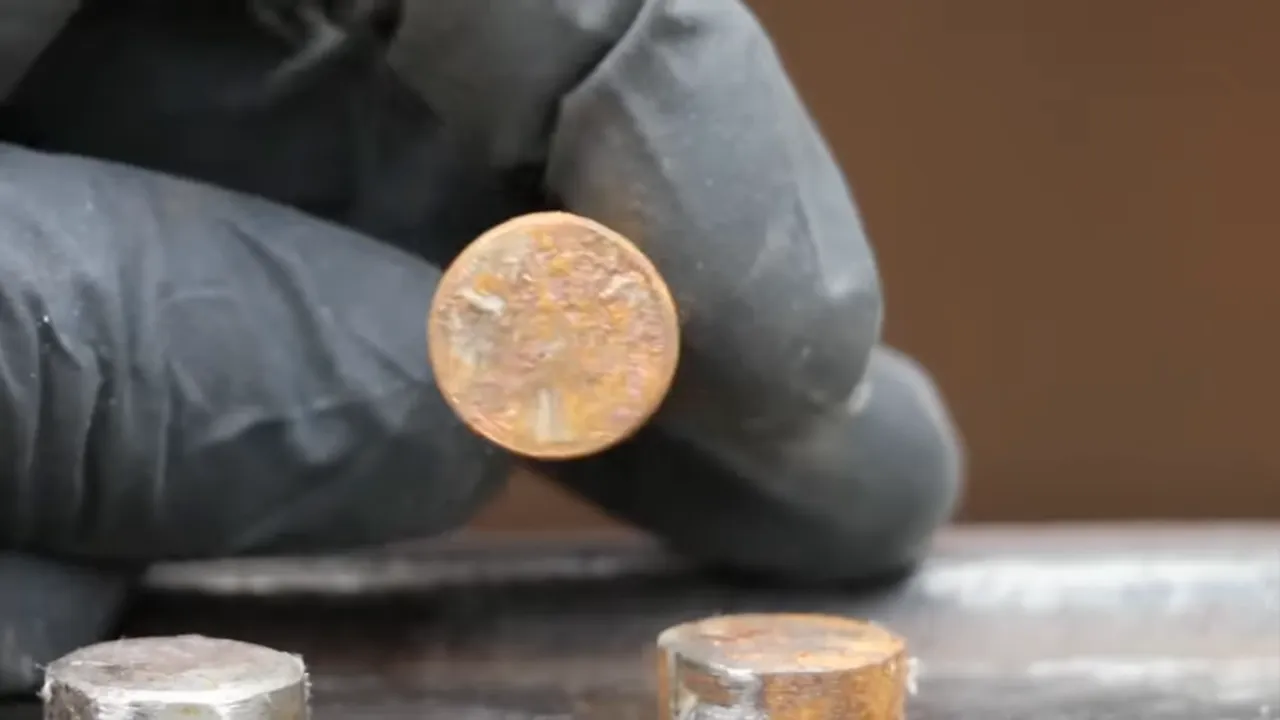
I also checked tool diameter. Getting a good grip doesn’t help much if the extractor won’t fit between nearby parts. Socket-style extractors generally had a big advantage over the larger adjustable tools and nut splitters.
One important distinction: the torque needed to loosen a bolt is not necessarily the tool’s maximum capacity. Once an extractor successfully removed its bolt, that test was finished. The later destructive test provided a better look at how firmly the successful tools could hold.
Universal Sockets: Versatile Doesn’t Always Mean a Strong Grip
Effecteer Universal Socket: $10.49
The least expensive tool used 54 hardened steel, spring-loaded pins that retract around the fastener. It came with a drive adapter and was made in China. Its body measured just over an inch in diameter.
The Effecteer struggled as the bolt head lost its shape:
- Completely rounded head: slipped at 4.6 foot-pounds.
- Partially rounded head: slipped at 34.6 foot-pounds.
- Undamaged head: successfully loosened the bolt at 98.8 foot-pounds.
It did very well on the undamaged bolt, but that performance didn’t carry over to rounded fasteners. For this job, the spring-pin design wasn’t a substitute for a dedicated extractor.
Adjustable Universal Socket: $17.88
The second universal socket adjusted by rotating its outer casing. Turning it clockwise reduced the opening; counterclockwise enlarged it. Made in China, it measured roughly 1.5 inches in diameter, making it considerably bulkier than the Effecteer or a conventional socket.
Unfortunately, the extra size didn’t produce extra grip. It slipped at 6.4 foot-pounds on the rounded head and 25.8 foot-pounds on the partially rounded head. It also failed to loosen the undamaged bolt, reaching only 80 foot-pounds.
Go2 Socket: $18.99
The Taiwan-made Go2 Socket took more preparation, but it delivered a completely different result. Its body measured about 1.457 inches in diameter, so clearance was still a consideration.
The supplied fitting procedure was quite specific:
- Place the socket on the bolt without a ratchet attached and hand-tighten its clamping screw.
- Wiggle the socket left and right to find a position that allows further tightening.
- Tap the socket farther onto the head with a hammer.
- Hand-tighten again, then use a 14 mm wrench to tighten the clamping screw.
- Attach the ratchet and attempt removal.
That preparation paid off. The Go2 removed the completely rounded bolt at about 87 foot-pounds. It left clear bite marks in the head, with only minor wear to its own teeth. There was no need to move on to the less damaged bolts.
Dedicated Rounded Bolt Extractors: Flute Design and Fit Matter
Amartisan 13-Piece Extractor Set: $24.95
The Amartisan set covered fastener sizes from 1/4 inch or 8 mm through 3/4 inch or 19 mm. I couldn’t find manufacturing-origin information for this set.
I really liked its tapered reverse-spiral flutes. The tool bit into the rounded head and removed the bolt at 86.5 foot-pounds, with no visible wear or damage afterward.
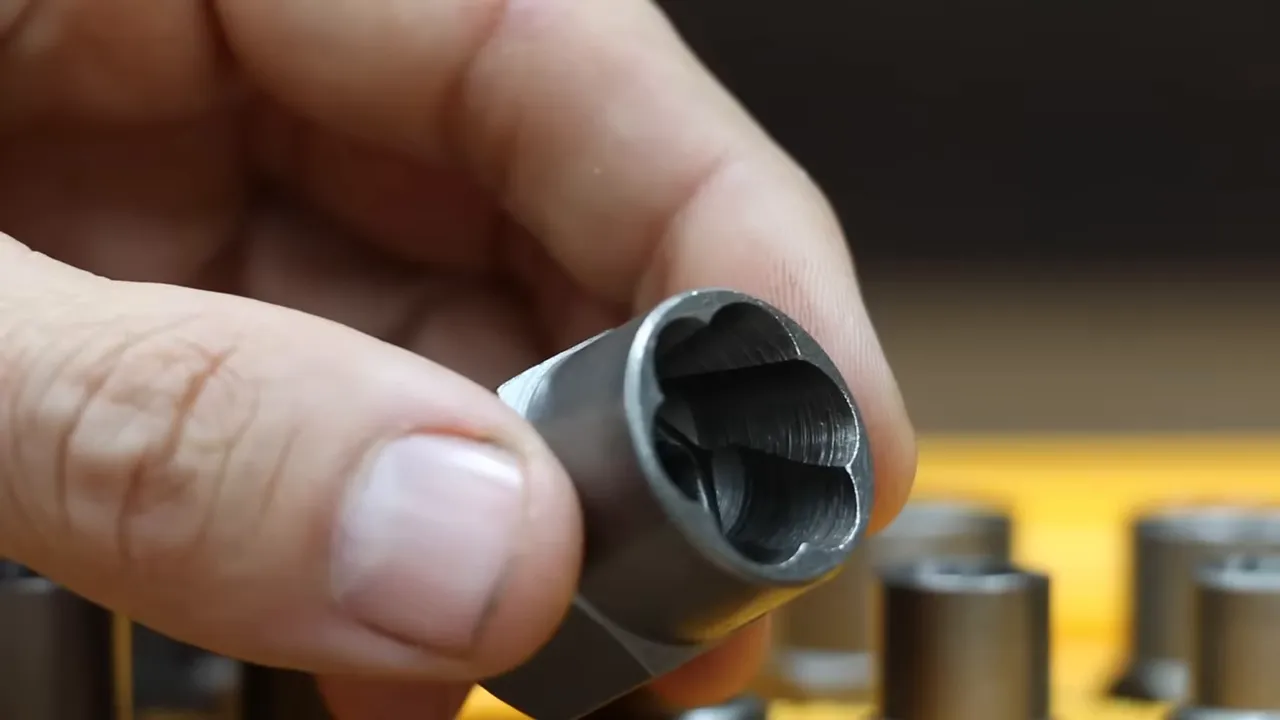
The extractor was close to a conventional socket in diameter, making it a good candidate for hard-to-reach areas. However, the external hex flats extended beyond the round body and could interfere in an especially tight opening.
Luckyway 13-Piece Extractor Set: $26.99
The China-made Luckyway also used tapered reverse-spiral flutes. Its measured body diameter of 0.836 inch was slightly smaller than the Amartisan’s.
It successfully loosened the rounded bolt at 84.4 foot-pounds and showed no visible damage. In this initial test, both inexpensive spiral-flute sets did a great job of biting into the damaged heads.
RocketSocket 13-Piece Extractor Set: $69.99
Made in the USA and designed for impact-tool use, the RocketSocket combined tapered reverse-spiral flutes with a round exterior. Its measured diameter was 0.885 inch, without protruding hex flats.
That exterior shape is a real advantage when nearby parts leave very little room. The RocketSocket gripped and removed its rounded bolt at 85 foot-pounds, and there was no visible wear or damage to the tool.
GearWrench Bolt Biter 15-Piece Set: $79.99
The China-made GearWrench set covered 1/4-inch through 3/4-inch fasteners and carried a lifetime warranty. It was advertised for hand and power tools, with claims of longer impact life and increased gripping force.
Its internal geometry stood out. Instead of tapered spiral flutes, it used straight flutes with little apparent taper. At 0.942 inch, the tested socket was also a bit larger in diameter than several competitors.
The first size slipped at just 15.4 foot-pounds. Moving down one size worked, but getting the smaller, untapered extractor onto the head required considerably more force. Once installed, it held firmly enough to remove the bolt at 94 foot-pounds. There were pronounced tooth marks on the bolt and no visible damage to the extractor.
The result was successful, but it demonstrated how much extractor fit can change performance.
Irwin Hanson Extractor Set: $91.06
The Irwin set covered 1/4-inch through 3/4-inch fasteners and was made in the USA with global components. Its online product description listed compatibility with impact tools.
The first extractor lost grip at 61.9 foot-pounds. I then tried the next smaller size. Its taper made installation easier than with the GearWrench, but the extractor fractured at 57 foot-pounds.
That was a very good reminder to wear eye protection. A chunk of the tool flew off, and I never found it.
I’m not going to put all the blame on Irwin for this result. I may have used too much force fitting the undersized extractor onto the rounded head and damaged it during installation. That makes this a result worth reporting, but not a clean verdict on the tool’s strength under normal use.
Snap-on Extractor Set: $263
The most expensive kit was also made in the USA with global components. Its extractor dimensions, finish, and markings looked remarkably similar to the Irwin’s. That resemblance suggested a possible shared manufacturer, but appearance alone didn’t establish that.
Like the Irwin, the initial 5/8-inch Snap-on extractor slipped, requiring a smaller size. The smaller extractor maintained its grip and removed the rounded bolt at 82.3 foot-pounds. There was a small amount of wear on its flutes afterward.
The Snap-on got the job done. The next question was whether it could do something the much less expensive successful tools couldn’t.
Nut Splitters: Removing the Nut Without Turning It
A nut splitter takes a different approach. Rather than gripping and rotating the damaged hex, it drives a chisel into the nut. That can work very well, but the tool still needs room to fit and a cutting edge capable of handling the nut.
Vector Tools Nut Splitter: $19.95
The China-made Vector used a screw-driven chisel and an adjustable base for nuts from 7/16 inch through 3/4 inch. It required about 1.5 inches of clearance from the bolt’s center, which could be a problem around nearby obstructions.
It struggled with the Grade 8 test nut. Applying 110 foot-pounds to the tightening screw didn’t split it. I repositioned the tool for another attempt, but the chisel deflected as it pressed into the nut.
Teng Tools Nut Splitter Set: $29.99
The Taiwan-made Teng set included a smaller splitter for 5 to 20 mm nuts and a larger one for 14 to 27 mm nuts. Like the Vector, the tested setup needed roughly 1.5 inches of clearance from the bolt’s center.
At 74 foot-pounds on the drive screw, the chisel penetrated most of the way through the nut. I rotated the splitter to attack the opposite side, but the tool’s size and shape prevented a good cutting angle. It didn’t complete the split, and the chisel sustained considerable damage.
Mophorn 14-Ton Hydraulic Nut Splitter: $84.95
The hydraulic splitter was made in China and rated for 14 to 36 mm nuts. Its approximately 2.5-inch-wide head made it a poor candidate for tight spaces, but it was very impressive where room was available.
The operating sequence involved closing the release valve, positioning the head flat around the nut, and pumping the handle to advance the blade. The instructions called for extra care once the blade had penetrated roughly one-third of the nut. After the split, releasing hydraulic pressure allowed the blade to retract.
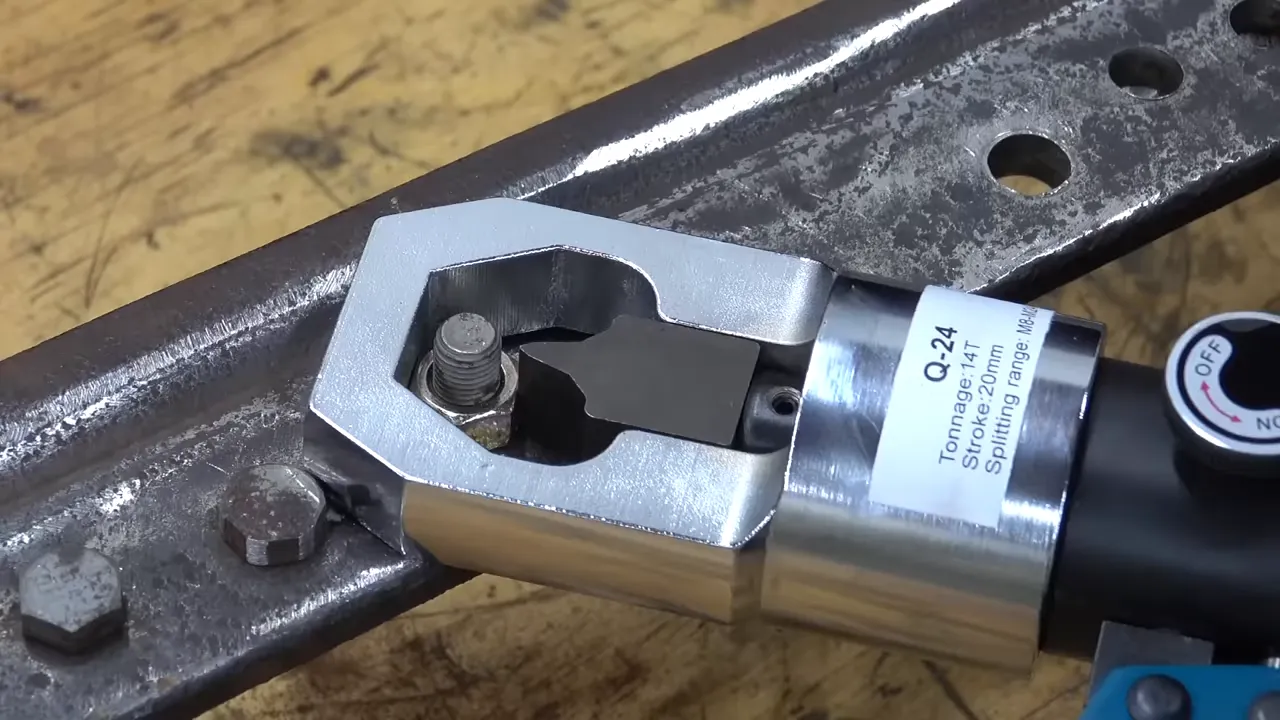
The nut had been tightened to 100 foot-pounds. After one split, it turned easily with pliers. I then rotated it 180 degrees and made another cut.
The Mophorn made clean cuts and showed no visible chisel damage. There was a slight line where the blade touched the bolt threads, but the threads remained in good condition. Of the three nut splitters tested, this one did a tremendous job.
Destructive Test: Which Extractors Held Until the Bolt Broke?
Seven of the first twelve tools successfully dealt with their rounded fastener or split the nut. The hydraulic nut splitter didn’t participate in the torque-to-failure round, leaving six gripping extractors to compete.
To make the job more difficult, I sprayed the damaged bolt heads with penetrating oil. Then each extractor had to hold on until it slipped or the bolt broke.
- Go2 Socket: held firmly despite the lubricant and snapped the bolt at 115 foot-pounds.
- Amartisan: needed a few additional taps during the test, but outlasted the bolt at 104 foot-pounds.
- Luckyway: initially slipped at 44 foot-pounds. After more light hammer taps, it reached 82 foot-pounds before slipping again.
- RocketSocket: locked onto the head without losing grip and snapped the bolt at 107 foot-pounds.
- GearWrench Bolt Biter: reached 99 foot-pounds before slipping. The next smaller size would not fit.
- Snap-on: held securely until the bolt broke at 108 foot-pounds.
The Go2, Amartisan, RocketSocket, and Snap-on all outlasted their bolts. The different breaking-torque readings don’t establish each tool’s ultimate strength, because the bolts failed first. What they do establish is that each of those four tools had enough grip for the test.
The tapered spiral-flute designs generally provided a very secure bite. The Go2’s adjustable clamping approach also worked extremely well, although it required more setup and more clearance.
Stud Removers: All Six Had Plenty of Grip
With no bolt head to grab, a stud remover has to clamp onto the exposed shank or threads. The final test pushed six stud removers until either the tool failed or the stud broke.
All six performed very well. That made access, tool size, and ease of engagement especially important differences.
DeWILL Stud Extractor: $16.99
The China-made DeWILL covered 6 to 12 mm fasteners. Its mechanism worked much like a drill chuck, tightening around the stud as the tool rotated counterclockwise.
The main body was just over 1.5 inches in diameter, tapering to just over an inch near the gripping end. It held securely enough to break the stud and showed no visible tool damage. For a $16.99 extractor, that was a great result.
ARES Bolt Extractor: $19.82
The Taiwan-made ARES covered 1/4-inch through 1/2-inch fasteners and used a self-tightening chuck design. Apart from its chrome finish, it looked very similar to the DeWILL.
Performance was very similar, too. It gripped firmly, outlasted the stud, and showed no visible wear or damage.
Powerbuilt Stud Remover: $19.94
The Powerbuilt covered 1/4-inch through 3/4-inch studs and was made in Taiwan. A toothed, chrome-molybdenum gripping wheel bit into the stud as the tool turned counterclockwise.
Its body measured over 2 inches in diameter. More importantly, the stud sat off-center, so the tool needed room to swing around it. An adjacent bolt interfered enough that I eventually removed that bolt to continue the test.
With the obstruction gone, the Powerbuilt won the contest easily. It broke the stud at 99.5 foot-pounds, with no visible damage to the gripping wheel or body.
Lisle Stud Remover: $23.76
The Taiwan-made Lisle covered 3/8-inch through 3/4-inch studs. It was intended for applications including engine blocks, exhaust manifolds, and cylinder heads.
Its diameter and offset-wheel design closely resembled the Powerbuilt’s. It also outlasted the stud without visible damage. Like the Powerbuilt, it needed considerably more working space than the socket-style designs.
GearWrench Stud Extractor: $33.38
This USA-made extractor covered 1/4-inch through 3/4-inch studs and carried a lifetime warranty. I liked the way the body supported the gripping wheel on both sides. It could also turn a stud clockwise or counterclockwise.
At roughly 2 inches in diameter, it still required extra swing clearance. However, it seemed quicker to establish a firm grip than the Powerbuilt or Lisle, and it also outlasted the stud.
ABN Stud Removal Set: $39.19
The Taiwan-made ABN set used an internal gripping arrangement that appeared to include three steel pins and three steel sleeves. Its socket-style body was the smallest of the stud-removal designs tested, with a working profile similar to an impact socket.
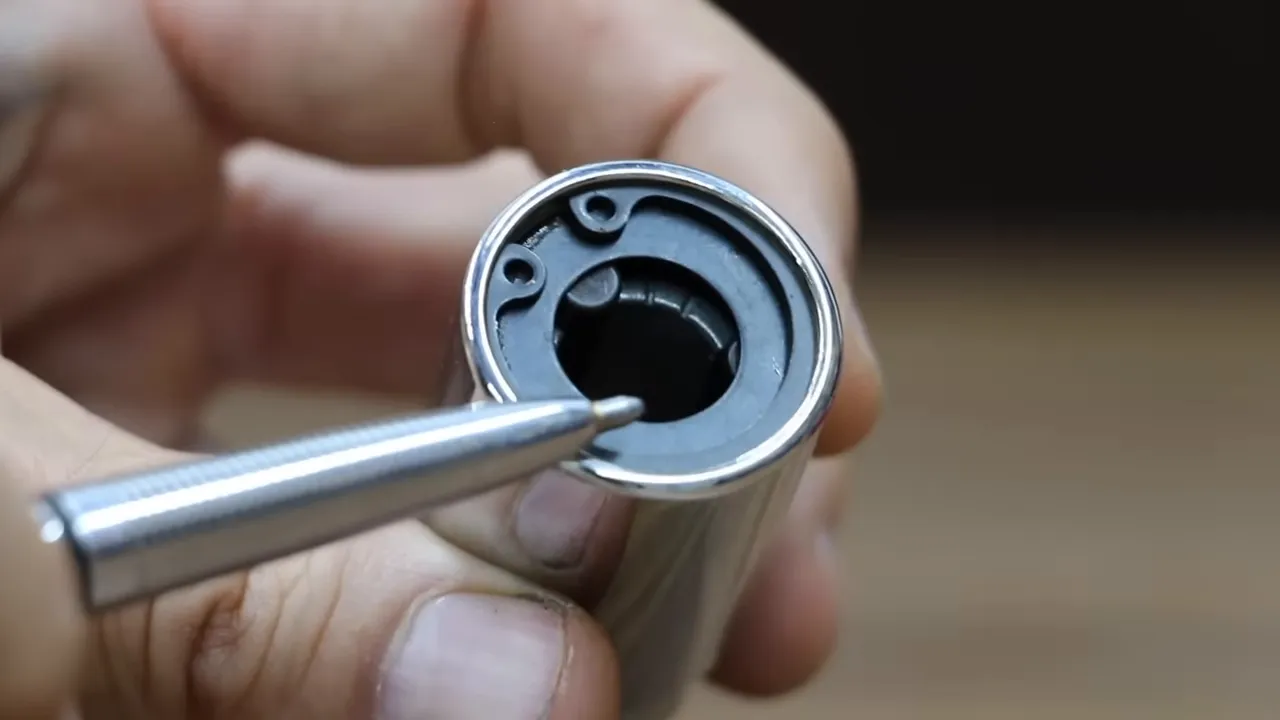
The ABN made quick work of the strength contest, snapping the stud at about 105 foot-pounds. There was no visible wear or damage afterward.
Its body measured just over an inch in diameter. The DeWILL and ARES narrowed to a similar size at the working end, but their wider upper bodies needed about half an inch more room. The offset-wheel tools were larger still and needed additional swing space.
When access is limited, the ABN has a very useful advantage. Since every stud remover had enough grip to break its test stud, that compact shape made it my favorite.
Which Rounded Nut and Stud Removers Would I Choose?
The least expensive universal socket wasn’t nearly as effective on rounded fasteners as the dedicated extractors. But spending the most money wasn’t necessary, either.
- Best affordable rounded bolt extractor set: Amartisan. It removed the rounded bolt, outlasted the bolt in the lubricated test, and cost only $24.95.
- My preferred rounded bolt extractor set: RocketSocket. It gripped securely in both tests, showed no visible damage, and had a round exterior well suited to restricted access.
- Strong inexpensive adjustable option: Go2 Socket. It held until the bolt broke, but required a more involved fitting procedure and more room.
- Best nut splitter in this test: Mophorn hydraulic. It split the nut cleanly while leaving the bolt threads in good condition, provided there was enough clearance for its large head.
- My preferred stud remover: ABN. All six stud removers performed well, but the ABN combined plenty of grip with the most compact overall profile.
The $263 Snap-on performed very well, but several much less expensive tools also held until their bolts broke. For my money, the Amartisan offers impressive value, the RocketSocket is the set I’d choose with a larger budget, and the ABN is my pick for studs. The right tool needs more than strength: it has to fit the job, bite securely, and stay attached when the torque goes up.


