Motor oil additives promise a lot: less engine wear, easier starting, more horsepower, better fuel economy, and sometimes a quieter engine. Thousands of positive customer reviews make those claims pretty tempting. But does adding another product to a good motor oil actually make it better?
I purchased five popular oil additives, tested them against Pennzoil Ultra Platinum 5W-30, and hired an independent oil analysis lab to examine the blends. The testing included vehicle acceleration, fuel consumption, cranking power, evaporation, extreme-cold flow, and metal-to-metal wear.
Some products delivered impressive results straight out of the bottle. Once mixed with motor oil and exposed to heat, the story changed quite a bit. None of the additives beat straight motor oil across the overall bench-test comparison. Here is what worked, what did not, and why a slick demonstration does not necessarily translate into better engine protection.
Quick Summary
- Liqui Moly tied straight motor oil overall, while the other additive blends ranked lower.
- ProLube improved short-term road results but performed poorly in cold-flow and wear tests after heating.
- Full-concentration additive wear demonstrations did not predict performance after blending with oil and heating.
- For a healthy engine, my preference remains high-quality motor oil and regular oil changes.
Table of Contents
- The Oil Additives and Their Claims
- How I Tested Them
- Room-Temperature Oil Flow: Lucas Makes a Big Change
- Do Oil Additives Improve Fuel Economy or Power?
- Do They Make the Engine Easier to Crank?
- Heat Exposure and Evaporation
- Extreme-Cold Flow Before and After Heating
- The Wear Test: Why Full-Concentration Demonstrations Can Mislead
- What the Independent Oil Analysis Found
- Which Motor Oil Additive Performed Best Overall?
- Should You Use an Oil Additive?
The Oil Additives and Their Claims
All five products had strong customer ratings at the time of testing, ranging from 4.6 to 4.8 stars out of five. Prices below are the purchase prices for the containers tested, not the cost of treating every engine.
- Liqui Moly MoS2 Anti-Friction Engine Treatment, $11: Claims immediate friction and wear reduction, with no lengthy driving period needed before results. The German-made treatment is labeled compatible with turbochargers and catalytic converters. One 300 mL can treats up to 6.4 quarts of motor oil.
- Lucas Heavy Duty Oil Stabilizer, $12: Claims to eliminate dry starts, slow oil consumption by sealing worn cylinders, cool and quiet engines and gearboxes, and make starting easier at any temperature. This is some very thick stuff. The nickname “motor honey” makes sense.
- Bestline Engine Treatment, $25: Advertises nano diamond technology, internal cleaning, reduced friction, lower temperatures, less wear, and improved fuel economy and performance. It is made in the USA.
- ProLube Oil Treatment, $39: Claims reduced friction, improved fuel economy, lower oil temperatures, less sludge and varnish, and longer engine and oil life. The USA-made product calls for 1 ounce per quart of motor oil, or up to 2 ounces per quart for high-mileage engines.
- Archoil AR9100 Friction Modifier, $40: Claims a solid boundary lubricating film that reduces wear, friction, heat, engine noise, and vibration while protecting during cold starts. The USA-made product calls for 1.2 ounces per quart, so a 16-ounce bottle treats just over 13 quarts.
ProLube and Archoil both recommend treatment at every oil change. Those ongoing costs need to buy a measurable benefit, not just a good first impression.
How I Tested Them
Pennzoil Ultra Platinum 5W-30 served as the reference oil and the oil used in the additive blends. Before mixing, I shook the containers in case any ingredients had settled.
I prepared samples for independent laboratory analysis and separate bench tests. The Liqui Moly sample preparation used 80 mL of treatment. For the ProLube bench-test blend, I used the high-mileage dosage of 2 ounces per quart. The vehicle test used its standard 1-ounce-per-quart dosage.
The testing addressed several different questions:
- Does the additive substantially change how the oil flows?
- Does it improve acceleration or fuel economy in a short before-and-after test?
- Does the starter require less electrical power to crank the engine?
- How much mass does the blend lose during heating?
- How does it flow at minus 40 degrees before and after heat exposure?
- Does the heat-exposed blend reduce wear in a consistent bench test?
- What happens to the oil’s existing additive package and reserve alkalinity?
These are different measurements, not interchangeable proof of engine life. Acceleration is not a direct horsepower measurement, a flow ramp is not an oil pump, and a metal-contact tester is not a complete engine. Together, though, they provide a much more useful picture than testing a fresh additive at full concentration.
Room-Temperature Oil Flow: Lucas Makes a Big Change
At approximately 70°F, or 21°C, most of the blends flowed very close to straight motor oil. The measured times were:
- Bestline: 1.27 seconds.
- Archoil: 1.28 seconds.
- Straight motor oil: 1.30 seconds.
- Liqui Moly: 1.32 seconds.
- ProLube: 1.32 seconds.
- Lucas: 2.00 seconds.
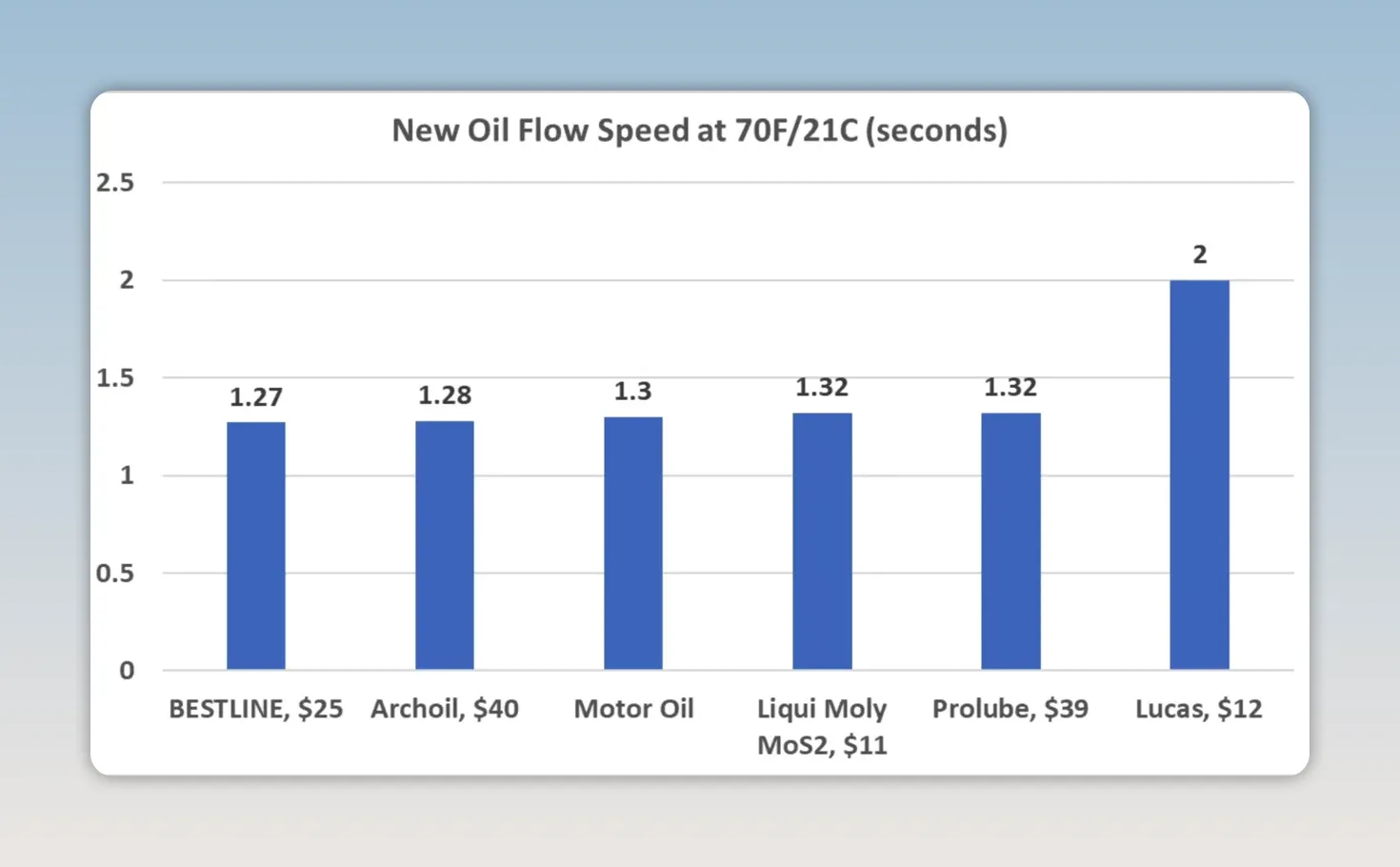
Bestline and Archoil flowed slightly faster, while Liqui Moly and ProLube flowed slightly slower. Lucas was the clear outlier, adding quite a bit of viscosity.
The goal here is not simply to win a race down the ramp. Faster is not automatically better. In most cases, I do not want an aftermarket additive substantially changing the viscosity of the oil selected for the engine.
Do Oil Additives Improve Fuel Economy or Power?
For the vehicle tests, I established a baseline with motor oil, added the treatment, and repeated the route. I monitored engine data at three checkpoints: a relatively flat section, an uphill section, and a slight downhill section.
Fuel economy was calculated from distance traveled and gasoline added, rather than trusting the dashboard estimate. At each refill, I used the same station and procedure: allow the pump to shut off, wait 15 seconds for the fuel to settle, then restart it once.
These were short, real-world before-and-after comparisons. Weather, traction, traffic, and refueling variation can affect the results. The vehicles also differed, so the useful comparison is each vehicle against its own baseline, not one additive’s MPG against another vehicle’s MPG.
Liqui Moly: Essentially No Acceleration Change
The Liqui Moly test vehicle was a 2003 Chevrolet Suburban with a 5.3-liter V8 and more than 320,000 miles. Cruise control was set to 70 mph for the highway portion.
With straight motor oil, fuel flow at the three checkpoints was 3.04, 6.18, and 2.53 gallons per hour. With Liqui Moly, those readings became 3.48, 5.95, and 2.74 gallons per hour. That is one checkpoint better and two worse.
- Baseline fuel economy: 17.36 MPG over 81.3 miles.
- With Liqui Moly: 16.86 MPG over the same distance.
- Baseline 0 to 60 mph: 8.64 seconds.
- With Liqui Moly: 8.66 seconds.
A difference of two hundredths of a second is basically no detectable power change in this test. There was a little tire spin on the baseline run and none on the treated run. Rain also arrived during the treated route, which could have hurt fuel economy.
Some owners report an immediately quieter engine with Liqui Moly. This Suburban sounded about the same to me, although it was already a pretty quiet engine for something with only 320,000 miles on it.
Bestline: Slightly Quicker, but Lower Fuel Economy
A Toyota 4Runner handled the Bestline comparison over a 97.6-mile route.
The baseline fuel-flow readings were 2.85, 5.33, and 2.28 gallons per hour. With Bestline, they increased to 3.22, 5.41, and 2.29 gallons per hour. All three checkpoints pointed in the same direction: slightly more fuel use.
- Baseline fuel economy: 23.42 MPG.
- With Bestline: 21.21 MPG.
- Baseline 0 to 60 mph: 8.24 seconds.
- With Bestline: 8.19 seconds.
The treated run was five hundredths of a second quicker, but the fill-up calculation showed a loss of about 2.2 MPG. This test did not demonstrate a fuel-economy benefit from Bestline.
ProLube: Better Short-Term MPG and Acceleration
For ProLube, I used a 2020 Chevrolet Suburban with a 5.3-liter V8, active fuel management, gasoline direct injection, and 120,884 miles at the start.
The baseline checkpoint fuel-flow readings were 2.91, 6.12, and 1.90 gallons per hour. After adding 8 ounces of ProLube, or 1 ounce per quart, the readings improved to 2.64, 6.07, and 1.58 gallons per hour. Three checkpoints, three improvements.
- Baseline fuel economy: 21.92 MPG.
- With ProLube: 23.40 MPG.
- Baseline 0 to 60 mph: 7.70 seconds.
- With ProLube: 7.55 seconds.
That is about 1.5 MPG better and a 0.15-second quicker acceleration run. ProLube delivered the most encouraging short-term vehicle results of the products tested this way.
However, this was freshly added treatment. The heat-exposure results raised serious questions for me about whether those improvements would persist. I did not establish their durability over a long mileage interval.
Archoil: No Fuel-Savings Benefit in the Generator Test
Archoil went into a fuel-injected generator powering a set of lights. The baseline runtime on the filled test fuel cell was 22 minutes, 48 seconds.
With the recommended Archoil dosage, the generator ran for 22 minutes, 25 seconds on the timer. I added 8 seconds because the lights had been connected before timing began, bringing the corrected runtime to 22 minutes, 33 seconds.
That was 15 seconds short of the baseline. Archoil did not improve fuel efficiency in this comparison. Lucas was included in the bench and laboratory testing, but not in a vehicle fuel-economy or acceleration comparison.
Do They Make the Engine Easier to Crank?
To check starting claims, I disabled fuel delivery so the engines would crank without firing. A clamp meter measured current, and a multimeter measured voltage. Multiplying amps by volts gives electrical power in watts.
This measures power draw during cranking, not total energy used during a complete start.
- Liqui Moly: The older Suburban dropped from about 1,516 watts with motor oil to 1,392 watts with treatment, a reduction of approximately 124 watts. It did appear to turn over more easily.
- Bestline: The 4Runner increased from approximately 2,020 watts to 2,105 watts, about 85 watts more.
- ProLube: The newer Suburban’s baseline was just under 1,400 watts. After treatment and roughly 24 hours of cooling, it sounded like it cranked faster, but drew about 140 additional watts.
A faster-sounding starter is not necessarily drawing less power. Liqui Moly was the product that reduced measured cranking power in these comparisons.
Heat Exposure and Evaporation
I weighed out 200 grams of each oil or oil blend and heated the samples for two hours, rotating containers between burners every 10 minutes to reduce the effect of burner differences.
The purpose was to compare evaporation and see how heat affected later performance. The formal Noack volatility test also measures evaporation tendencies, but this hot-plate comparison is not a standardized Noack test.
After the samples cooled, the mass losses were:
- Liqui Moly blend: 2.83 grams.
- ProLube blend: 3.06 grams.
- Straight motor oil: 3.13 grams.
- Lucas blend: 3.15 grams.
- Archoil blend: 3.42 grams.
- Bestline blend: 4.77 grams.
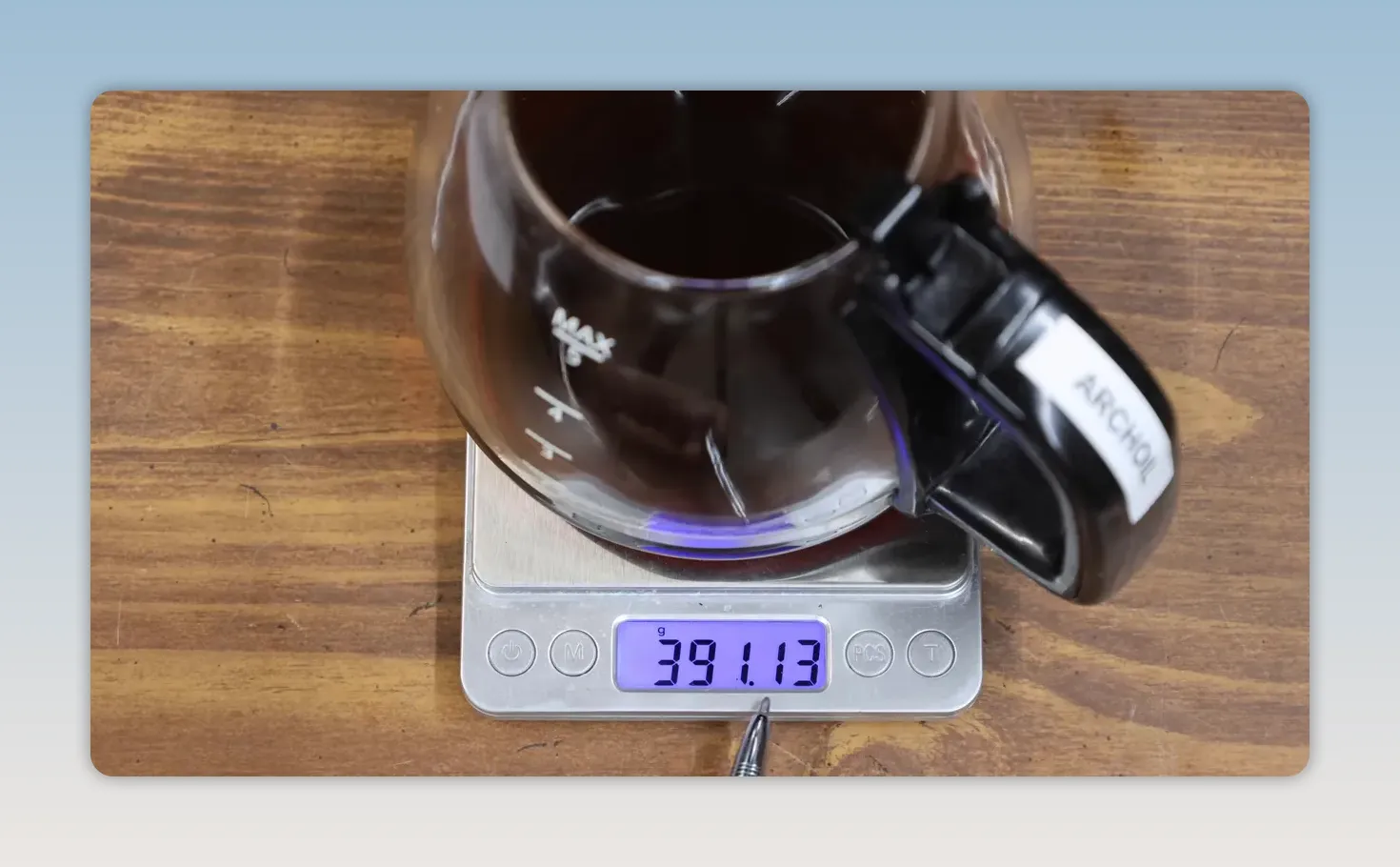
Liqui Moly lost the least mass. ProLube was slightly better than motor oil, and Lucas was almost identical to it. Archoil lost somewhat more, while Bestline had the greatest evaporative loss.
But evaporation was only part of the heat test. ProLube’s small mass loss did not mean the blend came through unchanged.
Extreme-Cold Flow Before and After Heating
I placed both fresh and heat-exposed samples in a freezer overnight at minus 40°C, which is also minus 40°F, then compared their flow down the same ramps.
Fresh Blends at Minus 40 Degrees
The fresh samples finished in approximately:
- Archoil: 55 seconds.
- Bestline: 55.5 seconds.
- Straight motor oil: 62 seconds.
- ProLube: Just under 69 seconds.
- Liqui Moly: About 71 seconds.
- Lucas: Just under 114 seconds.
Bestline and Archoil flowed faster than the reference oil. Liqui Moly and ProLube were slower, but Lucas was much slower. That is worth considering alongside its claim of easier starting at any temperature.
Heat-Exposed Blends at Minus 40 Degrees
After the two-hour heat exposure, the cold-flow results were:
- Bestline: 51.1 seconds.
- Archoil: 57.5 seconds.
- Straight motor oil: 59.05 seconds.
- Liqui Moly: About 71 seconds.
- Lucas: 104.4 seconds.
- ProLube: 128.77 seconds.
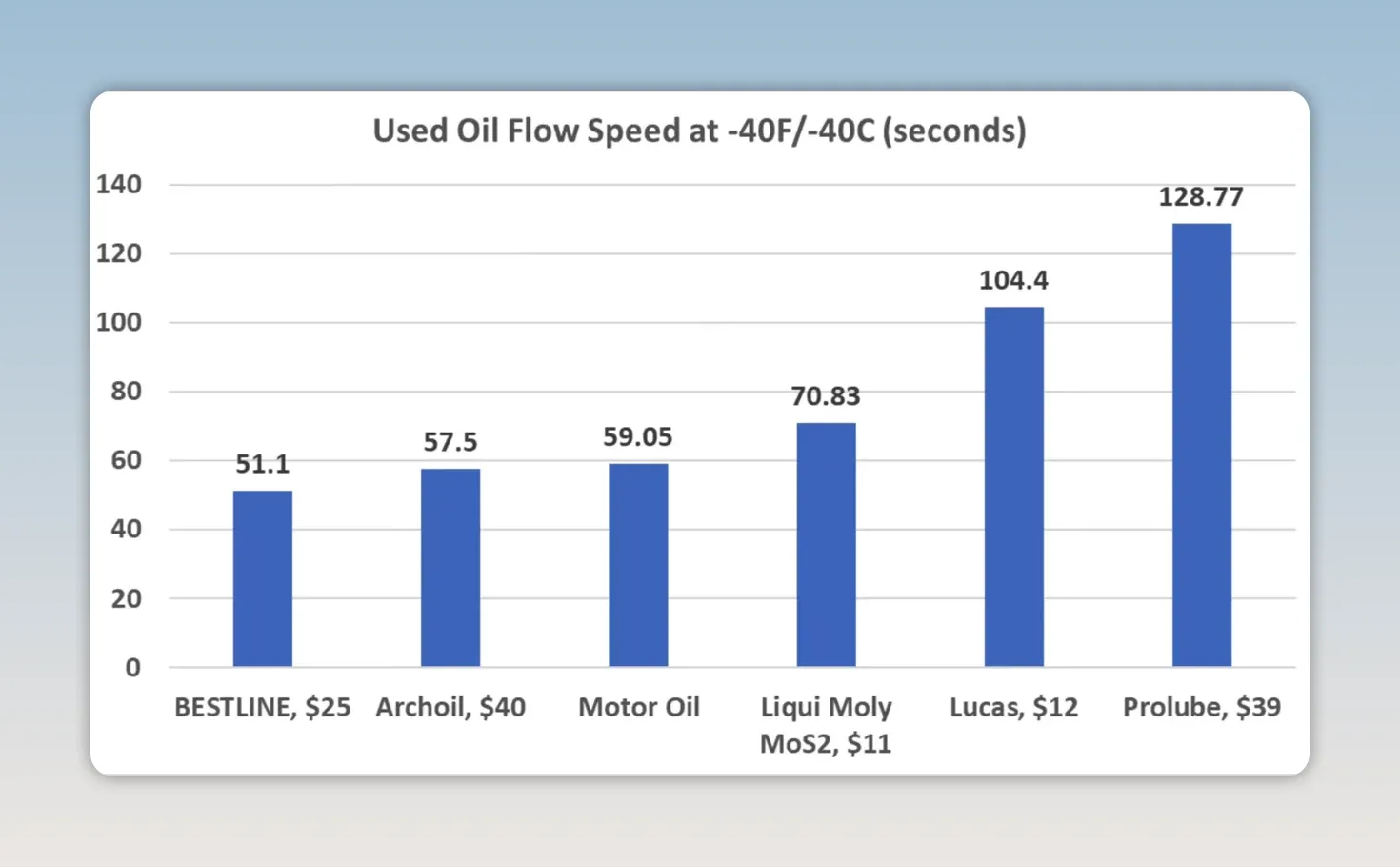
Archoil remained close to straight motor oil, and Bestline flowed even faster than before. Liqui Moly stayed near its previous result. Lucas remained slow.
ProLube showed the biggest unfavorable change. Its flow time increased from just under 69 seconds to nearly 129 seconds. That heat-related change is why I am not convinced the fresh-treatment fuel-economy and acceleration gains tell the whole story.
The Wear Test: Why Full-Concentration Demonstrations Can Mislead
A lubricity tester does not fully reproduce conditions inside an engine. I agree completely with that criticism. An engine is far more complex than a single loaded metal contact.
What the tester can provide is a controlled comparison of wear under one specific condition. I kept the method consistent, installed a new test pin, cleaned and resurfaced the wheel between tests, and did not touch the machine once a run was underway.
I compared two very different situations: fresh additive at 100% concentration, and the additive mixed with oil at the test dosage after heat exposure.
Fresh Additives at 100% Concentration
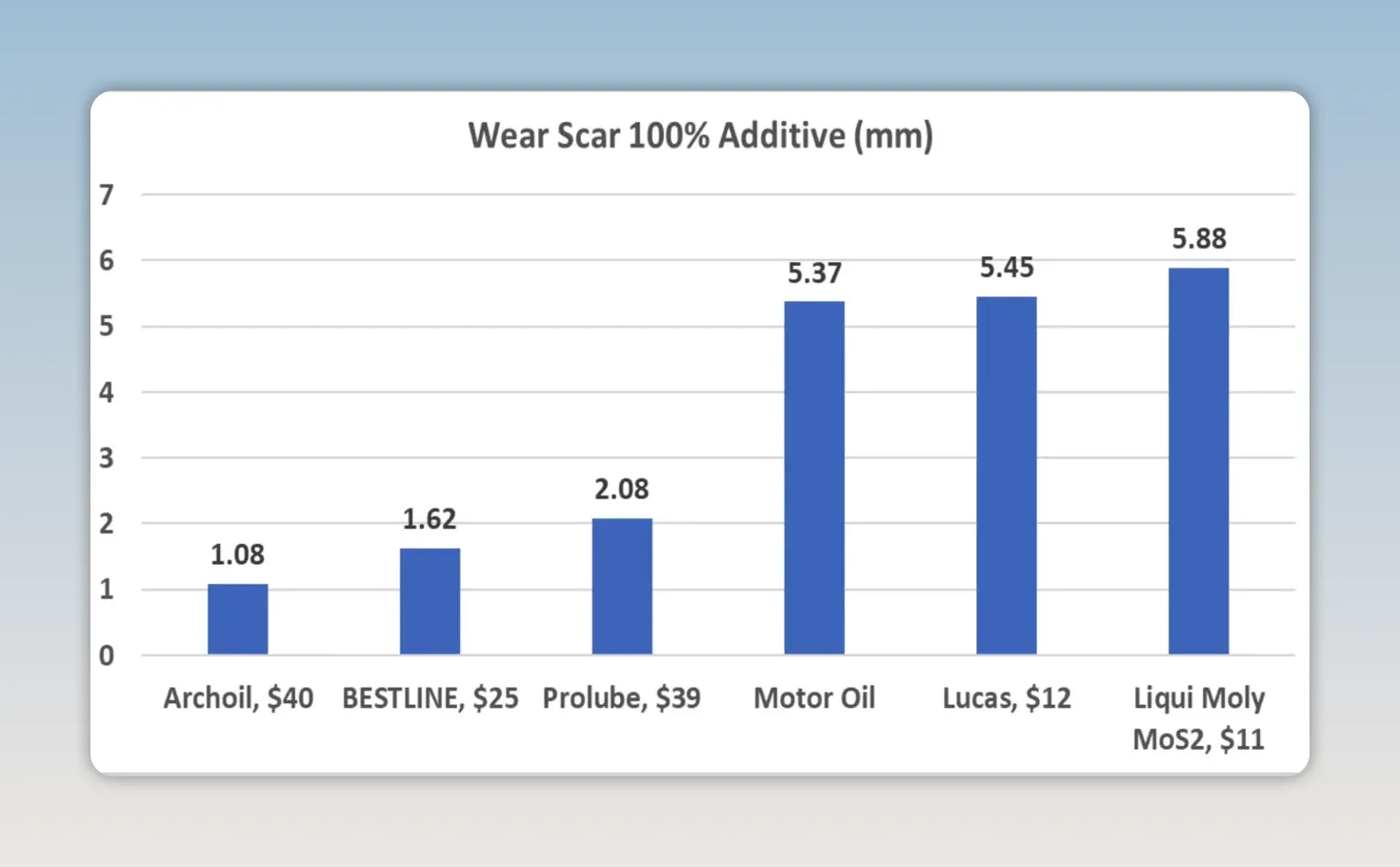
Smaller wear scars indicate less wear in this particular test:
- Archoil: 1.08 mm.
- Bestline: 1.62 mm.
- ProLube: 2.08 mm.
- Motor oil reference: 5.37 mm.
- Lucas: 5.45 mm.
- Liqui Moly: 5.88 mm.
Archoil, Bestline, and ProLube looked fantastic at full concentration. This is the kind of comparison that can make an additive demonstration very persuasive.
But an engine is not supposed to run on a crankcase full of concentrated treatment. The blended, heated comparison is much more relevant to the intended application.
Oil Blends After Heat Exposure
- Bestline blend: 4.70 mm.
- Straight motor oil: 5.37 mm.
- Lucas blend: 5.37 mm.
- Liqui Moly blend: 5.44 mm.
- Archoil blend: 5.54 mm.
- ProLube blend: 5.84 mm.
Bestline was the only additive blend to outperform motor oil in this test. Lucas tied the reference oil, and Liqui Moly was close behind. Archoil and ProLube produced larger scars.
The full-concentration results did not predict the heated-blend results. That is my concern with using a fresh, undiluted additive demonstration as proof of superior engine protection.
The Chemistry Behind the Results
Liqui Moly suspends solid microparticles of molybdenum disulfide, or MoS2, in the oil. Lucas behaved primarily as a viscosity enhancer, rather than a large source of additional anti-wear chemistry.
My research into Bestline pointed to long-chain chlorinated paraffin technology with calcium sulfonate buffering. That chemistry raised a concern about acidic breakdown products over extended use. However, this testing did not establish long-term corrosion in an engine.
Archoil uses a synthetic carrier with potassium borate technology intended to form a low-friction boundary layer on metal. It was exceptionally effective at full concentration on the tester, but that advantage disappeared in the heated oil blend.
What the Independent Oil Analysis Found
The laboratory analyzed the motor oil and additive blends. These results matter because replacing part of a finished oil with another product changes more than just friction.
Trace Metals and Existing Additives
The wear-metal and trace-metal results did not reveal an obvious concern in the fresh blends. Archoil contained a very large amount of potassium, along with sodium, consistent with its potassium borate approach.
The lab comparison also showed these changes:
- Detergent and dispersant-related content: Lower in every additive blend except Archoil, which was particularly high in boron.
- Molybdenum: Higher with Liqui Moly and Bestline than with straight motor oil.
- Phosphorus: ProLube was the only product to increase it over the reference oil.
- Zinc: Lower in every additive blend than in straight motor oil.
An elemental oil analysis reports elements such as molybdenum; it does not, by itself, identify every chemical compound containing them. Likewise, adding up additive-related elements is not a complete measure of cleaning or wear performance.
The important point is that adding a treatment can dilute portions of the additive package already present in a high-quality motor oil. It is not simply adding benefits without changing anything else.
Viscosity and Insolubles
The lab’s viscosity reference range at 210°F was approximately 54 to 65 SUS. Straight Pennzoil measured 59.1, near the middle. Bestline and ProLube were toward the lower end of that range.
The Liqui Moly blend also registered 0.2% insolubles. That result needs to be considered in the context of a treatment designed to suspend solid particles, rather than automatically treated as dirt contamination.
Total Base Number: Acid-Neutralizing Reserve
Total base number, or TBN, measures an oil’s reserve alkalinity: its capacity to neutralize acidic byproducts.
- Straight motor oil: TBN of 7.4.
- Archoil blend: TBN of 12.2.
- ProLube blend: TBN of 5.8, the lowest result.
Every additive except Archoil lowered the blend’s TBN compared with straight oil. ProLube’s reduction suggested to me that some alkalinity might have been consumed neutralizing acidic material introduced by the treatment. That is an interpretation, not direct identification of an acid.
All the fresh blends still had a safe TBN in this comparison. These fresh-oil results do not establish how long that reserve would last in service.
Which Motor Oil Additive Performed Best Overall?
I converted the bench-test results into category rankings for evaporation, heat-exposed wear, room-temperature flow, and cold flow before and after heating. For flow, I did not automatically reward a product just for being faster than the reference oil.
The overall order was:
- Straight motor oil and Liqui Moly: Tied for the best overall result.
- Bestline: Next, with the best heated-blend wear result but the greatest evaporative loss.
- Archoil: Stayed close to motor oil in heated cold flow, but did not improve heated-blend wear.
- ProLube: Encouraging short-term road results, offset by poor heated cold flow and the largest heated-blend wear scar.
- Lucas: Tied motor oil for heated-blend wear, but substantially increased flow times.
Liqui Moly tied motor oil overall. It did not establish an across-the-board improvement over it. None of the other additive blends matched the reference oil’s overall result.
Should You Use an Oil Additive?
In a healthy engine, I would use a high-quality motor oil rather than an aftermarket oil additive. My preference is to change the oil at around 5,000 miles or less. That is the approach I have used with the 2003 Suburban, and its engine is still in fantastic shape beyond 320,000 miles.
I see additives as a possible band-aid for a specific problem, not a routine upgrade for an engine that is working properly. I have had good results with a couple of stop-leak products, but I would not put stop leak in an engine that does not leak.
If an engine has a particular mechanical issue, a targeted additive may be worth considering. That is a different decision from expecting a bottle of treatment to improve every aspect of an already balanced lubricant.
Are all motor oil additives a scam? That is too broad a conclusion. Some produced measurable benefits in individual tests. But the bigger claim, that adding one of these products makes a good motor oil better overall, did not hold up here. A quality motor oil set a very tough baseline to beat.


