A ratcheting screwdriver should save time and effort. But if the mechanism has too much drag, the shaft wobbles, or the handle uses up most of its movement before turning the bit, the ratchet might not be helping very much.
I bought 14 ratcheting screwdrivers, priced from $16 to $144, to compare efficiency, precision, magnetic strength, bit retention, and durability. That includes the approximately $70 Linus Tech Tips screwdriver, along with Megapro, Wera, Snap-on, PB Swiss, Milwaukee, and eight other brands.
The LTT finished first for working efficiency and low back drag, while PB Swiss earned the best overall average ranking. However, neither tool won every test. The best choice depends on which capabilities matter most for the work you do.
Key Takeaways
- LTT led working-arc efficiency and back drag while tying for the least sideways shaft movement.
- PB Swiss earned the best overall ranking through exceptional magnetic strength, bit retention, and locked-position tightness.
- Megapro and Williams delivered strong everyday performance at roughly half the tested LTT price.
- Every screwdriver outlasted its supplied Phillips bit, making overload strength less important than everyday handling.
The Screwdrivers: Prices, Storage, and First Impressions
Prices below are what I paid for the tested products, not a guarantee of current pricing. Bit storage, selector placement, and handle comfort varied quite a bit, even before measuring performance.
Budget Options: $16 to $24
- Black+Decker, $16: Includes ten standard 1-inch, 1/4-inch bits, with room for six in the removable end cap. The textured handle provides grip, but the directional selector is stiff. There is considerable rattling and shaft play, and the freely rotating front bit holder did not always release a bit on the first or second attempt.
- SATA, $17: This 19-in-1 model includes eight double-sided bits and storage behind the rear cap. The bits fit loosely enough to rattle. Its narrow directional ring is even harder to operate than the Black+Decker selector.
- Lenox, $17: The 8-in-1 design stores its double-sided bits inside a removable shaft. The heavily textured handle provides grip, but the narrow selector sits far enough into the grip area that changing direction will likely require repositioning your hand. There is also quite a bit of rattling.
- Husky, $18: Includes 30 bits, with a pull-out compartment that stores six. The metal selector ring is stiff and difficult to grip with slick hands. The shaft has noticeable play.
- Klein Tools, $20: This 15-in-1 screwdriver stores six double-sided bits in the handle. The selector is well positioned, but stiff and short on grip. It rattles less than several budget competitors.
- Milwaukee, $24: Stores six bits in the handle and has an accessible, grippy selector. The open handle design feels a little uncomfortable, and the stored bits rattle considerably.
Midpriced Options: $34 to $47
- Megapro, $34: Stores six double-sided bits inside the handle. Its directional ring is easy to reach and grip, the rear handle end rotates freely, and there is very little rattling.
- Irwin, $34: This 8-in-1 accepts standard, double-ended, power, and insert bits. It feels heavy, and its stiff selector will probably require a hand-position change. Rattling is relatively limited.
- Williams, $36: Includes five bits and an ergonomically shaped handle. The selector is easy to reach and offers excellent grip. Bits are stored loose inside the handle, which creates quite a bit of rattling.
- GearWrench, $40: Offers a straight or pistol-grip handle, a 45-tooth ratchet, and two LED lights. Accessing the bit compartment requires pressing two side tabs.
- Wera, $47: Has an anti-roll handle and an integrated six-bit magazine. The tool feels tight, with almost no rattling, and the selector is easy to reach and grip.
Premium Options: $70 to $144
- LTT, approximately $70: Includes 12 short bits that all fit inside the handle. Only six standard 1-inch bits fit in the same storage system. The selector is accessible and grippy, the rear cap rotates freely, and rattling is minimal. Its ratchet is a substantially modified Megapro design intended to reduce back drag and noise.
- Snap-on, $90: Includes two bits, with additional loose storage inside the handle. Shaft knurling provides very good grip. The selector is accessible and grippy, although a little stiffer than Wera’s.
- PB Swiss, $144: The most expensive set includes 20 bits and an easy-to-operate selector. Unlike the other storage-equipped designs, this screwdriver does not have onboard bit storage.
Working Arc: Which Ratchet Gets the Most Done in a Tight Space?
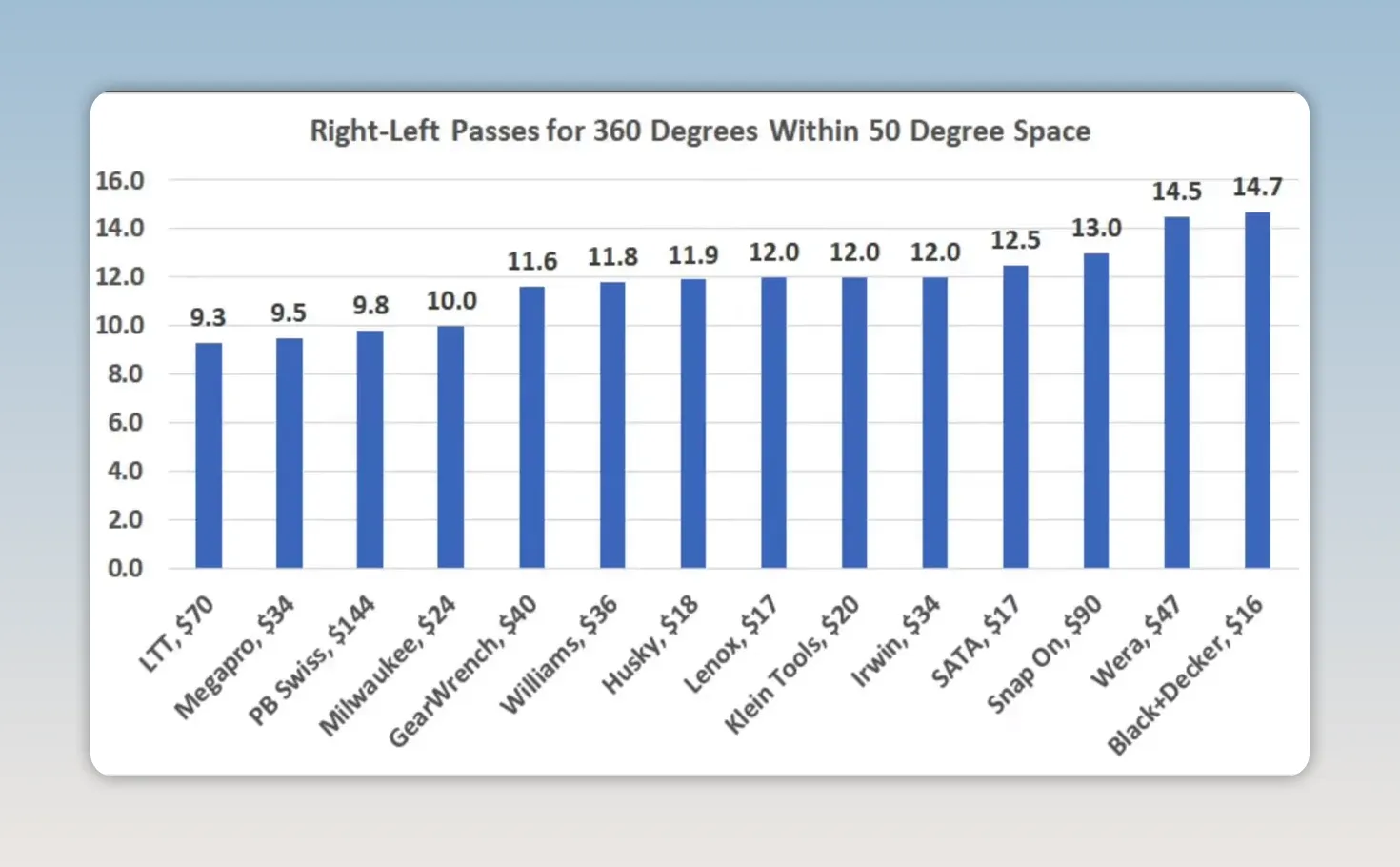
For the first test, I built a fixture that limited handle travel to a 50-degree space. With an Allen wrench attached to the handle, I counted the back-and-forth passes needed to complete one full shaft rotation. Fewer passes means more useful rotation from the available movement.
The LTT took the lead at 9.3 passes. Megapro was very close at 9.5, followed by PB Swiss at 9.8 and Milwaukee at 10. Very impressive performance from all four.
The rest of the results were:
- GearWrench: 11.6 passes.
- Williams: 11.8 passes.
- Husky: 11.9 passes.
- Lenox, Klein Tools, and Irwin: 12 passes each.
- SATA: 12.5 passes.
- Snap-on: 13 passes.
- Wera: 14.5 passes.
- Black+Decker: 14.7 passes.
Wera’s ratchet moved freely, but the lost motion hurt its result. Snap-on also felt low in drag, yet needed considerably more passes than the leaders. A freely moving mechanism does not necessarily make the best use of a limited working arc.
Weight: The Bits Can Change the Comparison
Without bits, Megapro and Milwaukee were the lightest at approximately 5.8 ounces. LTT followed at about 6 ounces, Husky at 6.3, and Wera at 6.5.
Including the supplied bits, Husky and LTT were the lightest at about 7.4 ounces, followed by Wera at 7.5 and Megapro and Williams at about 7.7. Milwaukee’s long bits brought its total to approximately 11 ounces. Lenox and Irwin were among the heaviest, at roughly 12 and 12.1 ounces with bits.
Those loaded weights do not represent identical bit collections. PB Swiss includes 20 bits, for example, while Snap-on includes only two. They do show how much the complete supplied kit weighs.
Back Drag: LTT Takes Only a Featherlight Touch
Back drag is the resistance the ratchet creates during the return stroke. Too much resistance can turn a lightly loaded fastener backward instead of allowing the mechanism to reset. At that point, you have to help the tool by holding the shaft or adding resistance at the fastener.
To compare back drag, I supported each shaft on a metal platform to keep it level and avoid side loading. I then measured the force needed to move the handle until the mechanism clicked into the next tooth. The readings are in grams from this test fixture, with lower numbers being better.
LTT won at just 9.08 grams. Williams also performed exceptionally well at 13.88 grams, followed by Megapro at 19.48 grams.
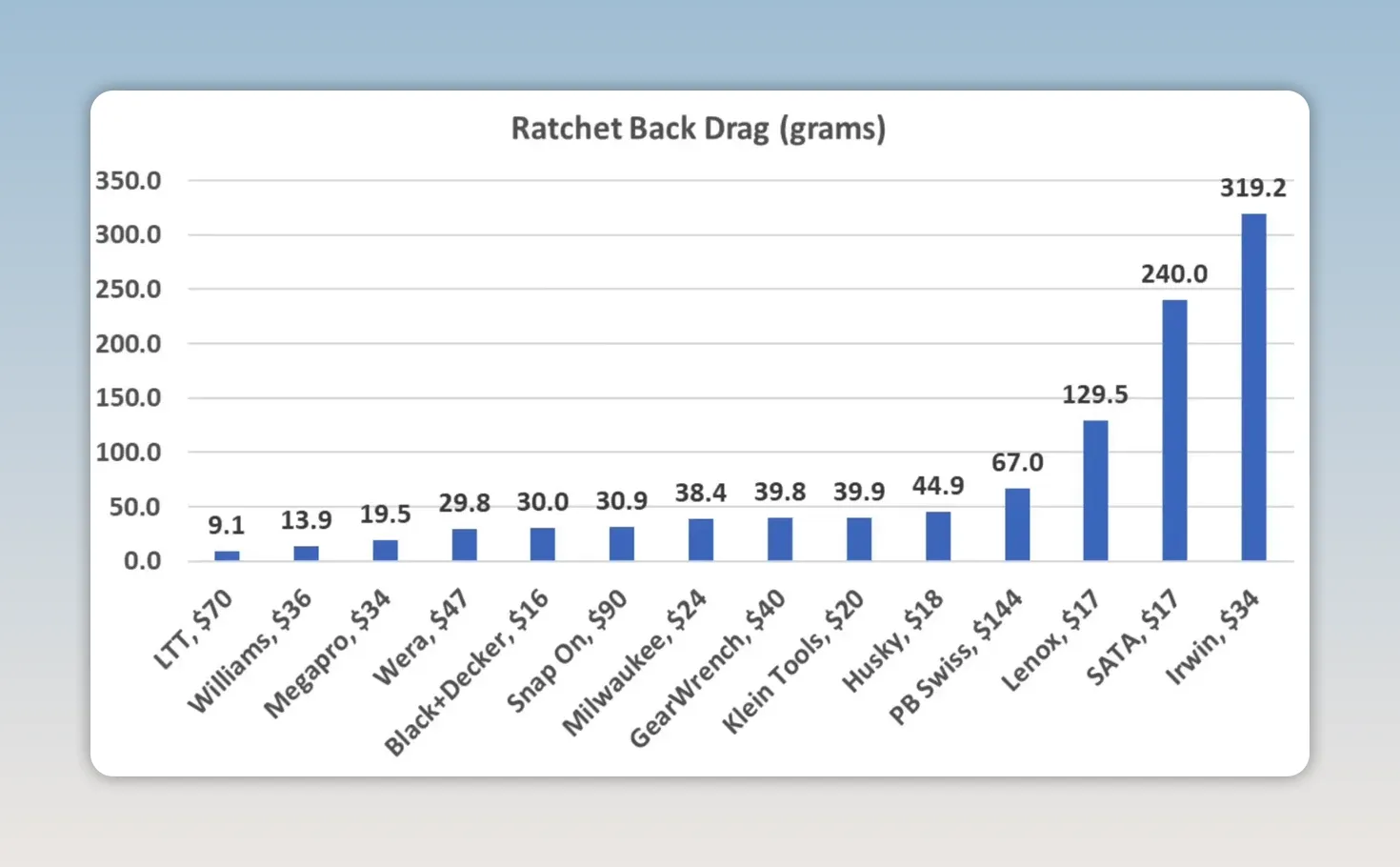
Wera measured 29.8 grams, Black+Decker approximately 30, and Snap-on 30.88. Milwaukee, GearWrench, and Klein Tools were closely grouped at 38.38, 39.8, and 39.89 grams. Husky measured 44.88 grams.
PB Swiss required 66.98 grams, which was quite a bit more resistance than the low-drag leaders, especially considering its price. Lenox measured 129.5 grams, SATA 240, and Irwin more than 319.
The SATA and Irwin results were particularly high. For fasteners needing a light touch, that much drag takes away a lot of the benefit of a ratcheting screwdriver. Black+Decker, despite its low price, actually performed fairly well here.
Shaft Wobble: Low Drag Does Not Have to Mean Loose Construction
Side-to-side shaft movement matters when the work requires precision. I measured shaft movement with a digital indicator rather than relying only on how loose the tool felt in hand.
Megapro, Irwin, and LTT tied for the least movement at 0.041 inch. Lenox and Williams were close behind at 0.048 inch.
Some high-drag tools performed well in this test, but Megapro and LTT showed that low back drag and good shaft control can exist in the same screwdriver. Williams also delivered a very good combination.
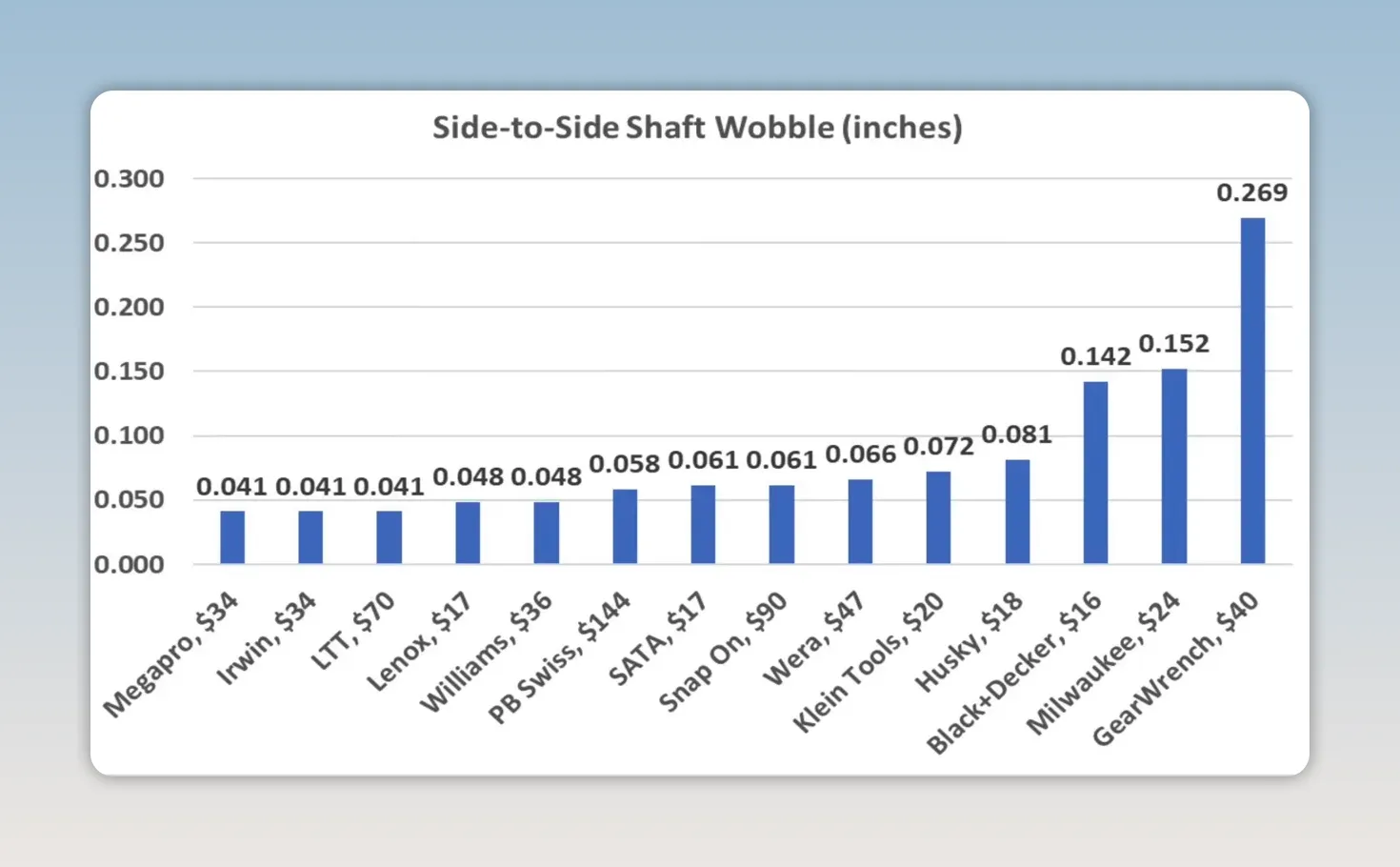
PB Swiss measured 0.058 inch. SATA and Snap-on each measured 0.061, followed by Wera at 0.066, Klein Tools at 0.072, and Husky at 0.081.
Black+Decker had considerably more movement at 0.142 inch, and Milwaukee measured 0.152. GearWrench struggled the most at 0.269 inch, more than a quarter inch of movement.
Locked-Position Play: PB Swiss Is Exceptionally Tight
Sideways wobble and rotational play are two different things. A shaft can be stable side to side but still rotate noticeably before the locked mechanism takes up the slack.
For this comparison, I measured movement at a point 4 inches from the shaft’s centerline with the selector in the locked position. These inch readings describe travel at that measuring point, not sideways shaft movement.
- PB Swiss: 0.170 inch, approximately 2 to 3 degrees of rotation.
- Milwaukee: 0.308 inch.
- Megapro: 0.420 inch.
- Husky: 0.495 inch.
PB Swiss was really dialed in on this test. SATA followed the top four at 0.519 inch, then Klein Tools at 0.547, Williams at 0.556, Snap-on at 0.599, and Lenox at 0.637.
Black+Decker measured 0.708 inch, approximately 11 degrees, and Irwin measured 0.718. LTT had 0.745 inch of movement. Its very low back drag did not come with the same locked-position tightness as Megapro.
Wera measured almost an inch of movement at 0.988. GearWrench finished at 1.017 inches, with its two-position handle contributing to the overall movement.
This is an important trade-off: LTT led the efficiency tests, but PB Swiss was much tighter when used as a locked screwdriver.
Magnetic Strength: Holding Screws and Holding Bits Are Different Jobs
How Strongly Does the Bit Hold a Screw?
A magnetic bit holder does not automatically provide a strong magnetic pull at the screw. To test the complete supplied setup, I used the bits that came with each screwdriver.
PB Swiss won by a large margin at 199.48 grams of magnetic pull. That was more than twice LTT’s already strong 89.9-gram result.
Wera measured 69.8 grams, Williams 68.89, Snap-on 54.9, and GearWrench 49.88. Those tools provided useful magnetic holding strength in this comparison.
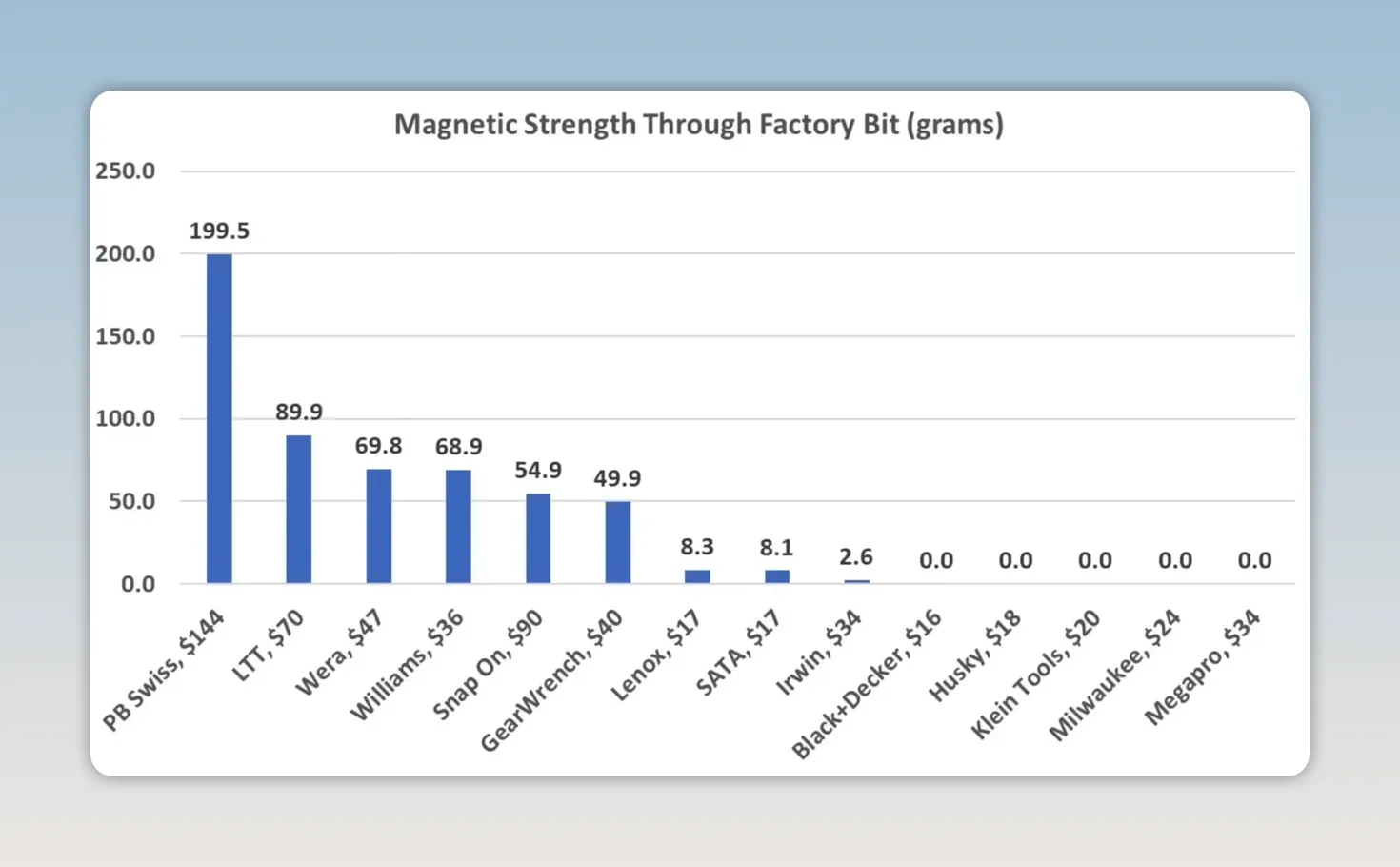
SATA and Lenox were much weaker at 8.1 and 8.3 grams. Irwin managed only 2.58 grams. Black+Decker, Husky, and Klein Tools could not lift the test screw, while the tested Milwaukee and Megapro setups were not magnetized.
LTT also included something the other sets did not: a dedicated magnet insert. Tested separately, it lifted the screw, the wood block, and the scale, a combined load of more than 300 grams. That is separate from the 89.9-gram result measured through its screwdriver bit.
How Strongly Does the Holder Retain the Bit?
For bit retention, I measured the pull needed to separate the bit from the screwdriver.
- PB Swiss: 2,199 grams, just over 4.8 pounds.
- Wera: 1,436 grams, almost 3.2 pounds.
- SATA: 1,227 grams.
- Irwin: 1,220 grams.
- Lenox: 1,216 grams.
- LTT: 1,201 grams, approximately 2.7 pounds.
Milwaukee and Klein Tools also held well at 1,181 and 1,155 grams. GearWrench released just short of 1,000 grams, while Black+Decker measured 989.
Husky, Williams, and Megapro were closely grouped at 899, 898, and 890 grams. Snap-on released earliest at 498 grams.
PB Swiss won both magnetic tests, but the rest of the results show why the categories should remain separate. SATA retained its bit quite firmly despite having very little magnetic pull at the screw.
Phillips Bit Strength: Which Supplied Bit Survives the Most Torque?
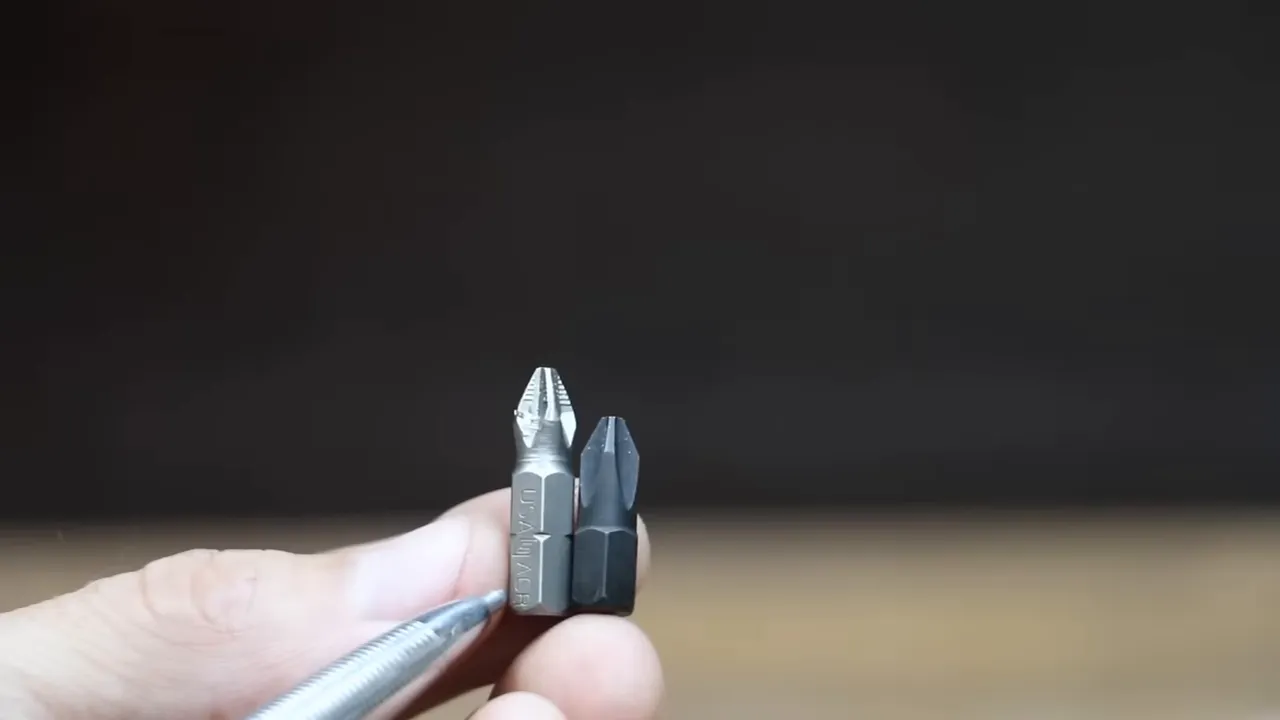
Next, I tested the supplied Phillips No. 2 bits to failure or cam-out. The fixture used a drill press with a wheel attached to its lever arms. A 20-pound load on the lever system provided approximately 140 pounds of downward force on the screwdriver handle.
That downward pressure helped keep the bit engaged while torque increased. Some bits snapped, while others twisted and eventually slipped out of engagement.
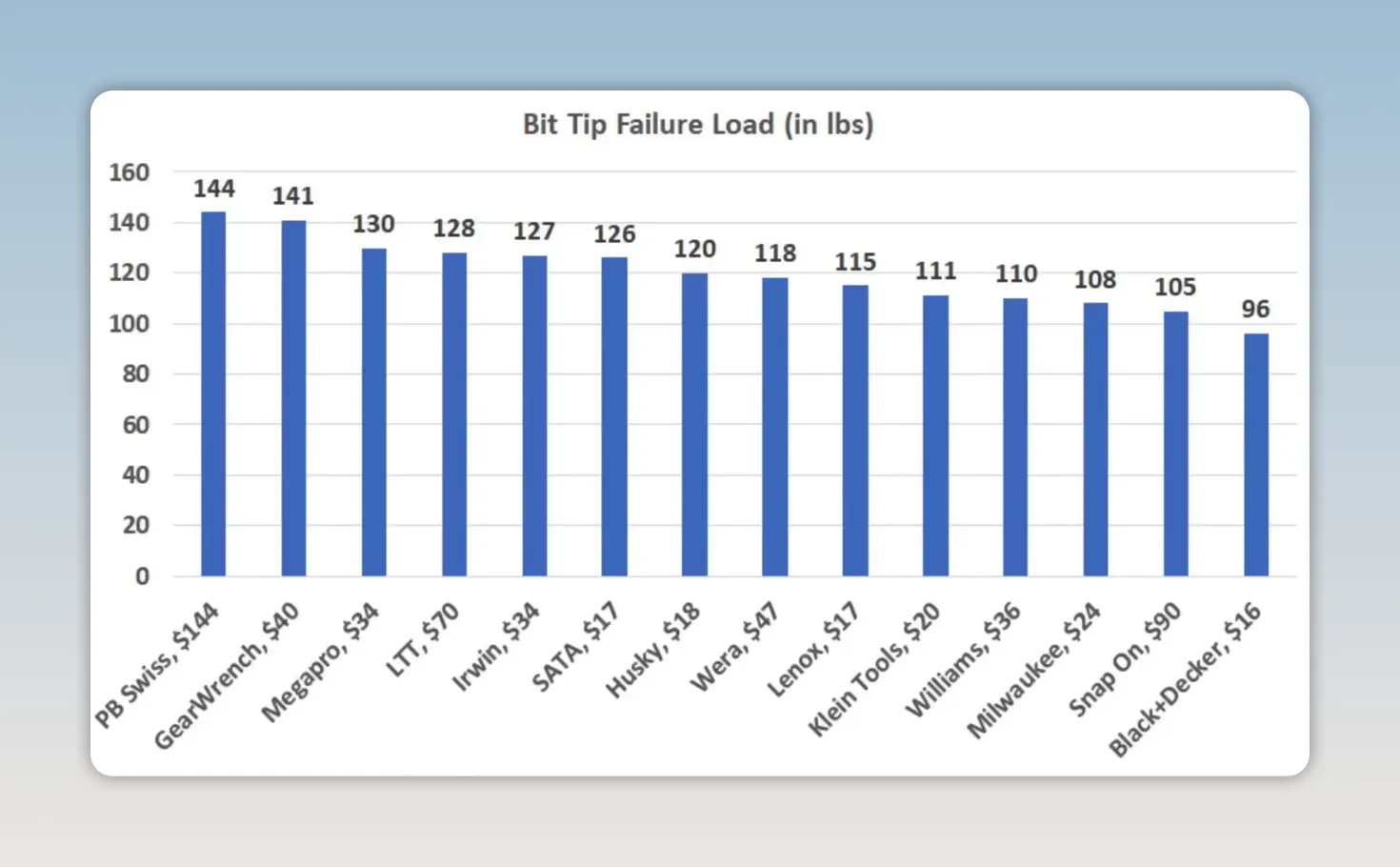
The results, from highest to lowest, were:
- PB Swiss: 144 inch-pounds, fractured.
- GearWrench: 141 inch-pounds, cammed out with substantial damage.
- Megapro: 130 inch-pounds, cammed out with badly twisted flutes.
- LTT: 128 inch-pounds, fractured without visible flute twisting.
- Irwin: 127 inch-pounds, fractured with little flute deformation.
- SATA: 126 inch-pounds, twisted considerably before breaking.
- Husky: 120 inch-pounds, fractured.
- Wera: 118 inch-pounds, cammed out rather than breaking.
- Lenox: 115 inch-pounds, snapped without visible twisting.
- Klein Tools: 111 inch-pounds, cammed out with badly twisted flutes but stayed in one piece.
- Williams: 110 inch-pounds, fractured without flute twisting.
- Milwaukee: 108 inch-pounds, lost its tip with some flute twisting.
- Snap-on: 105 inch-pounds, snapped.
- Black+Decker: 96 inch-pounds, sheared without flute twisting.
The magnified inspection revealed meaningful differences in failure behavior. Lenox and Irwin appeared quite brittle, while SATA deformed considerably before breaking. Wera’s more oval-shaped flutes did not grip as well as some competing profiles in this test.
Every screwdriver outlasted its supplied Phillips bit. Under these conditions, the bit was the limiting component, not the handle or ratchet.
Destruction Testing: Wera Takes the Highest Load
Since the bits failed first, the next step was deliberately overloading the screwdrivers themselves. This was abuse testing, not a recommended way to use these tools. It also provided an excuse to open the mechanisms and inspect the damage.
Failure did not always mean stripped ratchet teeth. Handles broke, shafts failed, and complete gearboxes spun loose inside their handles.
- Black+Decker: The ratchet first popped out of position at 213 inch-pounds.
- SATA: The handle broke at 477 inch-pounds while the ratchet resisted failure.
- Lenox: The ratcheting assembly broke free inside the handle at 552 inch-pounds.
- Husky: The mechanism began grinding internally at 361 inch-pounds.
- Klein Tools: The ratcheting assembly broke free inside the handle at 326 inch-pounds.
- Milwaukee: The handle failed before the gearbox, at a reported 319 inch-pounds.
- Megapro: The shaft failed at 252 inch-pounds while the gearbox held up.
- Irwin: Locking pliers destroyed the handle at 477 inch-pounds, but the ratchet still worked.
- Williams: Reached 404 inch-pounds despite its very low back drag.
- GearWrench: The ratcheting mechanism failed at 468 inch-pounds.
- Wera: Reached 602 inch-pounds, the highest load of the group.
- LTT: Reached 295 inch-pounds, exceeding its stated 221-inch-pound rating.
- Snap-on: Began grinding teeth at 335 inch-pounds; the shaft ultimately failed at 433.
- PB Swiss: The assembly began spinning inside the handle at 230 inch-pounds, while the ratchet itself remained intact.
Wera took quite a bit more effort to break than expected. It combined relatively low weight and low back drag with the highest overload strength. However, the broader finding is that all of these screwdrivers survived more torque than their supplied Phillips bits could withstand.
Inside the Ratchets: Is LTT Just a Megapro?
GearWrench’s teardown revealed minor gear damage and damage to several teeth on one of its two pawls. Wera used a similar-looking gear-and-pawl arrangement, and one pawl also showed substantial damage after overload.
Megapro took a different approach. Its single-pawl arrangement allows very low back drag. A plastic fitting inside the mechanism appeared to control direction selection and influence the amount of drag.
LTT looked similar internally, but the main gear had worn one pawl’s working edge flat during the destruction test. The opposite working edge remained undamaged.
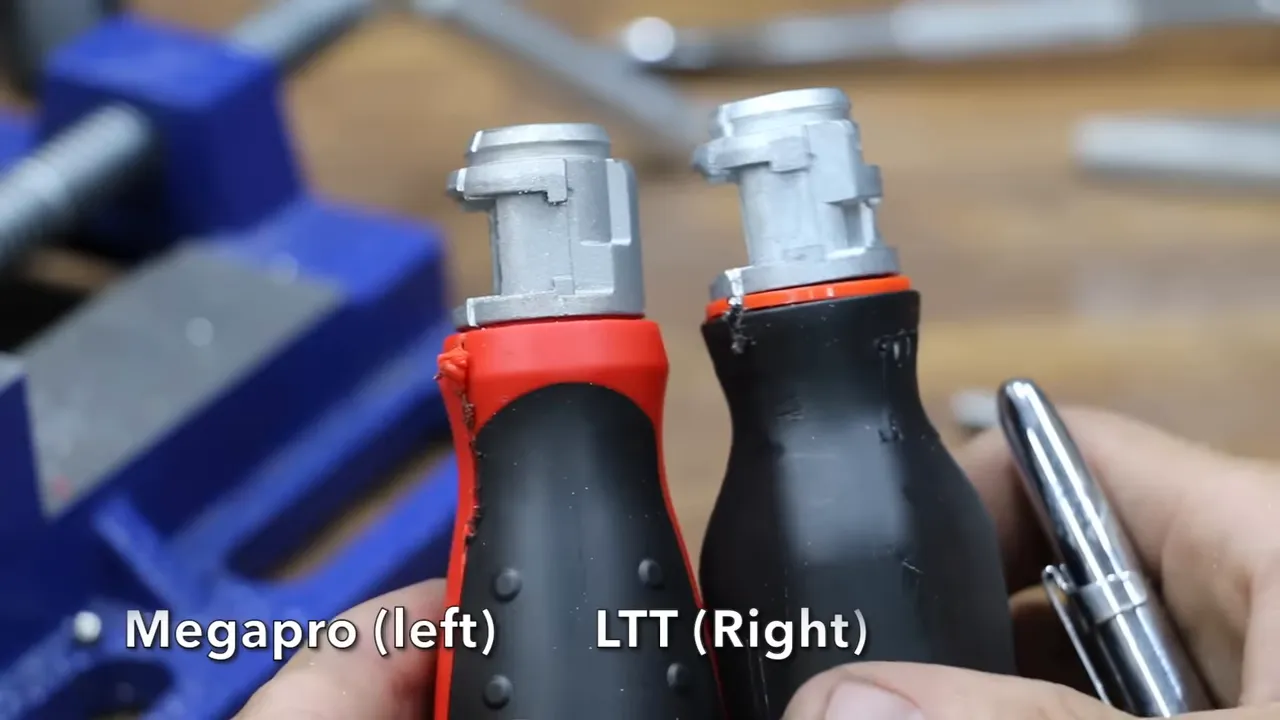
Comparing the two directly showed differences in the ratchet housings and plastic selector fittings. The LTT fitting had a shorter profile, which may help explain the measured performance difference.
The LTT and Megapro are definitely not the same screwdriver. They share a design foundation, but LTT’s modifications produced measurably lower back drag and slightly better working-arc efficiency.
Which Ratcheting Screwdriver Is Best?
For the overall comparison, I left out both the bit destruction test and the screwdriver destruction test. These are not tools intended for rugged abuse, and replaceable bit strength is a separate consideration from the screwdriver’s everyday performance.
Across the remaining categories, the leading average rankings were:
- PB Swiss: 3.3.
- LTT: 3.8.
- Megapro: 5.3.
- Williams: 5.5.
A lower average ranking is better. PB Swiss earned the top overall result, but that does not automatically make it the best purchase for every job.
Choose LTT for Low-Resistance Ratcheting
LTT finished first in working-arc efficiency and back drag, tied for the least shaft wobble, and provided strong magnetic performance. At about 7.4 ounces with its supplied bits, it was also among the lightest complete setups.
Its main measured compromise was rotational play in the locked position. It also costs approximately twice as much as the tested Megapro.
Consider Megapro or Williams for Strong Performance at a Lower Price
At $34, Megapro came very close to LTT in working-arc efficiency, matched its shaft stability, and had less locked-position play. The major limitation of the tested version was its lack of magnetic screw holding.
The $36 Williams delivered exceptionally low back drag, very little shaft wobble, and useful magnetic strength. Loose bit storage caused rattling, and working-arc efficiency was not quite at the leaders’ level.
Choose PB Swiss for Magnetic Grip and a Tight Locked Position
PB Swiss dominated screw holding, bit retention, and locked-position tightness. It also completed the working-arc test in fewer than 10 passes and supplied the strongest Phillips bit tested.
The trade-offs are the $144 price, no onboard bit storage, and noticeably more back drag than LTT, Williams, or Megapro.
Keep the Other Strengths in Perspective
Wera provided excellent bit retention and the highest overload strength, but its working-arc efficiency and locked-position play were disappointing. Milwaukee performed well for working arc and locked-position tightness at just $24, but had substantial sideways shaft movement. Husky offered a lightweight, low-cost package with reasonably low back drag, although magnetic screw holding was weak.
The most useful ranking is the one that matches your work. If bit retention is not important to you, removing that category changes the outcome and puts LTT ahead. If you regularly work with lightly loaded fasteners, back drag deserves more weight. If you mostly use the locked setting, rotational play may matter much more.
PB Swiss won the broad average. LTT won the efficiency tests. Megapro and Williams delivered strong results for considerably less money. Pick the capabilities you need rather than paying for a first-place finish in a category you rarely use.


