Rusted nuts and bolts can take a tremendous amount of force to break loose. Heat can make the job a whole lot easier, but an open flame is not always an option. Can a portable induction heater deliver enough heat to replace the torch?
I purchased 10 induction heaters, priced from $130 to $400, to find out. The testing covered small-bolt heating speed, performance on heavier steel, heating-coil quality, and an endurance torture test. Before comparing the tools, I also tested whether heating rusty fasteners actually reduces breakaway torque compared with penetrating oil or using nothing at all.
The Bolt Buster delivered the best overall performance, while the Mxmoonfree offered the best value. However, some of the inexpensive tools performed surprisingly well, and the heating coil made a much bigger difference than the advertised wattage might suggest.
Quick Summary
- Bolt Buster delivered the best overall performance and would be my choice if the budget allows.
- Mxmoonfree offered the best value, combining strong heating performance with an excellent coil kit.
- Heat reduced average rusty-fastener breakaway torque far more than a 30-minute Kroil treatment.
- Coil fit and quality strongly affected heating speed, making advertised wattage alone a poor buying guide.
Table of Contents
- Does Heat Really Help Loosen Rusty Nuts and Bolts?
- The 10 Induction Heaters: Prices and Equipment
- Small-Bolt Test: Which Heater Reaches 1,000°F Fastest?
- Heavy-Bolt Test: Melting an Embedded Aluminum Rod
- Same-Coil Test: Separating Heater Performance From Coil Quality
- Endurance Torture Test: Power Draw and Thermal Shutdown
- Which Induction Heater Would I Buy?
Does Heat Really Help Loosen Rusty Nuts and Bolts?
To make a meaningful comparison, I started with nuts and bolts tightened to 100 foot-pounds. Then I applied an aggressive rusting agent every day for three months. These fasteners were very rusty!
A torque-wrench calibration tool measured the force required to break them loose. Without heat or penetrating oil, the first two fasteners required approximately 290 and 289.1 foot-pounds. That established a very consistent baseline.
Heating and loosening immediately
I heated each nut until it glowed red, approximately 1,300°F. The rust began popping and breaking apart as the nut heated.
- First attempt: 47.1 foot-pounds.
- Second attempt: 47.82 foot-pounds.
- Third attempt, with a little more heating: 36.8 foot-pounds.
The average was only 43.9 foot-pounds, compared with approximately 290 without treatment. Very impressive! I did not expect heat to make that much difference.
Heating, then letting the fasteners cool
Next, I heated three more nuts generously and allowed the assemblies to cool completely before loosening them. An air duster helped cool the first assembly.
- First attempt: 73.74 foot-pounds.
- Second attempt: 41.7 foot-pounds.
- Third attempt: 44.24 foot-pounds.
The average was 53.2 foot-pounds. Loosening the nuts while hot worked best on average, but heating and cooling still performed a whole lot better than doing nothing. The benefit clearly did not disappear once the fasteners returned to room temperature.
Kroil penetrating oil with a 30-minute soak
I applied Kroil to three separate rusty assemblies and gave it 30 minutes to work. Their breakaway torque measurements were 241.6, 285, and 265.9 foot-pounds, averaging 264.2 foot-pounds.
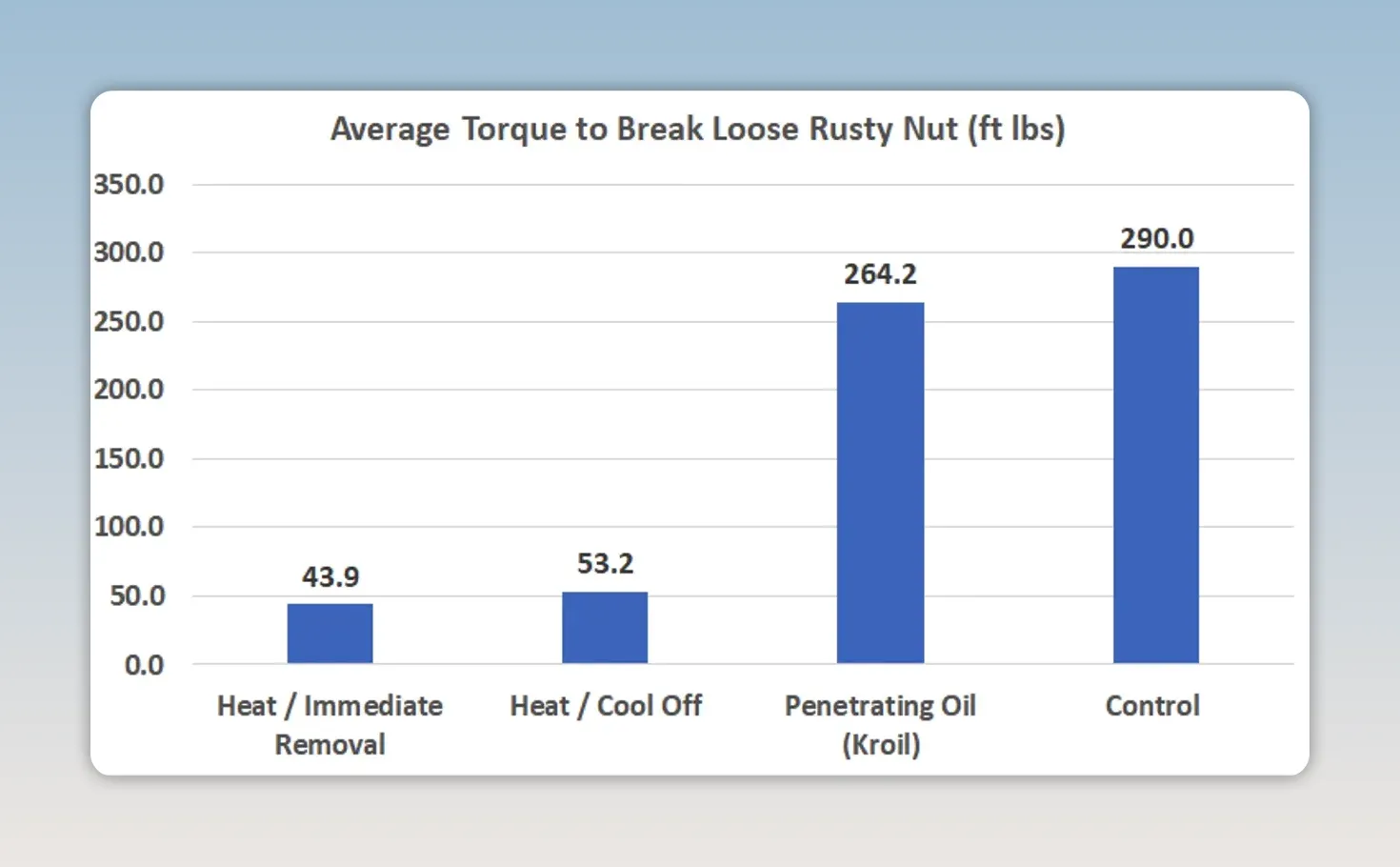
Penetrating oil helped somewhat, but it was not close to heat under these conditions. This was only a 30-minute soak, not a 24-hour treatment, so the results should not be stretched into a conclusion about every possible penetrating-oil application.
The 10 Induction Heaters: Prices and Equipment
These portable tools use a coil around a ferrous-metal target to produce heat without an open flame. For background on the underlying process, induction heating uses an alternating electromagnetic field to heat electrically conductive material. The tools in this comparison are intended for ferrous-metal applications.
Prices below are what I paid for the tested units. Advertised power ratings are manufacturer claims, not the measured power draw during every test.
- EMAGIH, $130: Rated at 1,300 watts, with three heating coils and claimed overheat protection. Its cord measured about 4 feet 6 inches, and it weighed 1,176 grams, or 2.59 pounds.
- KKSEVENS, $135: Rated at 1,300 watts and supplied with five coils. Its cord measured 4 feet 8 inches, and it weighed 1,330 grams, or 2.93 pounds.
- Pawcute, $138: Rated at 1,200 watts, with six coils, an ergonomic grip, and LED illumination. It claims to heat rusty bolts in 30 seconds. Its cord measured about 4 feet 8 inches, and it weighed 1,330 grams, or 2.93 pounds.
- Harsire, $154: Rated at 1,500 watts, with eight coils, claimed smart overheat protection, and a cooling system. It advertises 25-second bolt heating. Its cord measured about 5 feet 6 inches, and it weighed 1,262 grams, or 2.79 pounds.
- Solary, $170: Rated at 1,200 watts, with eight coils and LED illumination. It advertises 15-second heating. Its cord measured 6 feet 3 inches, and it weighed 1,202 grams, or 2.65 pounds.
- KAZMIO, $178: Advertised at 1,500 watts, with a 10-piece coil set and a claimed 25-second heating time. Its cord measured just under 4 feet 9 inches, and it weighed 1,312 grams, or 2.89 pounds.
- VEVOR, $189: Rated at 1,100 watts, with eight coils and LED illumination. It claims to heat metal in 30 seconds. Its cord measured just under 6 feet 4 inches, and it weighed 1,198 grams, or 2.64 pounds.
- Mxmoonfree, $189: Rated at 1,500 watts, with eight coils and a claimed 25-second time to turn bolts cherry red. It also claims upgraded cooling for longer continuous operation. Its cord measured about 4 feet 9 inches, and it weighed 1,248 grams, or 2.76 pounds.
- Autoinnowin, $210: Rated at 1,200 watts, with eight coils, a cooling fan, and claimed overheating protection. It advertises 30-second heating. Its cord measured about 6 feet 4 inches, and it weighed 1,218 grams, or 2.69 pounds.
- Bolt Buster, $400: Rated at 1,800 watts, with claimed 95% efficiency and a robust coil kit. It advertises cherry-red fasteners in 15 to 20 seconds. Its cord measured just under 5 feet 9 inches, and it weighed 1,178 grams, or 2.6 pounds.
The Bolt Buster is made in the USA. All nine other tested brands are made in China.
Proper coil installation matters. KKSEVENS specifically warns to tighten the coil connections and never energize the tool without a heating target inside the coil, since running without a load may shorten its lifespan.
Small-Bolt Test: Which Heater Reaches 1,000°F Fastest?
For the first speed test, I heated the end of a 10 mm bolt to 1,000°F while a temperature probe tracked its progress. Each induction heater used its smallest supplied coil to help it heat as quickly as possible.
First, two familiar alternatives established a baseline:
- Craftsman heat gun: Only about 580°F after two minutes, so I stopped the test.
- MAP-gas torch: Reached 1,000°F in 43 seconds.
Every induction heater beat the torch in this setup. Here are the results, from fastest to slowest, with approximate peak electrical input during the test:
- Mxmoonfree: 15 seconds, 872 watts.
- Bolt Buster: 15 seconds, nearly 1,000 watts.
- KKSEVENS: 18 seconds, 789 watts.
- Pawcute: 19 seconds, 752 watts.
- KAZMIO: 21 seconds, 731 watts.
- Harsire: 28 seconds, 562 watts.
- Solary: 28 seconds, 553 watts.
- Autoinnowin: 29 seconds, 536 watts.
- VEVOR: 31 seconds, 510 watts.
- EMAGIH: 32 seconds, 474 watts.
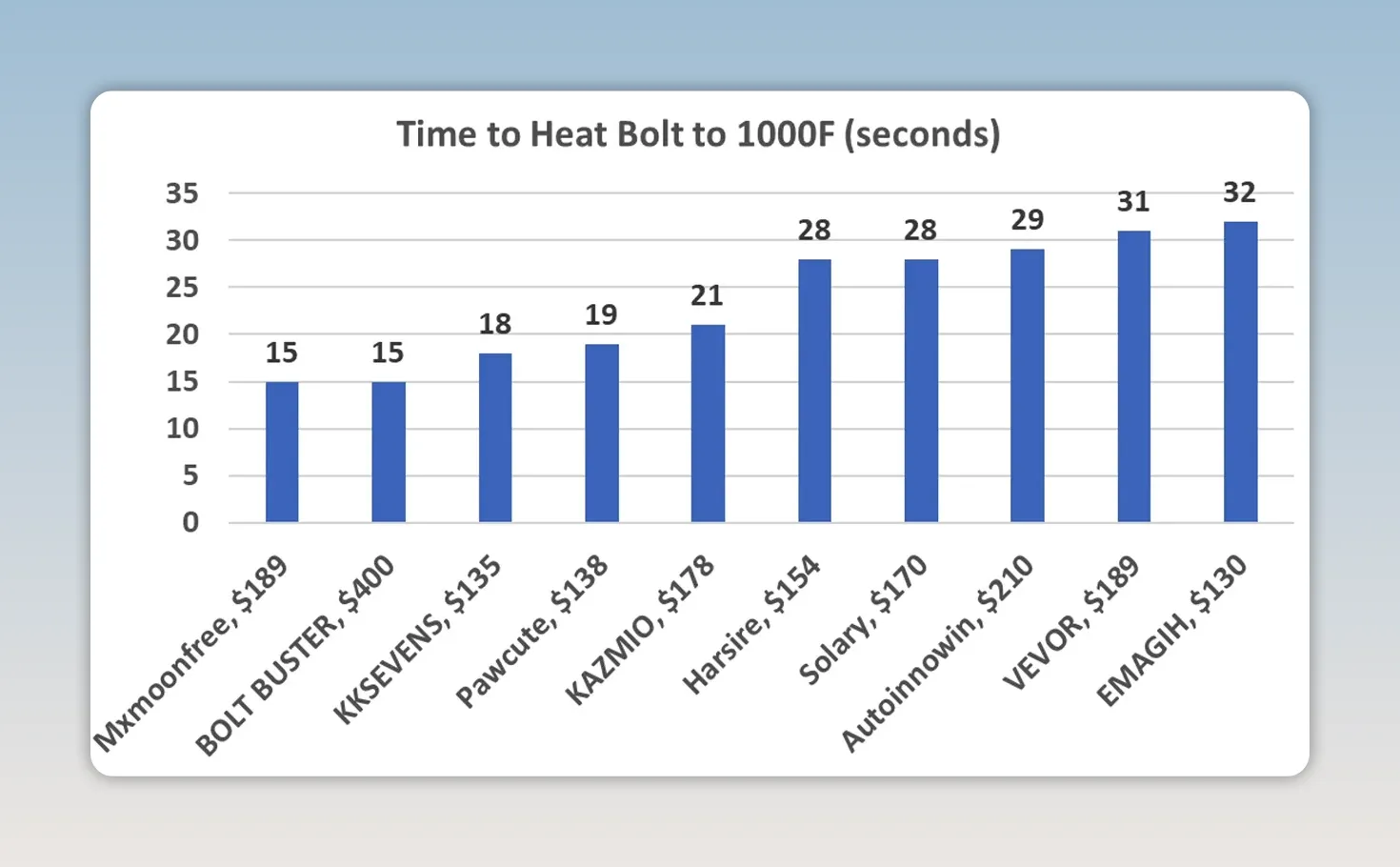
The KKSEVENS was especially impressive for the price. Its smallest coil was also smaller than the EMAGIH coil, an important difference when heating a small target.
A larger advertised wattage did not automatically mean a faster result. Harsire’s 1,500-watt rating did not keep it ahead of the lower-rated KKSEVENS or Pawcute. Coil fit and the tool’s behavior under the actual load mattered.
Heavy-Bolt Test: Melting an Embedded Aluminum Rod
A small bolt heats quickly, but a larger fastener demands much more energy. For this test, I drilled a hole into a 3/4-inch steel bolt and inserted a piece of low-temperature aluminum welding rod. The rod’s stated melting range was approximately 900°F to 1,000°F.
The task was to heat the steel until it melted the embedded rod. This tested more than the temperature at one small spot: the larger bolt had to absorb enough heat to melt the material inside it. The bolt was cooled to around 80°F between tests.
- Bolt Buster: 55 seconds, approximately 1,255 peak watts.
- Mxmoonfree: 65 seconds, approximately 950 peak watts.
- VEVOR: 71 seconds, approximately 833 peak watts.
- KAZMIO: 72 seconds, approximately 873 peak watts.
- Autoinnowin: 72 seconds, approximately 850 peak watts.
- EMAGIH: 76 seconds, approximately 755 peak watts.
- Pawcute: 76 seconds, approximately 821 peak watts.
- Harsire: 77 seconds, approximately 825 peak watts.
- KKSEVENS: 80 seconds, approximately 827 peak watts.
- Solary: 176 seconds, approximately 515 peak watts.
The Bolt Buster moved into a clear lead, with the Mxmoonfree finishing 10 seconds behind it. VEVOR also performed very well, taking third despite having the lowest advertised wattage.
Solary ran into a coil-size problem. Its smaller coil would not fit over the bolt, so I used the next size up. That larger coil hurt its performance considerably, and the test took almost three minutes. This is a good example of why the included coil sizes deserve just as much attention as the tool itself.
Same-Coil Test: Separating Heater Performance From Coil Quality
The quantity and quality of the supplied coils varied quite a bit. Replacement sets cost roughly $40 to $75, so a poor coil kit can affect both performance and ownership cost.
To reduce that variable, I used the exact same Mxmoonfree coil on every heater and measured the time to bring a 5/8-inch bolt to approximately 1,300°F.
- Bolt Buster: 58 seconds.
- EMAGIH: 70 seconds.
- Mxmoonfree: 70 seconds.
- KKSEVENS: 75 seconds.
- KAZMIO: 75 seconds.
- Autoinnowin: 76 seconds.
- Pawcute: 77 seconds.
- VEVOR: 78 seconds.
- Harsire: 90 seconds.
- Solary: 90 seconds.
The Bolt Buster was once again the fastest. However, the least expensive heater, EMAGIH, tied the Mxmoonfree for second place. That is a very strong result for a $130 tool, and it shows how much the supplied coil can limit performance.
Several tools started strongly but drew less power as the bolt became hotter. Steel’s magnetic and electrical properties change with temperature, which affects the induction-heating load. The measured wattage was not a fixed output throughout the test.
Which brands supplied the best coils?
I measured the wire diameter in the heating coils:
- Bolt Buster: Approximately 3.2 mm.
- Mxmoonfree: Approximately 3.0 mm.
- Other tested brands: Approximately 2.4 mm.
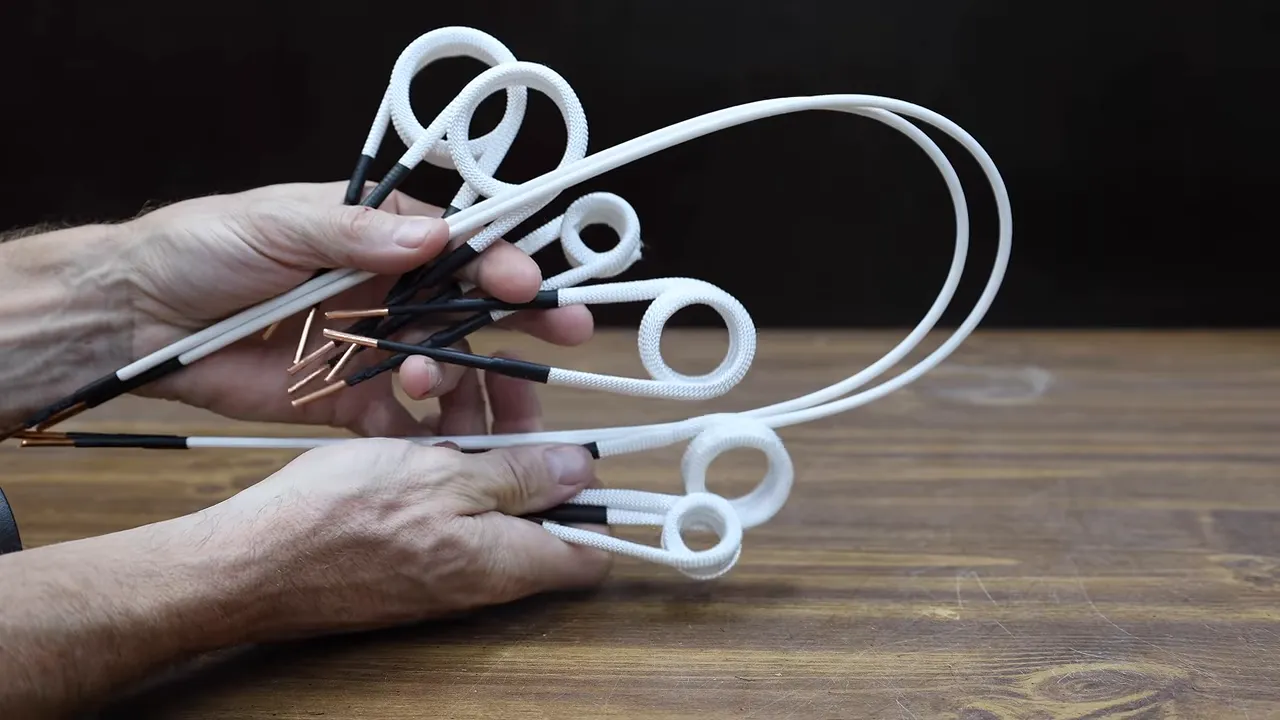
My assessment of coil quality and variety was subjective, using a scale of 1 for excellent to 5 for poor. Bolt Buster and Mxmoonfree both earned a 1, with KAZMIO next at 2.5. Harsire, Autoinnowin, VEVOR, and Solary scored 3; EMAGIH scored 3.5; Pawcute scored 4; and KKSEVENS scored 5.
Bolt Buster and Mxmoonfree had by far the best coil kits. KAZMIO’s 10-piece set was also fairly decent. A large number of coils is useful, but it does not tell the whole story about their construction or fit.
Endurance Torture Test: Power Draw and Thermal Shutdown
For the final test, I used a solid steel shaft approximately 35 mm, or 1.37 inches, in diameter. This provided a much heavier load than the bolts and allowed the heaters to draw substantially more power.
Every tool used the same coil, and the shaft cooled to approximately 80°F before each test. I recorded peak electrical input and whether the tool shut itself down. If it kept operating, I ended the test at approximately 15 minutes.
This was deliberate operation beyond normal duty cycles, not a recommended way to use these tools. None of the tested heaters was intended for 15 minutes of continuous operation. Follow the operating and cooling intervals specified for the particular unit rather than relying on an automatic shutdown.
Heaters that shut themselves down
- EMAGIH: Shut down after 2 minutes 30 seconds; approximately 1,495 peak watts.
- Pawcute: Shut down after 3 minutes 42 seconds; approximately 1,202 peak watts.
- KKSEVENS: Shut down after 5 minutes 36 seconds; approximately 1,261 peak watts.
- Harsire: Shut down after 6 minutes 21 seconds; approximately 1,304 peak watts.
- Autoinnowin: Shut down after 7 minutes 14 seconds; approximately 1,360 peak watts.
Heaters still operating when I stopped at 15 minutes
- Solary: Approximately 1,389 peak watts.
- KAZMIO: Approximately 1,264 peak watts.
- VEVOR: Approximately 1,380 peak watts.
- Mxmoonfree: Approximately 1,523 peak watts.
- Bolt Buster: Approximately 1,817 peak watts.
Only half of the units shut themselves down during the test. Solary did not shut down despite running well beyond its duty cycle, so thermal protection was not demonstrated under these conditions. Likewise, continuing to run for 15 minutes does not establish that a tool is safe or approved for that operating interval.
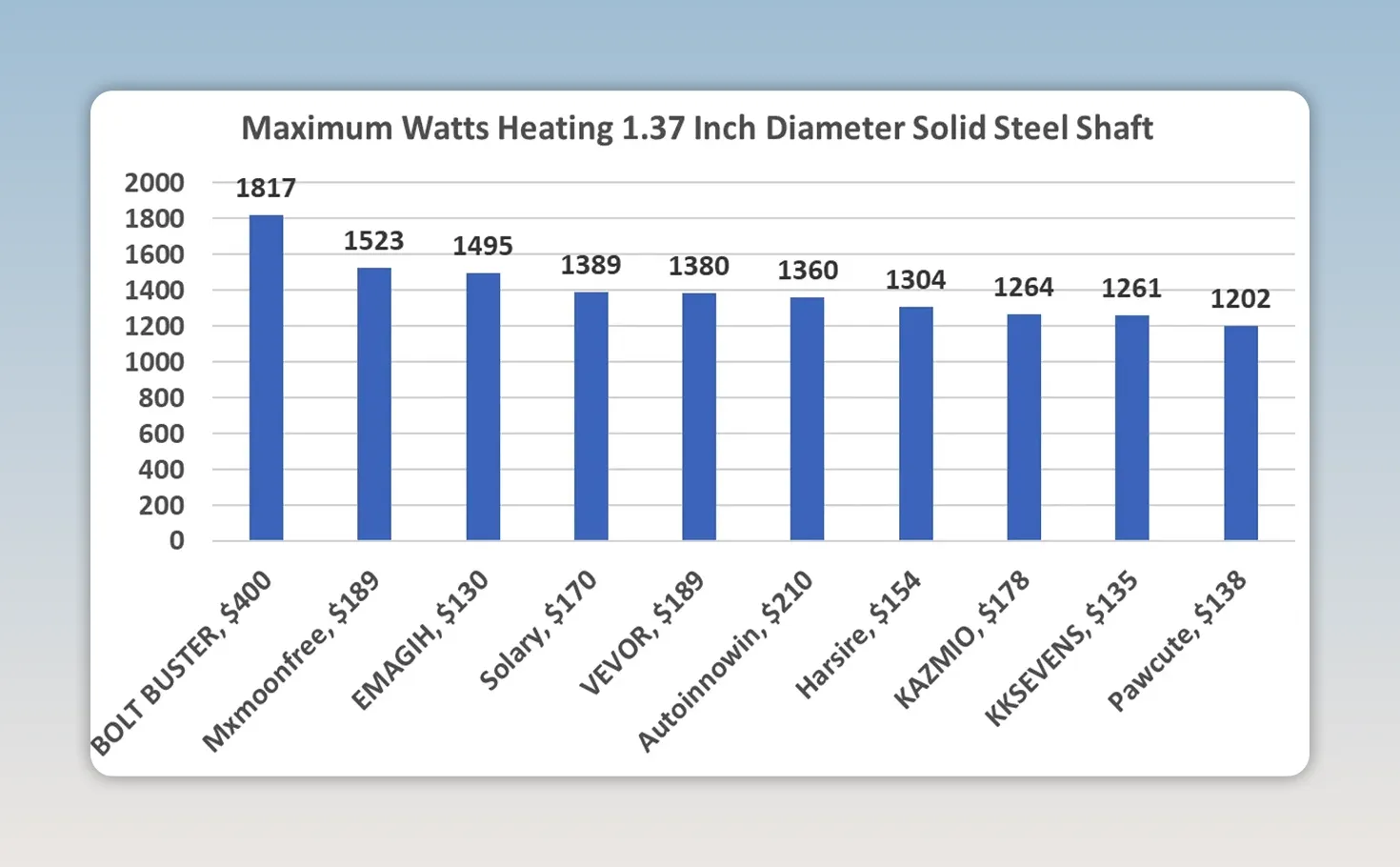
For raw power, the Bolt Buster was well ahead at 1,817 watts. Mxmoonfree finished second at 1,523 watts, and EMAGIH placed third at 1,495 watts. Several lower-rated tools exceeded their advertised wattage on this larger target.
These measurements are electrical input readings, not direct measurements of heat transferred into the steel. They also explain why the lower power readings on a small bolt did not necessarily indicate that a heater could never approach its rating.
Which Induction Heater Would I Buy?
For the overall comparison, I converted the performance results into first-through-last rankings. Basic specifications such as purchase price, weight, and cord length were not included in the performance score.
Best overall: Bolt Buster
The Bolt Buster finished first or tied for first across the scored categories. It matched the fastest small-bolt time, won the heavy-bolt test, won the same-coil test, and delivered the highest peak power. Its coil kit was also among the best.
At approximately $400, it is a substantial purchase. However, it is a high-quality, USA-made tool, and the performance helps explain the price. If the budget allows, the Bolt Buster would be my choice.
Best value: Mxmoonfree
The Mxmoonfree finished second overall with an average placement of 1.6. It tied the Bolt Buster in several categories and never finished worse than second in the scored categories.
At $189, it cost less than half as much as the Bolt Buster. It also included one of the two best coil kits. If value is the priority, I would definitely choose the Mxmoonfree.
Third place: KAZMIO
The KAZMIO finished third overall with an average placement of 4.8. Its 10-piece heating-coil set was fairly decent, and its heating performance was competitive.
However, with only an $11 difference between the tested prices, I would much rather have the Mxmoonfree. I would consider the KAZMIO if the Mxmoonfree were unavailable.
What about the cheapest options?
KKSEVENS was very quick on the small bolt, taking just 18 seconds. EMAGIH was especially impressive with the common coil, tying for second at 70 seconds. Both results show that an inexpensive heater can produce useful performance.
The trade-off is the supplied equipment. Their coil kits did not match the best brands, and replacement coils can narrow the initial price advantage.
For heavily rusted fasteners, these induction heaters worked a whole lot better than I expected. Heat reduced breakaway torque dramatically, and every induction heater beat the MAP-gas torch in the small-bolt test. The biggest buying lesson is simple: judge the heater and its coil kit together, not just the wattage printed on the housing.


