Why spend $400 to $600 on a Honda engine when a lookalike costs around $150? The red and white paint looks familiar, and the advertised horsepower might even be higher. But paint and stickers don’t pull a trailer or keep an engine from burning oil.
I bought a genuine Honda GX200, an inexpensive Honda clone, a Harbor Freight Predator 212, and a Briggs & Stratton engine to find out how they compare. Each engine went through 48 hours of running, followed by pulling and acceleration tests. I also compared starting effort, noise, vibration, oil consumption, and used oil analysis.
The Honda looked like the best engine overall, but the Predator made a very strong case for keeping the extra money in your pocket. The inexpensive Honda lookalike? That one had some problems.
Key Takeaways
- The Honda delivered the strongest stationary pull, lowest noise, and excellent oil control.
- The Predator offered the best value, winning both timed tests and consuming the least gasoline.
- The generic Honda clone suffered excessive vibration and needed repeated oil additions during testing.
- All four engines started on the first pull after an overnight stay just below freezing.
The Four Engines: What Does the Extra Money Buy?
Honda Clone: Around $150
The inexpensive clone certainly borrows the Honda appearance. Its description claims quality materials, metal cams, and a forged camshaft. It also has a throttle control, choke, and fuel shutoff.
However, the horsepower claims don’t agree with each other. The advertising and recoil starter indicate 6.5 horsepower, while a label on the side calls it a 7.5-horsepower engine. That’s quite a range before the engine has even started.
There were other concerns right out of the box. The fuel tank had a dent, and although the air cleaner labeling referenced a paper filter, mine came with only a basic foam element. That foam didn’t look very promising for keeping dirt out of the engine.
- Manufactured in: China
- Spark plug: SAP
- Weight before fuel and oil: 27.6 pounds
Honda GX200: $400 to $600
The genuine Honda is rated at 5.5 horsepower, less than either of the clone’s claims. Honda describes it as a commercial-grade engine with precision-engineered components for low vibration, easy starting, and quiet operation. It also has a cast iron cylinder sleeve for longer service life.
Unfortunately, this engine arrived with some damage, too. Its air filtration system was much more encouraging, with a paper element and a foam cover.
- Manufactured in: Thailand
- Spark plug: NGK
- Weight before fuel and oil: 34.9 pounds
Harbor Freight Predator 212: Around $150
The Predator is a 212 cc overhead-valve engine rated at 6.5 horsepower. It costs about the same as the generic Honda clone, but includes a paper air filter with a foam cover and a cast iron cylinder sleeve.
- Manufactured in: China
- Spark plug: Torch
- Weight before fuel and oil: 34.9 pounds, essentially matching the Honda
Briggs & Stratton: $312
The 208 cc Briggs & Stratton is rated at approximately 6.5 horsepower. Its Dura-Bore cast iron cylinder sleeve is intended to extend engine life, and its air cleaner also uses a paper element with a foam cover.
- Manufactured in: China
- Spark plug: Champion
- Weight before fuel and oil: About 32.5 pounds
Starting Effort: Briggs Takes the Least Muscle
I used Super Tech 10W-30 full synthetic motor oil in all four engines. Their oil capacity is just over half a quart, approximately 0.6 liters.
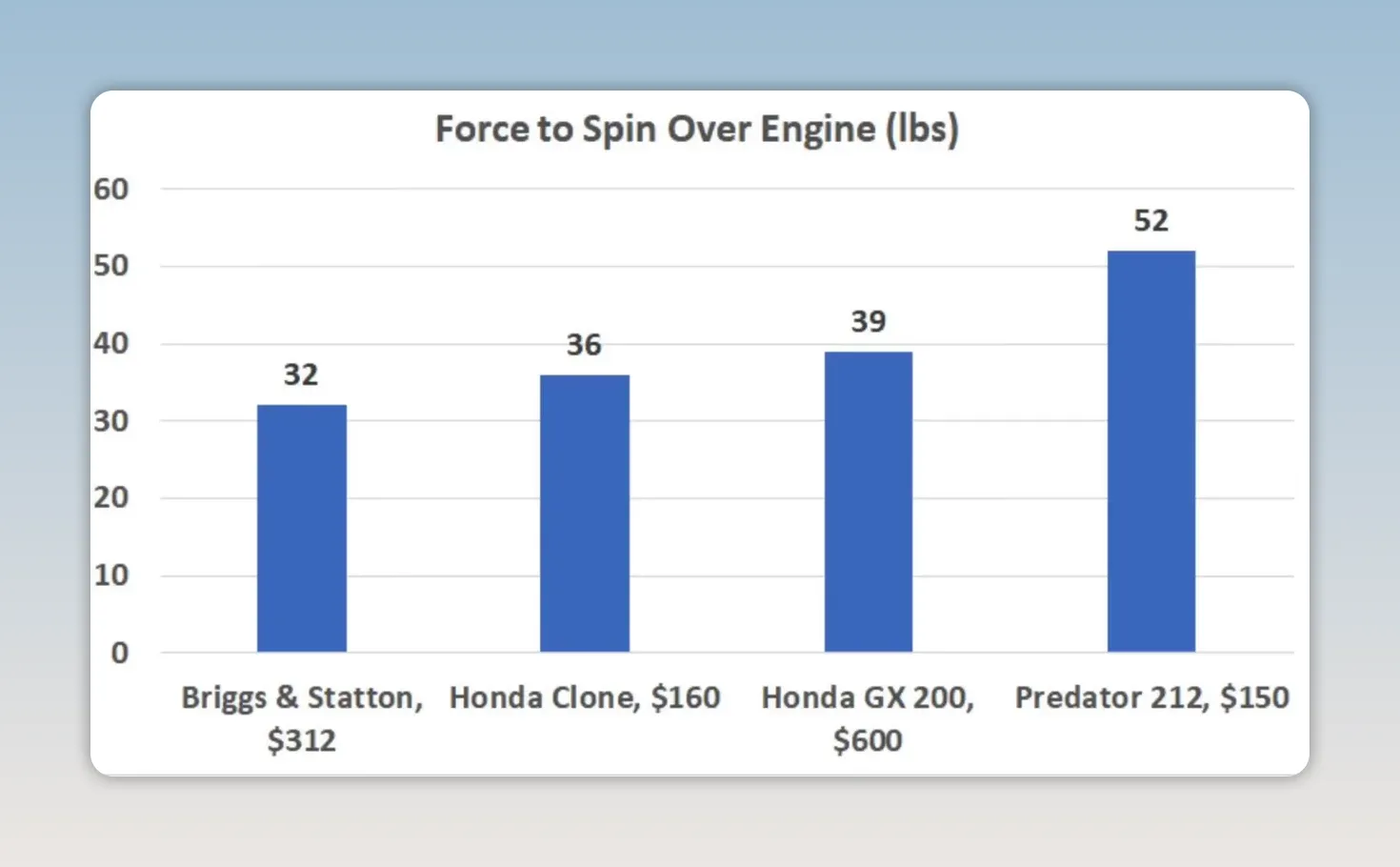
All four engines have an automatic compression release to make pull-starting easier. That also means a conventional compression test wouldn’t provide a useful comparison here. Instead, I measured the peak force needed to turn each engine over with its recoil starter.
- Briggs & Stratton: 32 pounds of peak pulling force
- Honda clone: 36 pounds
- Honda GX200: 39 pounds
- Predator 212: 52 pounds
The Briggs required the least effort. The Predator took considerably more force than the others, something worth considering if an easy recoil pull is important for your application.
During the initial running test, the clone started on the second attempt. The Honda, Predator, and Briggs all started on the first pull. The Predator and Briggs also restarted on the first pull for their second 24-hour period.
How the 48-Hour Engine Test Worked
Each engine was mounted to a stand and connected by belt to an alternator. The alternator charged a battery, and the battery supplied an inverter powering a 500-watt halogen light. The engines ran with that load for approximately four hours. Afterward, I removed the belts and continued running without a load.
To supply enough fuel for the extended test, I replaced the factory tanks with external fuel cells holding roughly six to seven gallons. Each engine received 87-octane gasoline containing 10 percent ethanol, and I set the no-load engine speed to 3,600 rpm.
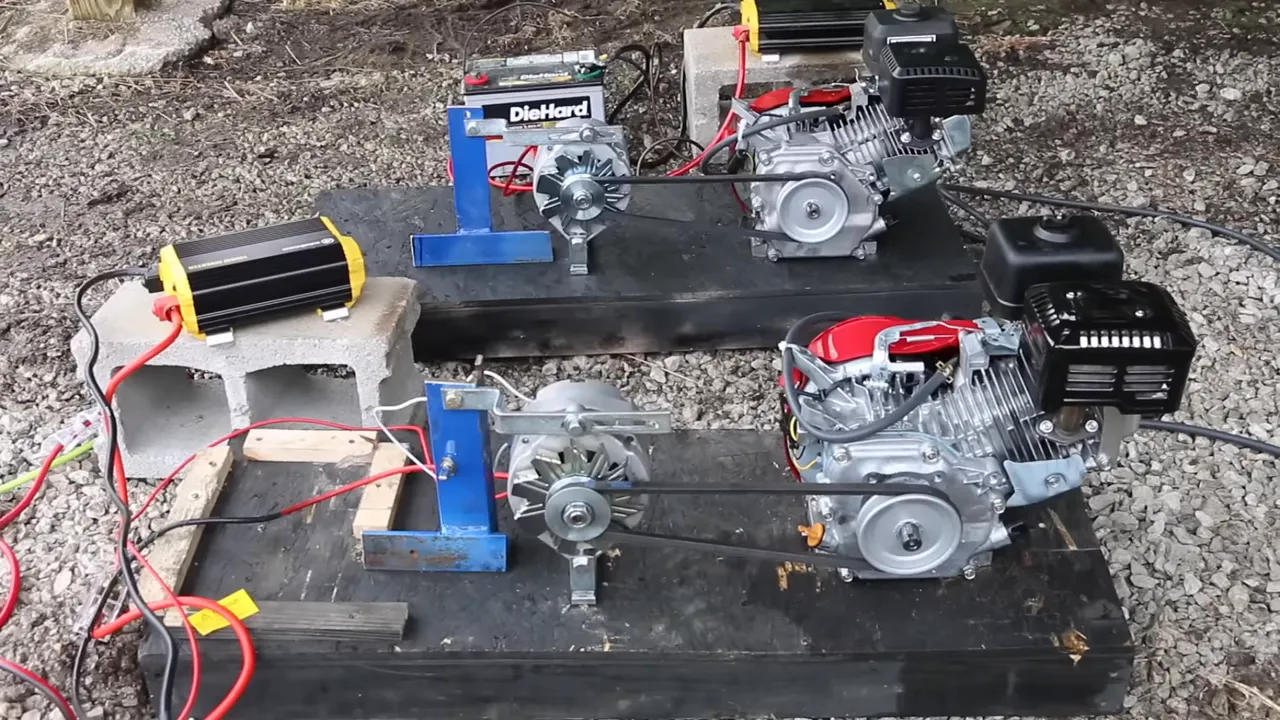
I weighed the fuel cells before and after each running period to measure gasoline consumption. After the first 24 hours, I drained and replaced the oil. At the end of the second period, I collected labeled samples for laboratory analysis.
This was primarily a light-load and no-load endurance comparison, not 48 hours at maximum output. That distinction matters when interpreting both fuel consumption and durability.
Noise, Vibration, and Heat: The Clone Stands Out for the Wrong Reasons
The Honda Was the Quietest
With the sound meter approximately three feet from the engine, the results were:
- Honda GX200: 91.7 dB
- Honda clone: 94.1 dB
- Briggs & Stratton: 94.4 dB
- Predator 212: 94.8 dB
The Honda made less noise than all three competitors. The other engines were fairly close to one another.
The Clone’s Vibration Exceeded the Meter’s Range
The Honda measured around 300 mm/s² on the vibration tester. The Briggs was very close to the Honda, while the Predator vibrated slightly less than either one.
The generic clone was a completely different story. It vibrated so much that the instrument couldn’t measure it. Even allowing for the normal vibration of a single-cylinder engine, this one felt badly out of balance. That raised a serious concern about how well it would hold together over time.
Exhaust and Temperature Checks
A combustible-gas detector reacted much more strongly to the clone’s exhaust than the Honda’s. The Predator also produced a stronger response than the Honda, while the Briggs appeared to burn a little cleaner than the Predator. These were comparative detector checks, not a full emissions analysis.
Under the moderate test load, the Honda’s muffler was around 430°F and its cylinder head around 150°F. The clone’s muffler was approximately 130°F hotter, and its cylinder head was hotter as well.
The Briggs and Predator both had cylinder head readings around 150°F. Of those two, the Briggs had the cooler muffler hot spot.
Fuel Consumption: Predator Wins by a Small Margin
The Honda used 29 pounds of gasoline during its first 24 hours and 28 pounds during the second. The clone used 30 pounds in each period. Across the full test, the Honda consumed about five percent less fuel than the clone.
The Predator matched the Honda’s first-day consumption at 29 pounds, then used just 27 pounds during the second period. The Briggs used 31 pounds during the first period and 28 pounds during the second.
There is an important complication with the Briggs: it stalled three times during the four-hour loaded portion. That interrupted operation needs to be considered when comparing its fuel use with the other engines.
Total gasoline consumption over 48 hours was:
- Predator 212: 56 pounds
- Honda GX200: 57 pounds
- Briggs & Stratton: 59 pounds
- Honda clone: 60 pounds
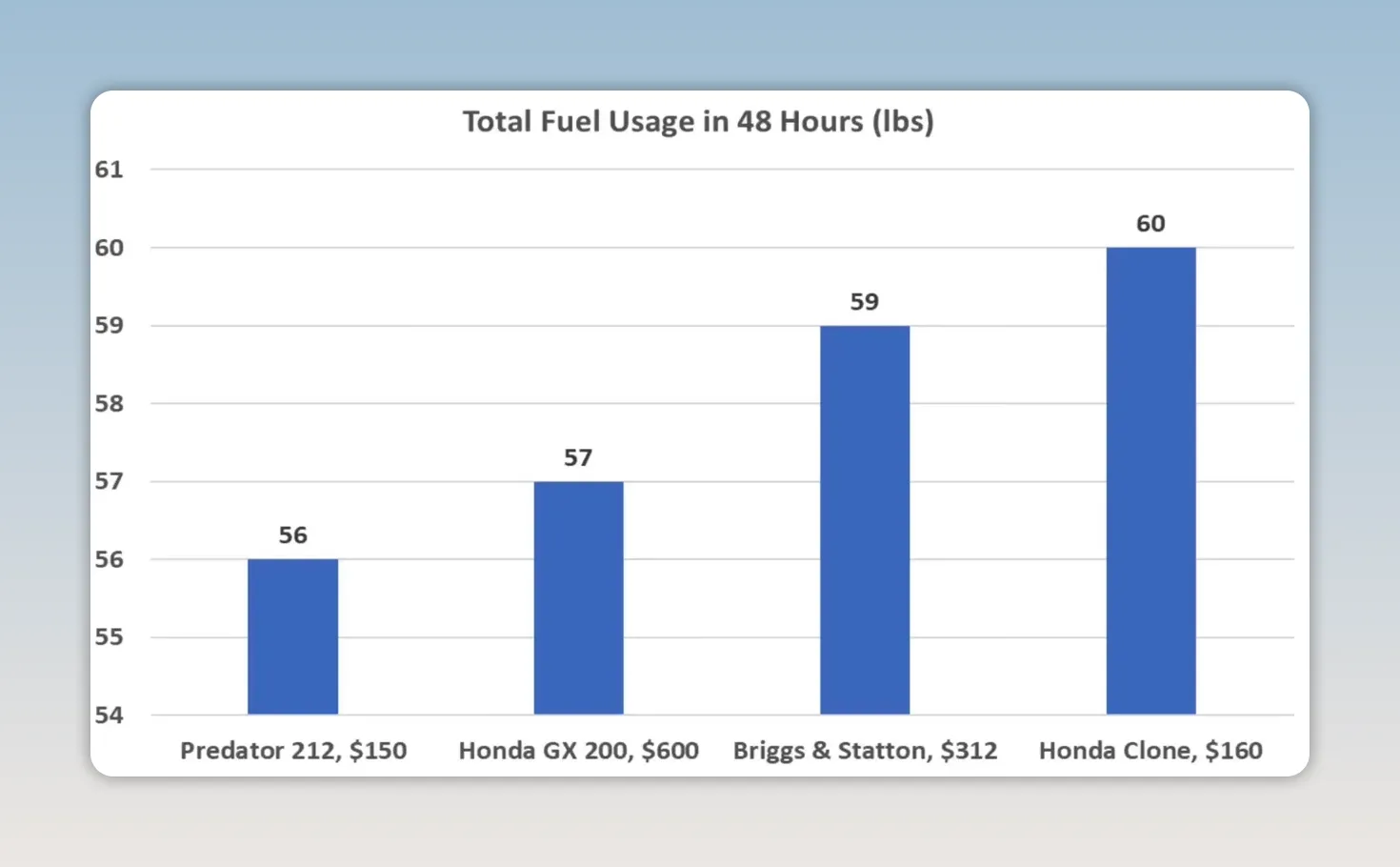
The Predator used the least fuel, with the Honda just one pound behind it. The clone used the most, despite also delivering less pulling and acceleration performance later.
Oil Consumption: A Serious Problem for the Generic Clone
After the first 24 hours, the Honda still had essentially its full oil charge. The clone was very low, and I couldn’t find any visible leaks.
Using identical collection jars weighing 430 grams empty, the drained oil comparison showed:
- Honda clone: 274 grams of recovered oil
- Honda GX200: 452 grams of recovered oil
That left the clone 178 grams, or just over six ounces by weight, short of the Honda. That is a lot of oil for an engine with such a small crankcase.
I refilled both engines with 0.6 liters of fresh oil. During the second 24-hour period, I had to add oil to the clone twice to keep it from running out. The Honda needed no additional oil.
The Briggs and Predator showed no obvious oil consumption after the first day. Their collected jar-and-oil weights were within 10 grams of the Honda’s.
The Spark Plugs Told the Same Story
After roughly 50 hours of total use, the clone’s spark plug had heavy carbon deposits consistent with the oil consumption. The Honda’s plug still looked very good.
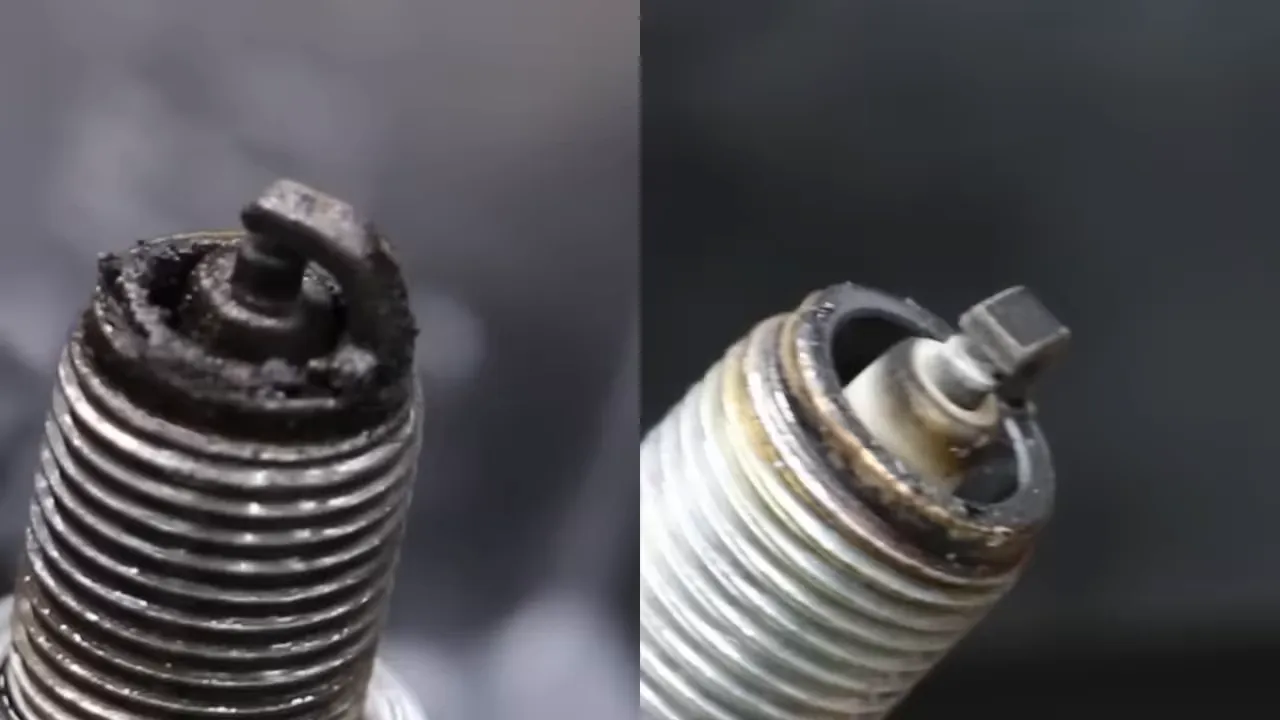
The Predator’s plug had more carbon than the Honda’s, suggesting it had begun burning a small amount of oil. The Briggs plug looked about as good as the Honda’s, with no indication of oil use at that point.
Pulling Power: The Lowest Horsepower Rating Wins
For the performance tests, I installed each engine in the same go-kart. Each engine received a new drive belt because this testing puts considerable wear on the belts.
First, I chained the kart to a tractor and measured peak pulling force to compare low-speed performance.
- Honda GX200: 239 pounds of pulling force
- Predator 212: 233 pounds
- Briggs & Stratton: 213 pounds
- Honda clone: About 200 pounds
The 5.5-horsepower Honda outpulled every competitor. The Predator, with slightly more displacement, came very close. The clone’s optimistic horsepower labels certainly didn’t translate into the strongest pull.
This measured pulling force through the kart’s drivetrain, not crankshaft torque or horsepower on a dynamometer. But it provided a useful comparison of what each engine could do in the same machine.
25-Foot Trailer Pull: Predator Edges Out Honda
Next came a trailer carrying a lawn tractor and Cousin Eddie. That should give the engines something to think about.
Each engine made three timed pulls over 25 feet:
- Honda clone: 4.15, 3.95, and 3.95 seconds, averaging 4.02 seconds
- Honda GX200: 3.59, 3.54, and 3.44 seconds, averaging 3.52 seconds
- Predator 212: 3.39, 3.44, and 3.59 seconds, averaging 3.47 seconds
- Briggs & Stratton: 4.10, 4.10, and 4.00 seconds, averaging 4.07 seconds
Cousin Eddie tried several positions on the trailer, including an aerodynamic-looking stretch over the tractor. Unfortunately for the Briggs, enthusiasm didn’t make up for the performance gap.
The Predator won by just 0.05 seconds over the Honda. Those two were very close, while the clone and Briggs finished about half a second farther back.
100-Foot Acceleration: Another Win for Predator
With the trailer removed, the 100-foot run gave each engine a chance to work through a broader rpm range.
The clone finished its first two passes in 5.31 and 5.16 seconds. Cousin Eddie joined the third pass, which slowed to 5.47 seconds. Because that changed the load, I excluded the third run and used the first two for the clone’s average.
The Honda ran 4.91, 4.86, and 4.71 seconds. The Predator was remarkably consistent, finishing all three passes in 4.76 seconds. The Briggs completed its runs in 5.42, 5.31, and 5.31 seconds.
The average times were:
- Predator 212: 4.76 seconds
- Honda GX200: 4.83 seconds
- Honda clone: 5.24 seconds
- Briggs & Stratton: 5.35 seconds
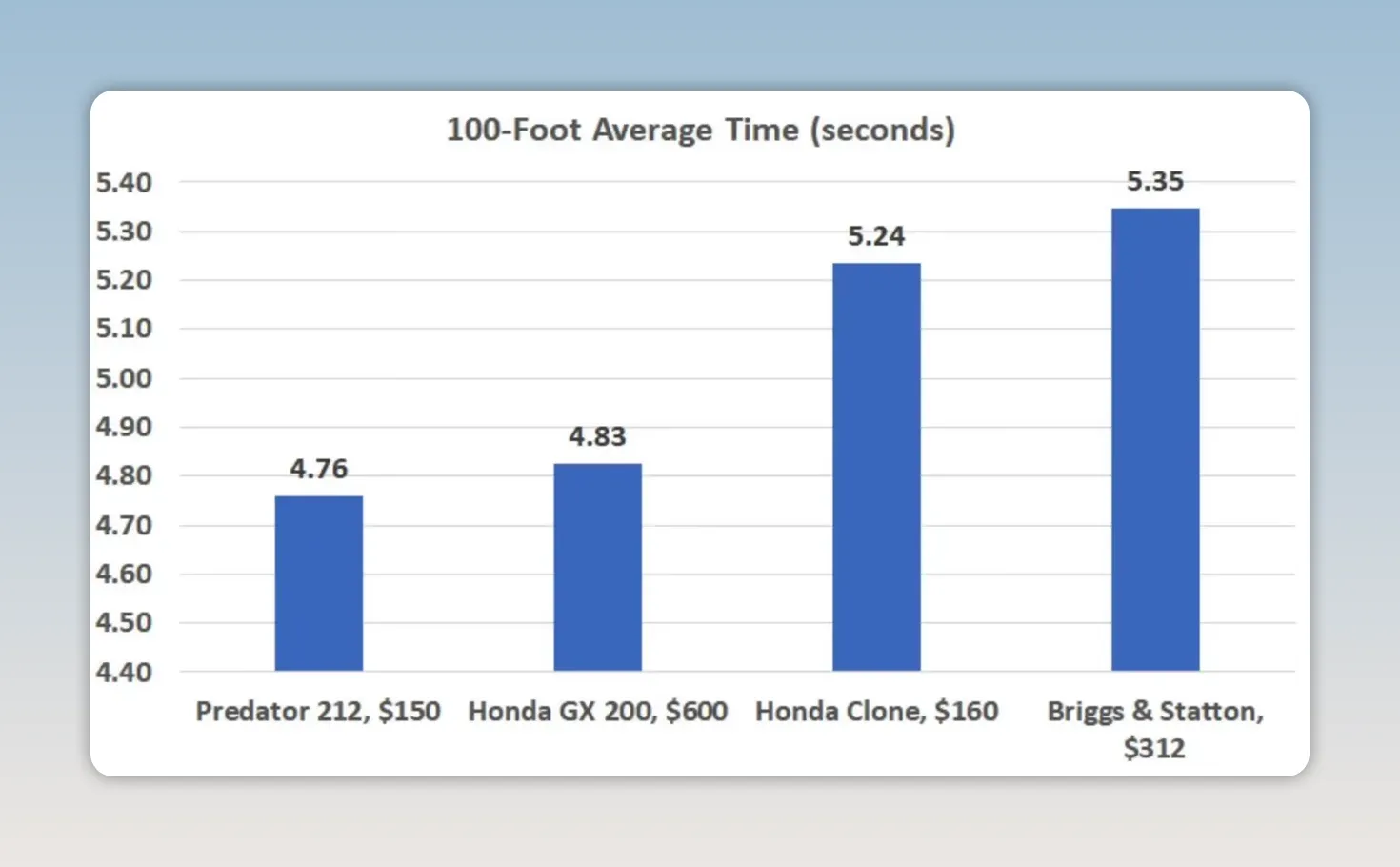
Once again, the Predator finished first, with the Honda close behind. The Briggs was consistent after its first run, but it still finished last.
Cold Starting: All Four Passed
Cold-weather starting can matter just as much as acceleration, depending on the equipment. I left all four engines outside overnight until they were just below freezing.
Fortunately, every engine started on the first pull. Under these conditions, none had a cold-starting problem.
Used Oil Analysis: Low Wear Metals, With an Important Catch
I collected and labeled the oil samples at the engines to avoid mixing them up, then sent them to a laboratory. At the time of testing, the analysis cost approximately $35 without a total base number test, or $45 with TBN included. The original oil analysis reports are available here.
The results provided a useful check on what was happening inside:
- Aluminum: The generic clone had more aluminum in its oil than the other three engines.
- Chromium: The Predator had the most at one part per million. Chromium can indicate piston ring wear, but this was still a very low reading.
- Iron: The clone had the lowest concentration. The Honda, Briggs, and Predator measured 12, 13, and 14 parts per million, respectively.
- Insolubles: The clone measured 0.2 percent, compared with 0.1 percent for each of the other engines.
All four engines had low wear-metal concentrations in this test. However, the clone’s results need an important qualification: I added a lot of fresh oil during the running period. Its sample therefore contained more recently added oil than the others, so its low iron reading shouldn’t be treated as proof of superior durability.
The used oil had also thinned from its original viscosity during operation. The clone’s higher insolubles were consistent with the concern about blowby and its poor oil-control performance.
A 48-hour test can expose early problems, but it does not establish the engines’ ultimate service life. In this case, the clone’s oil consumption and excessive vibration were already much more concerning than its wear-metal numbers.
Which Engine Would I Choose?
The Honda GX200 seems like the best engine overall. It was the quietest, delivered the strongest stationary pull, used little fuel, and showed no meaningful oil consumption. Its spark plug also remained clean. It didn’t win every timed test, but it performed very well across the board.
The Harbor Freight Predator 212 is the best value in this comparison. At around $150, it won both timed performance tests, used the least gasoline, and vibrated slightly less than the Honda and Briggs. Its drawbacks were the higher recoil pulling force, slightly greater noise, and signs of a small amount of oil burning.
The Briggs & Stratton required the least starting effort and kept a clean spark plug. However, its three stalls under load, higher fuel use, and slower performance made it harder to justify at $312.
As for the generic Honda lookalike, the low price didn’t make up for the missing paper filter, excessive vibration, heavy oil consumption, and weaker performance. With a Predator available for roughly the same money, the clone did not make a convincing case.
The extra money buys real advantages with the Honda. But when price and performance are considered together, the Predator is very tough to beat.


