Can a $96 gas chainsaw keep up with one that costs $430? Engine size and horsepower claims only tell part of the story. A saw also needs enough torque to keep the chain moving, good cutting speed, manageable vibration, and a starting system that doesn't wear out your shoulder before the work begins.
I purchased seven gas chainsaws from VEVOR, BILT HARD, Ryobi, Troy-Bilt, ECHO, Husqvarna, and Stihl, then compared them for cutting performance, weight, noise, vibration, and starting effort. I also included a large DeWalt battery chainsaw to see how it stacked up.
The Stihl was the cutting-speed champion, the ECHO offered a much more refined experience, and the inexpensive VEVOR was surprisingly competitive. However, each came with some important tradeoffs.
Quick Summary
- The Stihl MS 250 won every timed cutting test but required the most starting effort.
- The ECHO combined strong cutting performance with low vibration and fewer pulls to start.
- The $96 VEVOR delivered exceptional cutting value but was heavy and vibrated substantially.
- The larger DeWalt battery saw nearly matched the Stihl in hardwood while producing much less noise.
Table of Contents
- The Chainsaws: Prices, Features, and Build Quality
- Starting Performance: Pull Count and Pulling Force Are Different Things
- Noise and No-Load Sprocket Speed
- Load Test: How Much Force Stops the Chain?
- Cutting Speed: Three Passes Through the Test Log
- Controlled-Load Cutting With a 5-Pound Weight
- Hardwood Test: Cutting a Dead Locust Tree
- Vibration: Where the Better-Refined Saws Pull Ahead
- Which Chainsaw Would I Buy?
The Chainsaws: Prices, Features, and Build Quality
All seven gas chainsaws came with an 18-inch bar and chain. Prices below are what I paid for the test, not a guarantee of current pricing. The gas saw weights include their cutting equipment but exclude fuel and bar oil.
VEVOR: $96
The VEVOR chainsaw has the largest engine in the gas lineup at 52cc. The manufacturer claims 2.55 horsepower and a maximum speed of 12,000 RPM. It was made in China and weighed about 14.6 pounds, making it one of the heaviest gas saws tested.
The fuel opening is easy to reach, but the front handle gets in the way of filling the bar oil reservoir. Its front-mounted chain tension screw is less convenient than a side-access adjustment, and the plastic chain cover feels pretty lightweight.
The air filter looks adequate, although it must come off to access the spark plug. For less than $100, the overall build quality seems pretty decent. The bigger question is whether it can cut.
BILT HARD: $110
The BILT HARD uses a 46cc engine with claimed output of 2.4 horsepower and a rated speed of 8,500 RPM. Made in China, it weighed 14.57 pounds, almost exactly the same as the VEVOR despite having a smaller engine.
Its side-access chain tension screw is convenient. However, the chain cover feels light duty, the handle interferes with the bar oil opening, and the four bucking spikes aren't particularly sharp.
A wing nut holds the air filter in place. The filter seems adequate for a budget saw, but it must be removed to reach the spark plug.
Ryobi: $200
The Ryobi has the smallest gas engine at 38cc, but it is also very light at 11.93 pounds. It was marked as made in China with further processing in Vietnam.
Both the fuel and bar oil openings are located toward the rear and are easy to access. The side-mounted chain adjustment is convenient, and the reusable foam air filter doesn't have to come off to reach the spark plug.
Ryobi advertises an anti-vibration handle. Its four bucking spikes aren't very aggressive, but the low weight and service access make a good first impression.
Troy-Bilt: $225
The Troy-Bilt uses a 42cc engine and advertises spring-assisted starting, a lightweight design, and a low-kickback bar and chain. It weighed 12.51 pounds and was made in China with globally sourced materials.
The rear-mounted fuel and oil openings are easy to reach. Overall build quality seems similar to the Ryobi, while the side cover looks much like the BILT HARD's. A wing nut secures the air filter cover and filter.
One concern is the five large felling spikes. They project far enough forward to noticeably reduce the usable length of the bar.
ECHO: $379
The ECHO chainsaw has a 45cc engine advertised as a professional-grade two-stroke. It is designed for gasoline rated at 89 octane or higher. This saw was made in Japan and weighed 13.53 pounds.
Although the side cover is plastic, it feels considerably better built than those on the less expensive saws. The felling spikes are aggressive, and the large bar oil opening is easy to fill.
The air filter threads directly into place, and the spark plug is accessible without removing it. This is a noticeably more refined setup than the budget saws.
Husqvarna 440: $399
The Husqvarna 440 has a 40.9cc engine with claimed output of 2.4 horsepower. It advertises Smart Start for easier starting. Made in Sweden, it was the lightest saw tested at 11.85 pounds.
The handle partly obstructs the bar oil opening, but the large fuel opening is in a very convenient location. Its aggressive felling spikes and durable-feeling side cover compare well with the ECHO.
Two metal locating dowels and a threaded stud secure the bar assembly. The air filter snaps into place, and the spark plug can be reached without removing it.
Stihl MS 250: $430
The Stihl MS 250 has a 45.4cc engine with claimed output of 3 horsepower. This saw was made in the USA and weighed just 12.39 pounds, about 2 pounds less than either budget gas saw.
The inward-facing clutch and outward-facing sprocket make bar and chain installation especially easy. It also has convenient side-access chain tensioning, very aggressive felling spikes, and good access to the bar oil opening.
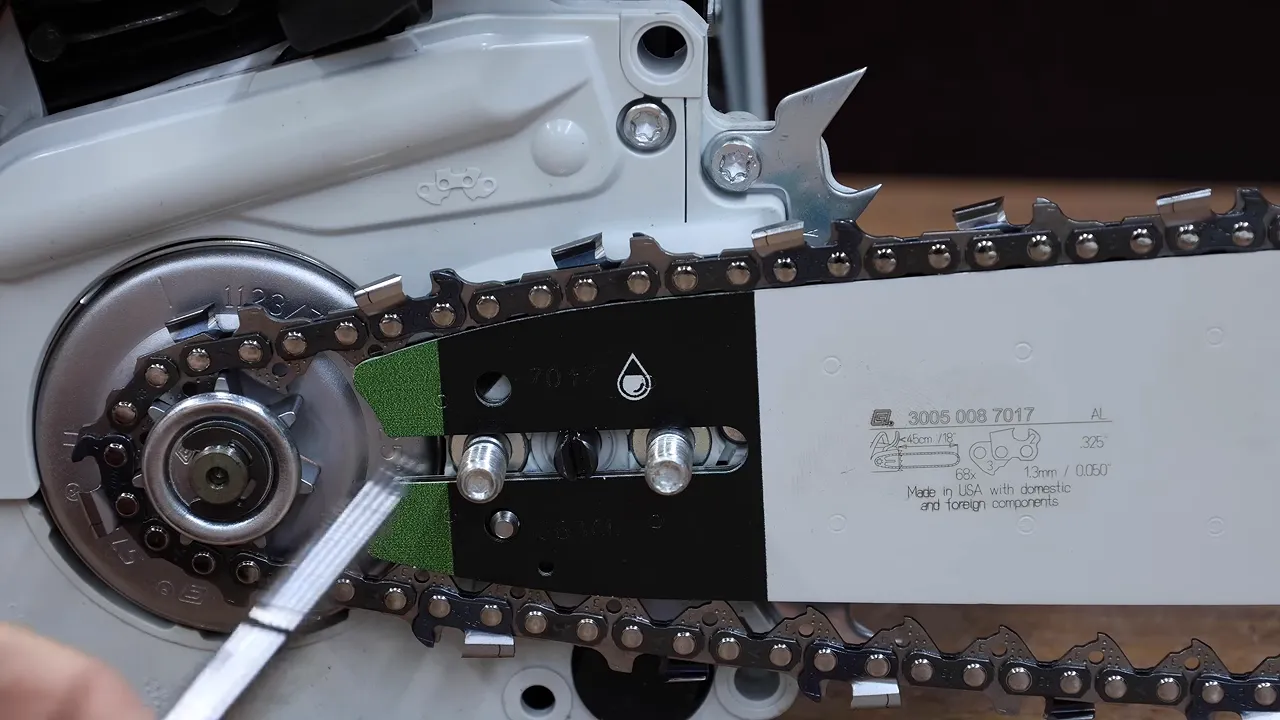
The air filter cover is easy to remove for servicing, although the filter itself must come off to access the spark plug. Of all the saws tested, the Stihl had the most user-friendly bar and chain installation arrangement.
The Battery Comparison: DeWalt 60V
The DeWalt is not a direct size match. It uses a 20-inch bar and a 60V battery system, so it is a larger saw than the gas models. I installed a new chain and used a fully charged 12 Ah battery.
With the battery installed, it weighed 15.71 pounds, the heaviest saw in the comparison. That weight matters, but so do the absence of a pull cord and its much lower noise level.
Starting Performance: Pull Count and Pulling Force Are Different Things
A saw that starts in three pulls isn't necessarily easy to pull. To separate those two factors, I counted the pulls needed for the initial start and later used a push-pull force gauge to measure starter-rope effort over three attempts.
I followed each manufacturer's starting sequence. Those sequences vary in primer use, choke position, and when to move the control after the engine first fires. The Stihl was the only gas saw here without a primer bulb.
- Ryobi: Started in 3 pulls; measured peak pulling force was 32 pounds.
- ECHO: Started in 3 pulls; peak pulling force was 39.4 pounds.
- BILT HARD: Started in 4 pulls; peak pulling force was 38.8 pounds.
- Troy-Bilt: Started in 4 pulls; peak pulling force was just 21.9 pounds.
- Husqvarna: Started in 5 pulls; peak pulling force was 37.3 pounds.
- VEVOR: Started in 7 pulls; peak pulling force was 39.1 pounds.
- Stihl: Started in 9 pulls; peak pulling force was 44.8 pounds.
The VEVOR nearly started after six pulls with the choke engaged, then ran on the next pull after I pushed the choke in. The BILT HARD and Troy-Bilt both showed signs of firing on the second pull and needed two more after changing the choke position.
The Troy-Bilt's spring-assisted starter made a real difference in pulling effort. It required less than half the peak force of the Stihl. The Ryobi also did well by combining a low pull count with relatively modest pulling force.
The ECHO started quickly, but each pull still required some strength. The Stihl was the most demanding in both categories. Nine pulls seems excessive for a brand-new saw, and it continued to require more pulls than the ECHO during testing.
Noise and No-Load Sprocket Speed
I measured noise with the sound meter 24 inches from each saw. Every gas model was loud, with a relatively narrow spread between the quietest and loudest:
- Troy-Bilt: 112.9 dB.
- ECHO: 113.6 dB.
- Ryobi: 113.8 dB.
- Husqvarna: 114.1 dB.
- BILT HARD: 114.3 dB.
- VEVOR: 114.6 dB.
- Stihl: 115.8 dB.
- DeWalt battery saw: 96 dB.
The DeWalt was much quieter than every gas saw. These are comparative readings at a fixed distance, not a substitute for an exposure assessment. For practical safety guidance, including protective equipment and kickback precautions, see OSHA's chainsaw safety guidance.
Next, I measured no-load sprocket speed. The Stihl opened up a very large lead:
- Stihl: 15,378 RPM.
- ECHO: 12,950 RPM.
- Husqvarna: 12,514 RPM.
- Troy-Bilt: 11,980 RPM.
- Ryobi: 11,780 RPM.
- BILT HARD: 11,662 RPM.
- VEVOR: 9,981 RPM.
The VEVOR had the largest engine but the lowest measured sprocket RPM. The Stihl's combination of relatively low weight and very high sprocket speed looked promising. However, no-load speed doesn't tell us how well a saw will hold up under pressure.
Load Test: How Much Force Stops the Chain?
Before making timed cuts, I used a chainsaw load tester to compare resistance to stalling. The setup measures how much downward force on the bar is needed to stop the chain. A steel plate weighing about 10 pounds provides the contact load.
This is a comparative test of how the complete saw handles load, not a direct engine torque measurement in pound-feet. Higher force means the chain kept moving against more resistance in this setup.
- Stihl: 32 pounds to stop the chain.
- ECHO: 24 pounds.
- VEVOR: 23 pounds.
- Ryobi: 17 pounds.
- Husqvarna: 17 pounds.
- BILT HARD: 16 pounds.
- Troy-Bilt: 16 pounds.
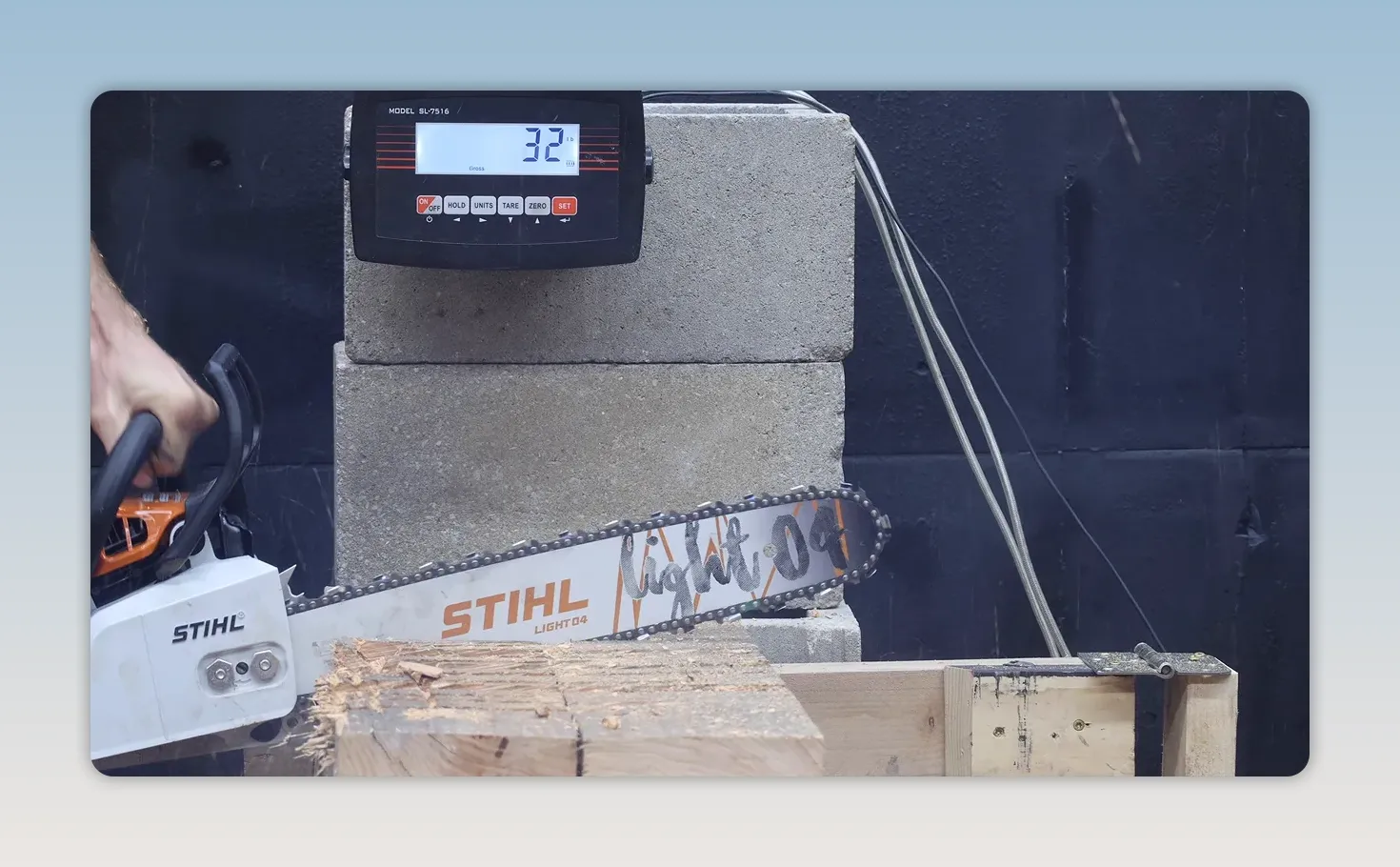
Very impressive performance from the Stihl. Despite having less displacement than either budget saw, it handled considerably more load. The VEVOR also did very well, nearly matching the ECHO and easily outperforming the other lower-priced saws.
Cutting Speed: Three Passes Through the Test Log
For the first cutting comparison, I allowed each gas saw to warm up for 30 seconds, then made three timed cuts through the same test-log setup.
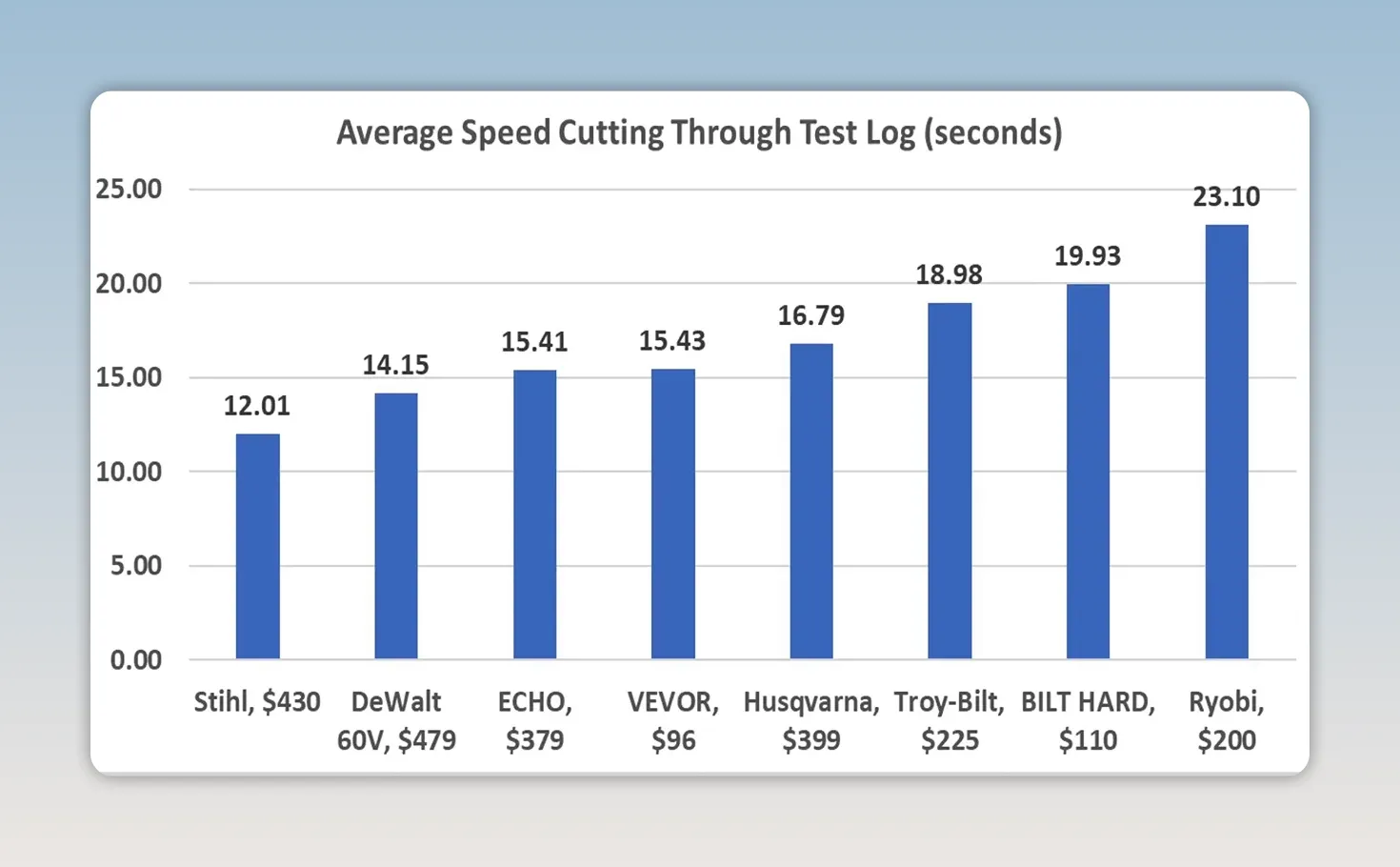
- Stihl: 11.46, 11.87, and 12.70 seconds; reported average of 12.01 seconds.
- DeWalt: 14.08, 14.14, and 14.24 seconds; average of 14.15 seconds.
- ECHO: 14.76, 15.12, and 16.36 seconds; average of 15.41 seconds.
- VEVOR: 15.17, 15.12, and 16.00 seconds; average of 15.43 seconds.
- Husqvarna: 18.68, 16.31, and 15.38 seconds; average of 16.79 seconds.
- Troy-Bilt: 18.98, 19.25, and 18.89 seconds; reported average of 18.98 seconds.
- BILT HARD: 20.41, 19.82, and 19.41 seconds; average of 19.93 seconds.
- Ryobi: 22.88, 23.08, and 23.34 seconds; average of 23.10 seconds.
The Stihl Was Clearly Faster
The Stihl combined enough power to keep cutting with the highest measured sprocket speed. Its average was about 3.4 seconds quicker than the ECHO, and even its slowest pass was faster than any other saw's best pass.
The DeWalt finished second and was very consistent. It didn't have the chain speed of the faster gas saws, but it made plenty of torque and discharged a steady stream of chips.
The VEVOR Was the Big Value Surprise
The ECHO and VEVOR were separated by only two hundredths of a second on their averages. That's a very strong showing for a $96 saw against one costing $379.
However, the ECHO felt much smoother during the work and weighed about a pound less. Similar cut times don't mean the two saws offer the same operating experience.
Warm-Up Behavior Made a Difference
The Husqvarna was the slowest to fully warm up. Its time improved from 18.68 seconds on the first cut to 15.38 seconds on the third. That final pass was competitive with the ECHO and VEVOR, even though its overall average was slower.
The BILT HARD also improved with successive cuts. The Ryobi went the other direction, becoming slightly slower on every pass. Its small engine simply didn't have enough power to keep pace in this test.
Controlled-Load Cutting With a 5-Pound Weight
For the next comparison, I attached a 5-pound weight to the front of each bar. With the test log getting short, I made one timed pass per saw.
- Stihl: 12.65 seconds.
- DeWalt: 16.52 seconds.
- VEVOR: 16.88 seconds.
- ECHO: Nearly identical to the VEVOR, finishing just behind it.
- Troy-Bilt: 21.27 seconds.
- Husqvarna: 21.84 seconds.
- BILT HARD: 22.41 seconds.
- Ryobi: 22.67 seconds.
The Stihl won again, and the VEVOR continued to impress. The Husqvarna had a harder time maintaining chain speed under this loading condition, while the Troy-Bilt also slowed noticeably.
The DeWalt remained second, but it seemed to benefit from more downward force than this setup provided. Its strong torque wasn't enough to overcome the Stihl's chain-speed advantage.
Hardwood Test: Cutting a Dead Locust Tree
A dead locust tree near the fence provided a much tougher cutting test. It needed to come down before branches began falling onto the fence, and its large thorns were another good reason to handle it carefully.
Once the tree was down, I made two timed cuts per saw. This wood was considerably harder than the first test log, making it a good opportunity to see which saws could keep working under a heavier cutting load.
- Stihl: 18.37 and 17.81 seconds; average of 18.09 seconds.
- DeWalt: 18.01 and 18.48 seconds; average of 18.25 seconds.
- VEVOR: 21.48 and 22.46 seconds; average of 21.97 seconds.
- ECHO: Just under 25 seconds on the first pass and 21.89 seconds on the second; average of 23.44 seconds.
- Husqvarna: 28.04 and 23.34 seconds; average of 25.69 seconds.
- Troy-Bilt: Just under 35 seconds and just under 30 seconds; average of 32.44 seconds.
- BILT HARD: 37.39 and 35.44 seconds; average of 36.42 seconds.
- Ryobi: 39.82 and 39.46 seconds; average of 39.64 seconds.

The DeWalt was a torque monster in hardwood. Its average was only 0.16 second behind the Stihl. That's very good performance, even allowing for the DeWalt's larger size and heavier weight.
The VEVOR finished third overall and second among the gas saws. Its larger engine and strong load-test performance translated into useful cutting ability.
The ECHO also performed well, while the Husqvarna again became considerably faster on its second pass. The Troy-Bilt, BILT HARD, and Ryobi struggled to maintain an efficient pace. For this kind of hardwood cutting, their power limitations were much more obvious.
Vibration: Where the Better-Refined Saws Pull Ahead
Fast cutting is important, but a saw that vibrates badly can become uncomfortable. The vibration measurements showed some of the largest differences in the entire comparison. Lower readings were better:
- DeWalt: 9.0 mm/s.
- Husqvarna: 10.5 mm/s.
- ECHO: 11.2 mm/s.
- Ryobi: 24.6 mm/s.
- Stihl: 44.8 mm/s.
- Troy-Bilt: 51.4 mm/s.
- VEVOR: 104.5 mm/s.
- BILT HARD: 107.6 mm/s.
The ECHO and Husqvarna were much smoother than the Stihl, and the DeWalt produced the lowest reading of all. The Ryobi's anti-vibration design also performed well, even though the saw lacked cutting power.
The VEVOR's low price and strong cutting performance come with a substantial vibration penalty. The BILT HARD vibrated even more without delivering the VEVOR's cutting speed. That's an important distinction when comparing two similarly priced budget saws.
Which Chainsaw Would I Buy?
For the final score, I converted the measured performance results into first-through-last rankings and averaged those finishes. Basic specifications such as price, displacement, weight, sprocket RPM, and noise were shown separately rather than included in the winning score.
The Stihl and ECHO tied for first with an average finish of 3.3. That tie reflects two very different strengths, not equal cutting performance.
Best for Cutting Speed: Stihl MS 250
If getting through wood quickly is the priority, I'd choose the Stihl. It won every timed cutting comparison, handled the most force before the chain stopped, and remained fairly light.
The tradeoffs are real: it required the most starter-rope force, needed the most pulls to get going, vibrated considerably more than the ECHO or Husqvarna, and was the loudest saw tested. If those drawbacks don't bother you, it's the performance pick.
Best Refined Gas Saw: ECHO
The ECHO is the better choice if you want a smoother gas saw that starts with fewer pulls and still cuts well. It doesn't match the Stihl's pace, but its low vibration, good service access, and solid-feeling construction make it much more pleasant to operate than the budget saws.
It still requires a firm pull on the starter rope. The advantage is that it typically gets running with far fewer pulls than the Stihl.
Best Value: VEVOR
If it's all about value, the VEVOR is where it's at. At $96 and an average ranked finish of 4.4, it delivered an impressive amount of cutting performance for the money.
It nearly matched the ECHO through the first test log and beat it in the locust hardwood. However, it is heavy, vibrates substantially, and has less convenient adjustments and filling access. These tests demonstrate its performance, not long-term durability.
Worth Considering for Other Priorities
- Husqvarna 440: The lightest saw and the smoothest gas model, but less competitive under heavier cutting loads.
- Troy-Bilt: By far the easiest gas saw to pull over, although cutting performance was well behind the leaders.
- Ryobi: Light, quick to start, and relatively smooth, but the slowest cutter in both the standard-log and hardwood tests.
- BILT HARD: Starts reasonably quickly, but its weight, vibration, and slower cutting make the less expensive VEVOR a stronger value in this comparison.
- DeWalt 60V: Heavy and not a direct size match, but very competitive in hardwood, much quieter, and the lowest-vibration option tested.
The most expensive saw earned its place when it came to cutting speed. But the cheapest saw proved that a low price doesn't automatically mean poor performance. I'd pick the Stihl for speed, the ECHO for refinement, and the VEVOR for value.


