Flex Glue makes some big claims, but how well does it actually hold up against JB Weld, Gorilla, and Loctite? A strong bond on wood is one thing. Holding a broken PVC pipe together under leverage is another. And keeping a cylinder head attached to an engine without head bolts? That is asking a whole lot of any adhesive.
I put all four products through tests on brick, wood, PVC, and metal, then tried the engine experiment with Flex Glue and JB Weld. JB Weld was the strongest overall, but Loctite won the wood test, and Flex Glue turned in some respectable results. The best choice depends on what you need to repair.
I purchased all the products myself, and none of these manufacturers sponsored the testing. These are workshop comparisons, not certified load ratings or recommendations for safety-critical repairs.
Key Takeaways
- JB Weld delivered the strongest overall results, especially on brick, PVC, and metal.
- Loctite won the wood test and had the lowest purchase-time cost per ounce.
- Flex Glue performed well on wood but did not match JB Weld’s overall strength.
- Neither Flex Glue nor JB Weld held an engine cylinder head in place without bolts.
The Products and Test Preparation
This comparison used Flex Glue, JB Weld Original two-part epoxy, Loctite PL Premium construction adhesive, and Gorilla Clear Grip contact adhesive. Those distinctions matter. These results apply to the specific products tested, not every adhesive sold under each brand.
Each product promises a broad range of uses:
- Gorilla Clear Grip: Advertised for metal, glass, fabric, wood, ceramic, leather, paper, plastic, and more, with a waterproof permanent bond.
- Loctite PL Premium: Lists materials including wood, OSB, drywall, brick, concrete, masonry, stone, metal, vinyl, PVC, and foam insulation.
- JB Weld Original: A two-part system intended for applications including metal, plastic, PVC, wood, concrete, and ceramic.
- Flex Glue: Marketed for home, garden, automotive, marine, construction, plumbing, maintenance, and general repairs.
For preparation, the metal and bolts were cleaned with brake parts cleaner, and the bolt heads were sanded flat to provide consistent bonding surfaces. The PVC was cleaned with isopropyl alcohol. Matching test pieces were cut and labeled for each adhesive.
All the samples were given seven days before testing. Flex Glue lists a 24 to 48 hour cure period but requires seven days to reach full cure, making it the slowest-curing product in this group. I did not want to test it before it had that opportunity.
Brick Test: JB Weld Held Until the Brick Broke
For the first strength test, I supported the bonded brick assemblies between two concrete blocks and added weight in the middle until something gave way.
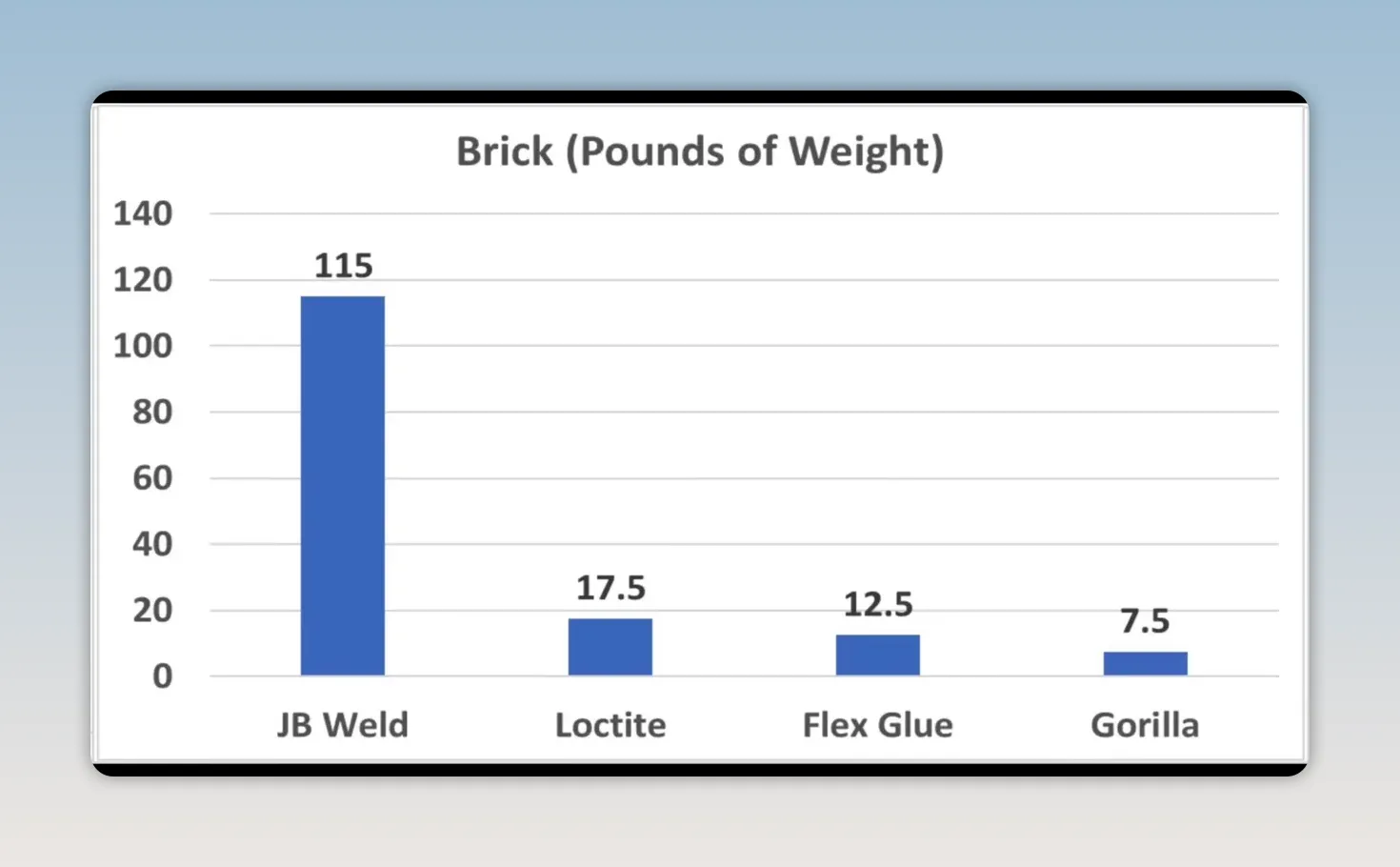
Gorilla failed at 7.5 pounds. Its cured adhesive had a very rubbery texture, somewhat like a spray adhesive. Loctite made it to 17.5 pounds and felt much harder after curing.
Then came JB Weld. I kept adding weight, and it kept holding. Eventually, I ran out of the weights I had prepared and had to find something heavier. A section of railroad rail, followed by more weight plates, finally brought the assembly down at 115 pounds.
That is a lot of weight for this setup. More importantly, the brick itself broke. The damage was not simply a clean adhesive joint pulling apart. That makes 115 pounds the failure load of the assembly, not a precise measurement of the adhesive’s ultimate strength.
Flex Glue failed at 12.5 pounds. It beat Gorilla but could not match Loctite or JB Weld.
- JB Weld: 115 pounds, with brick failure.
- Loctite: 17.5 pounds.
- Flex Glue: 12.5 pounds.
- Gorilla: 7.5 pounds.
Wood Test: Loctite Takes First Place
The wood assemblies measured 48 inches overall, with the bonded joint at the 24-inch midpoint. I added weight at the center to load the joint in bending.
Gorilla failed at just 5 pounds. It did not appear to stick to the wood very well, which was disappointing for a product that lists wood among its applications.
Loctite was a completely different story. It held until 72.5 pounds and showed very good adhesion to the wood. I was impressed with how much structural integrity the joint maintained.
JB Weld reached 57.5 pounds and remained well attached to both mating surfaces. Flex Glue was credited with the same 57.5-pound result, putting it alongside JB Weld and comfortably ahead of Gorilla.
- Loctite: 72.5 pounds.
- Flex Glue: 57.5 pounds.
- JB Weld: 57.5 pounds.
- Gorilla: 5 pounds.
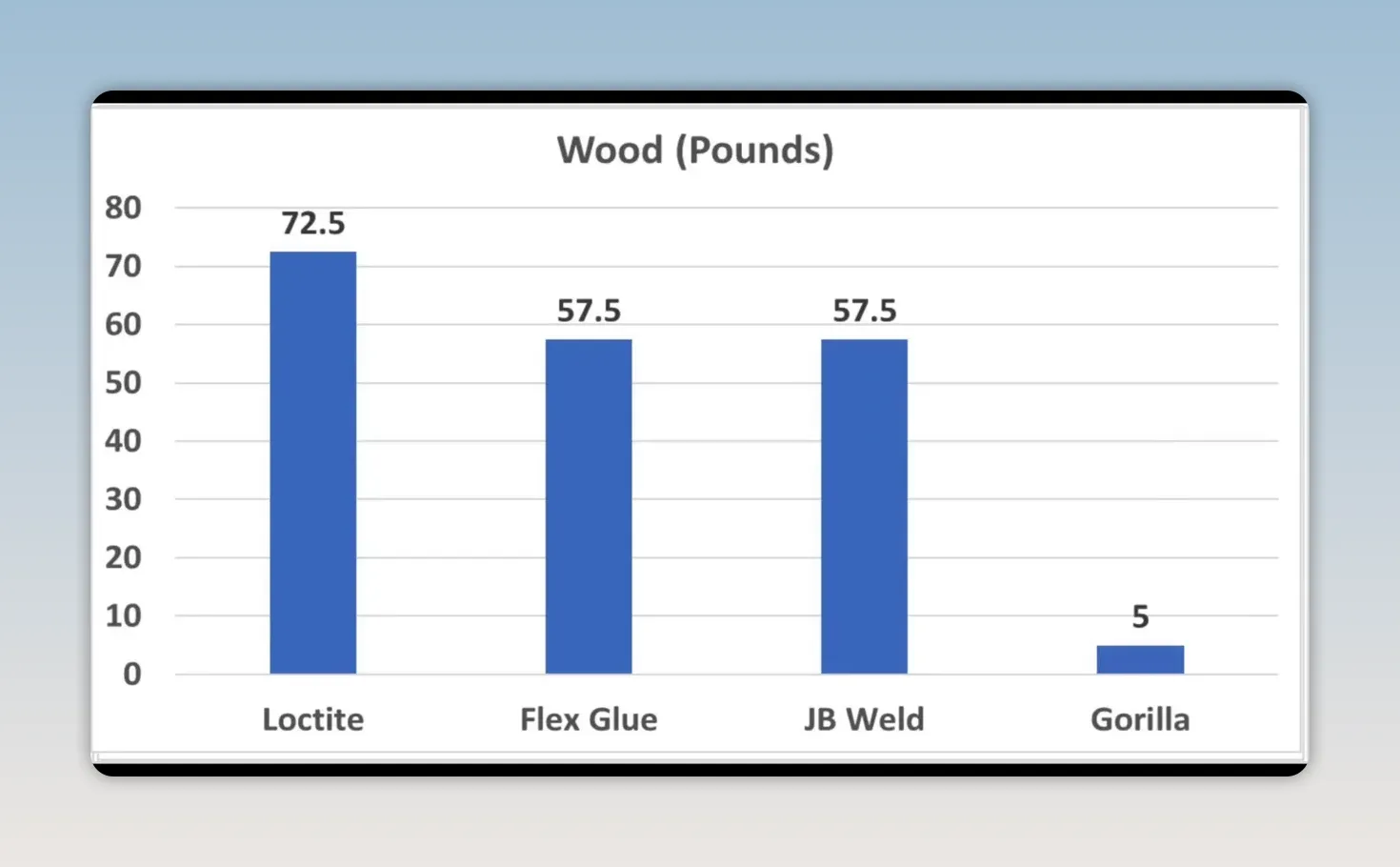
Loctite, JB Weld, and Flex Glue all did a good job sticking to the wood. This test is also a good reminder that the winner on one material does not necessarily win on another. JB Weld dominated the brick comparison, but Loctite carried the most weight here.
PVC Test: Increasing Leverage Separates the Products
For the PVC comparison, each pipe measured 48 inches long, with a repaired cut at the four-inch mark. I hung a 10-pound load from a chain and moved it outward one inch at a time.
The farther the weight moved from the repair, the greater the bending force on the joint. This puts a very different demand on an adhesive than simply hanging weight directly beneath it.
- Gorilla: Failed with the 10-pound load at the 13-inch position.
- Flex Glue: Failed at 16 inches.
- Loctite: Failed at 29 inches.
- JB Weld: Reached the far end with 10 pounds, then did it again with 20 pounds.
JB Weld was still holding, so I increased the load to 30 pounds and continued moving it outward. The assembly finally failed near the end of the pipe. Very impressive performance.
The resulting comparison expressed as bending torque was:
- JB Weld: 110 foot-pounds.
- Loctite: 24.2 foot-pounds.
- Flex Glue: 13.3 foot-pounds.
- Gorilla: 10.8 foot-pounds.
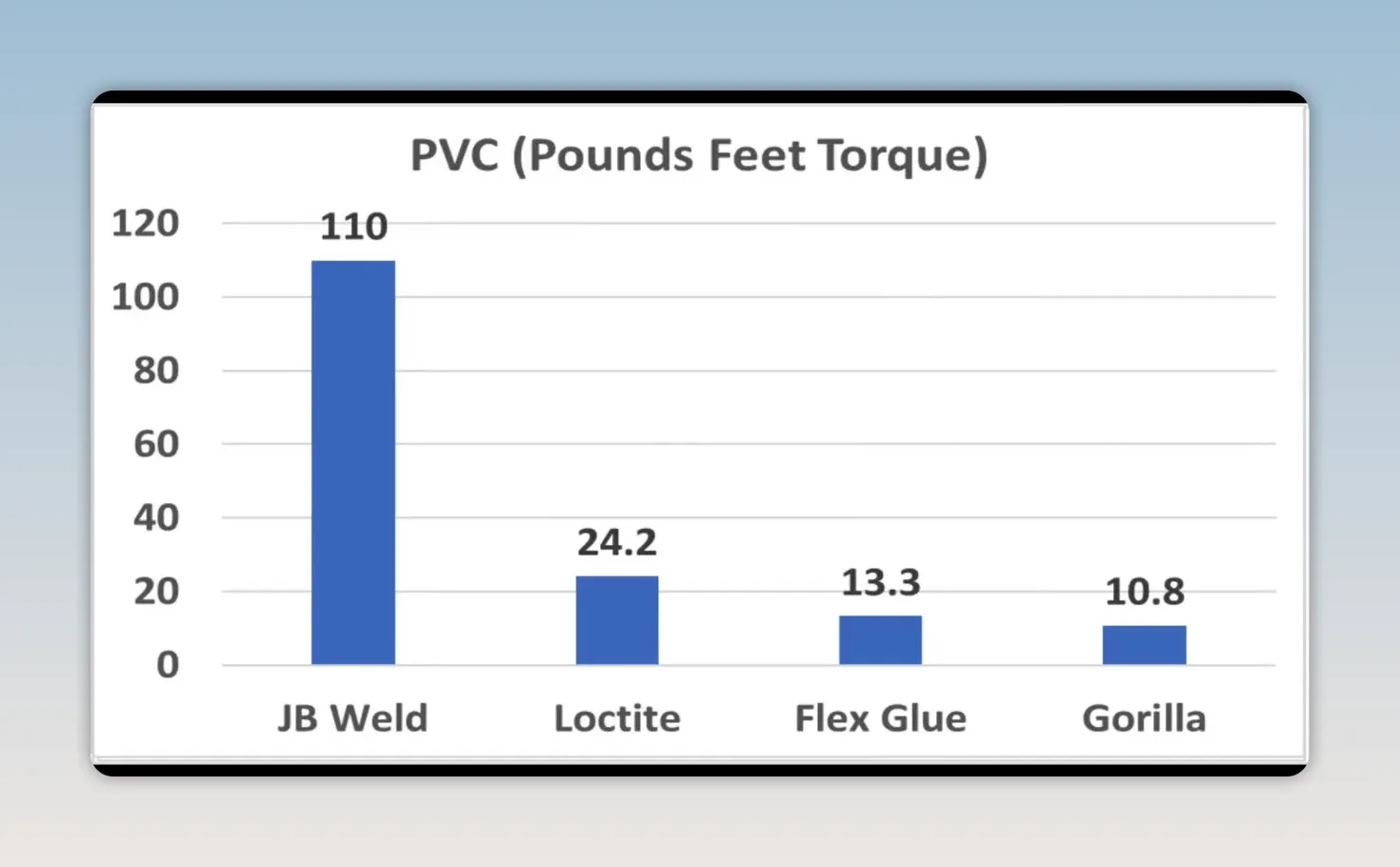
These results describe this repaired-pipe bending test. They do not establish that any of these products is an appropriate substitute for a specified plumbing joint or pressure-rated repair.
Metal Tests: Downward Force, Impact, and Twisting
For the metal comparison, I bonded five bolts by their heads to a steel bar with each product. Two bolts were tested with downward force, one with repeated impacts, and two with twisting force.
Using several loading methods matters. An adhesive can resist a sudden impact differently from a steady pull or a twisting load.
Downward Force
I used a scale to measure how much downward force it took to break each of the first two bolts free.
- JB Weld: 28 pounds on the first bolt and 31.4 pounds on the second.
- Flex Glue: 2.4 pounds and 1.6 pounds.
- Gorilla: No measurable load on the first bolt and 0.6 pound on the second.
- Loctite: No measurable load on the first bolt and 0.4 pound on the second.
JB Weld was in a different league in this particular metal-bonding setup. Flex Glue held more than Gorilla and Loctite, but the gap between it and JB Weld was substantial.
Repeated Impact
For the impact test, I started with a 14-millimeter wrench positioned against the underside of the bolt, then allowed it to fall and strike the bolt. If the bond survived ten drops, I moved to a larger wrench and repeated the process.
The wrench sizes at failure were:
- Gorilla: 16 millimeters.
- Loctite: 17 millimeters.
- Flex Glue: 19 millimeters.
- JB Weld: 1 5/16 inches, approximately 33.3 millimeters.
JB Weld took considerably larger wrench impacts before releasing. Flex Glue finished second, ahead of Loctite and Gorilla. These wrench sizes are a practical comparison within this setup, not calibrated impact-energy measurements.
Twisting Force
The final two bolts for each adhesive were tested with a digital torque tool.
Gorilla, Loctite, and Flex Glue all released without registering measurable torque. That does not mean the bonds had literally no resistance, only that they released before the tool recorded a value.
JB Weld required 207 inch-pounds on one bolt and 201 inch-pounds on the other, averaging 204 inch-pounds. Once again, it delivered a much stronger result on metal.
Can Glue Hold an Engine Cylinder Head Without Bolts?
This was the experiment I had been looking forward to all week. I applied Flex Glue to one engine’s cylinder head and JB Weld to another, then installed the heads with their bolts while the adhesives cured.
After a week, I removed the head bolts. Nothing but adhesive remained to hold each cylinder head against the engine block.
Neither product kept the cylinder head attached during the starting attempts. The JB Weld assembly separated, and the Flex Glue engine also blew its head free. Neither delivered sustained operation with an adhesive-only cylinder-head attachment.
The outcome was dramatic, but it is not a practical engine-repair method. Do not substitute adhesive for cylinder-head fasteners. This was a destructive experiment, not a repair recommendation.
Price: Loctite Was the Least Expensive per Ounce
Strength is important, but so is how much product you get for the money. At the prices paid for these test packages, the cost per ounce was:
- Loctite: About $0.53 per ounce, with a $5.28 package price.
- JB Weld: About $1.39 per ounce, with a $13.92 package price.
- Flex Glue: About $2.17 per ounce, with a $12.99 package price.
- Gorilla: About $2.53 per ounce, with a $7.58 package price.
These are purchase-time prices, not current price guarantees. Still, Loctite’s combination of the lowest cost per ounce and the strongest wood-test result made it a very impressive performer.
The Verdict: Choose for the Repair, Not Just the Brand
JB Weld is my overall winner for these tests. It dominated the brick, PVC, and metal comparisons, while also doing a very good job on wood. I have used it a lot, and it continues to impress me.
Is comparing a two-part epoxy with one-part adhesives completely apples to apples? No. But when something needs repairing, the practical question is often which product will fix it and keep it fixed. That is why JB Weld belongs in the comparison.
It is not the right choice for every job, though. If the repair needs considerable flexibility, I would look toward Loctite or Flex Glue rather than the rigid JB Weld system. Loctite was especially impressive on wood, and Flex Glue showed good wood adhesion plus better metal-impact resistance than the other one-part products tested.
I cannot recommend this particular Gorilla Clear Grip product for the repairs represented here. It finished last overall and did not perform well in these strength comparisons. That is not a judgment on the entire Gorilla brand. I have had excellent results with Gorilla Tape and other Gorilla products.
The main lesson is straightforward: Flex Glue did not beat JB Weld overall, and Loctite proved stronger in several important comparisons. Match the adhesive to the material, the way the joint will be loaded, and whether the repair needs to remain flexible. A strong result in one test is useful evidence, but it is not a guarantee for every repair.


