Does it really take $138 to make a good cordless impact wrench, or can a $30 knockoff do the same job? The inexpensive tool looks an awful lot like the genuine Makita. It even claims more torque. That sounds like a pretty good deal, but we're going to test that!
I compared the Makita XWT11Z 18V LXT brushless 1/2-inch impact wrench against a look-alike purchased on eBay. The tests covered tightening and reverse torque, lug nut removal speed, trigger control, sustained work under resistance, and drops onto concrete. Then I took both tools apart to see what was hiding inside those very similar housings.
To keep the two straight, the knockoff gets a name: Cousin Eddie. And while Cousin Eddie didn't win the performance contest, he did put up a better fight than I expected for $30.
Quick Summary
- Makita produced nearly twice Cousin Eddie's high-setting tightening result on the clamp-load fixture.
- Faster trigger response helped Makita finish the lug nut removal test 14 seconds sooner.
- The teardown revealed a stronger Makita housing, heavier hammer, and less anvil wear.
- The $30 knockoff offered useful features but fell well short of its advertised torque.
Table of Contents
- What $30 Buys Compared With $138
- Trigger Response and Low-Speed Control: A Very Noticeable Difference
- Measured RPM: Did Either Tool Match Its Claims?
- No-Load Power Draw
- Torque Testing: A Big Claim Meets the Test Rig
- Lug Nut Removal Speed: Makita Pulls Ahead
- Working Against Continuous Resistance
- Concrete Drop Tests: Can They Take a Fall?
- Teardown: Similar Outside, Very Different Inside
- The Verdict: Not as Good as Makita, but Worth $30?
What $30 Buys Compared With $138
Cousin Eddie cost just under $30, shipped directly from China, and took about a month to arrive. My first impression was surprisingly positive. For that price, it seemed like a much better tool than I expected.
The genuine Makita cost $138, or nearly five times as much. Both tools were made in China, and their weights were almost identical:
- Makita: 1,133 grams.
- Cousin Eddie: 1,132 grams.
Just one gram apart! However, matching weight and a similar shape don't necessarily mean matching performance.
The advertised torque figures actually favored the cheaper tool. Cousin Eddie claimed 520 Newton meters, equivalent to about 384 foot-pounds. The Makita was rated for 210 foot-pounds of maximum fastening torque and 295 foot-pounds of nut-busting torque. The official Makita XWT11Z specifications provide a useful reference for the genuine model.
Controls, lights, and battery mounting
The control panels were an early clue that these tools weren't quite the same underneath the paint. Makita offered three speed settings in both forward and reverse. Cousin Eddie offered two forward speeds and one reverse speed. Both included a reverse rotation auto-stop feature.
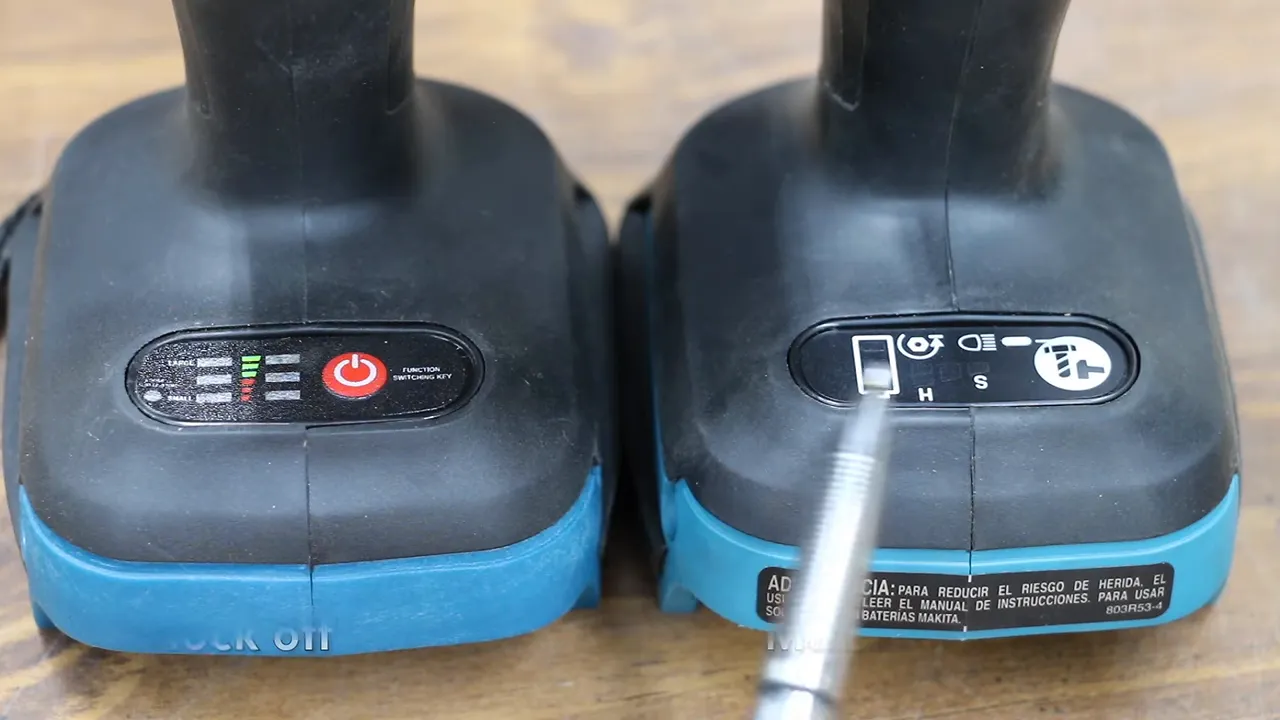
The Makita also had several small details working in its favor:
- A rubber roller and pin helped with battery installation and removal.
- Three rubber cushions supported the battery.
- The battery and mode indicators were larger and easier to read.
- The work light was brighter and illuminated a wider area.
Socket retention differed, too. Cousin Eddie used a friction ring, while this Makita used a pin detent.
Trigger Response and Low-Speed Control: A Very Noticeable Difference
Cousin Eddie had quite a bit of delay between squeezing the trigger and getting the anvil moving. The Makita's response was nearly instantaneous.
In a slow-motion comparison, the Makita completed about 4.5 rotations before Cousin Eddie even began spinning. That's a considerable head start, especially when moving from one fastener to the next.
The Makita also stopped a little sooner after releasing the trigger, despite spinning faster. It had an even bigger advantage when trying to turn slowly:
- Cousin Eddie's minimum measured speed: about 470 RPM.
- Makita's minimum measured speed: about 45 RPM.
Both had variable-speed triggers, but the Makita provided a much wider usable range at the slow end. A variable-speed trigger isn't quite as helpful if the tool jumps straight to several hundred RPM.
How quickly did reverse auto-stop react?
Reverse auto-stop is meant to stop rotation after a fastener breaks loose. It's a very nice feature, provided it reacts before the nut comes completely off.
Measuring the total rotation from the initial trigger squeeze until the anvil stopped, the Makita completed eight rotations. Cousin Eddie completed 10.5 rotations.
Those extra 2.5 rotations may not matter on a long bolt. On a shorter threaded section, they could be the difference between leaving the nut in place and spinning it completely free.
Measured RPM: Did Either Tool Match Its Claims?
Cousin Eddie's specification sheet promised 3,000 RPM without a load. A laser tachometer told a different story.
Cousin Eddie's no-load speeds
- Low forward: about 1,800 RPM.
- Reverse with the low setting selected: about 2,300 RPM.
- High forward: about 2,300 RPM.
- Reverse with the high setting selected: about 2,300 RPM.
The highest measured speed was roughly 700 RPM short of the advertised figure. Changing the forward power setting didn't change reverse speed.
Makita's no-load speeds
- Low: nearly 1,500 RPM forward and just over 1,500 RPM in reverse.
- Medium: nearly 2,000 RPM forward and about 2,140 RPM in reverse.
- High: nearly 2,750 RPM forward and just over 3,000 RPM in reverse.
The Makita ran around 100 RPM below its 1,600 RPM rating in low. Its medium reverse speed slightly exceeded the 2,100 RPM rating, and high reverse exceeded its 2,800 RPM rating.
So, while Cousin Eddie's maximum speed fell well short of its specification sheet, the Makita stayed much closer to its published figures and exceeded them in some reverse settings.
No-Load Power Draw
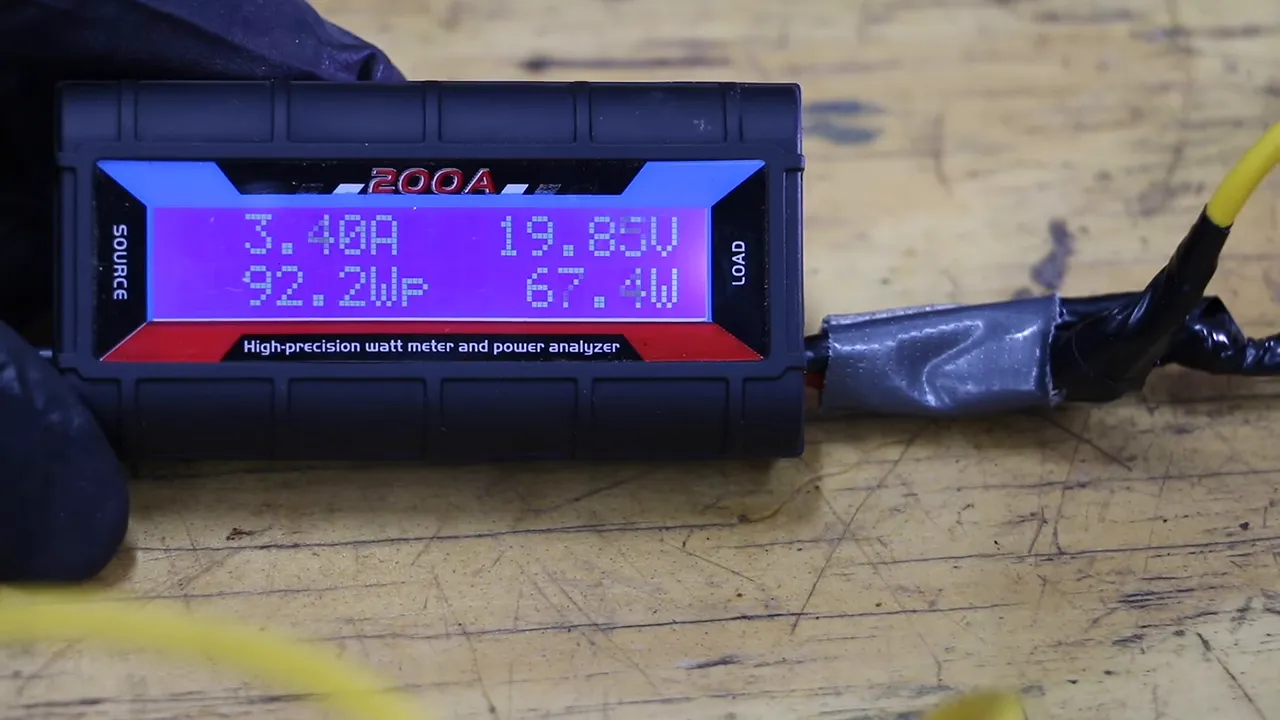
I connected a power analyzer between the battery and each impact wrench to measure electrical input while the tool ran without a load. The fully charged battery measured about 20.2 volts before testing.
- Cousin Eddie: approximately 1.73 amps and 34 watts in both forward and reverse.
- Makita forward: approximately 2.61 amps and 52 watts.
- Makita reverse: a peak of about 3.4 amps and roughly 65 watts.
The Makita used considerably more power in this test. No-load electrical input isn't a torque measurement, but with Cousin Eddie claiming substantially more torque, the next test was going to be interesting.
Torque Testing: A Big Claim Meets the Test Rig
I built a clamp-load fixture using two hydraulic rams between thick steel plates. Tightening a bolt squeezed the fixture and raised the hydraulic pressure.
Before testing, I used a torque wrench to establish how much tightening torque was needed to produce pressure readings in 100 PSI increments from 100 through 2,000 PSI. Premium synthetic grease was used throughout to help keep results consistent, and each impact test ran for about 15 seconds.
Right-hand threaded hardware allowed forward testing. Switching to a left-hand threaded bolt let me load the same fixture while running the tools in reverse.
These are torque-equivalent results from this particular clamp-load setup. The reverse test is not the same procedure as breaking free a conventional nut previously tightened to a known torque, so it should not be treated as a direct verification of a manufacturer's nut-busting rating.
Forward tightening results
Cousin Eddie produced the following results:
- Low: 900 PSI, corresponding to about 78 foot-pounds.
- High: 1,050 PSI, corresponding to about 91 foot-pounds.
Only 91 foot-pounds in high? I expected quite a bit more from a tool claiming 384 foot-pounds.
The Makita delivered:
- Low: 650 PSI, corresponding to about 57 foot-pounds.
- Medium: 1,150 PSI, corresponding to about 100 foot-pounds.
- High: 2,050 PSI, corresponding to about 178 foot-pounds.
The Makita's medium setting outperformed Cousin Eddie's high setting. At full power, the Makita produced nearly twice the tightening result of the knockoff. Its 178 foot-pounds was still short of its 210 foot-pound rating in this setup, but it was much closer to its claim.
Reverse results
With the left-hand threaded bolt installed, both tools performed better than Cousin Eddie had in forward:
- Cousin Eddie: 1,300 PSI, equivalent to about 113 foot-pounds.
- Makita: 1,825 PSI, equivalent to about 159 foot-pounds.
Cousin Eddie improved in reverse, but the Makita still had a very comfortable lead.
Lug Nut Removal Speed: Makita Pulls Ahead
For a practical speed comparison, I set up a row of lug nuts, all torqued to 100 foot-pounds. Both batteries were fully charged, and both impact wrenches ran in their high settings.
- Cousin Eddie: 49 seconds to complete the removal test.
- Makita: 35 seconds.
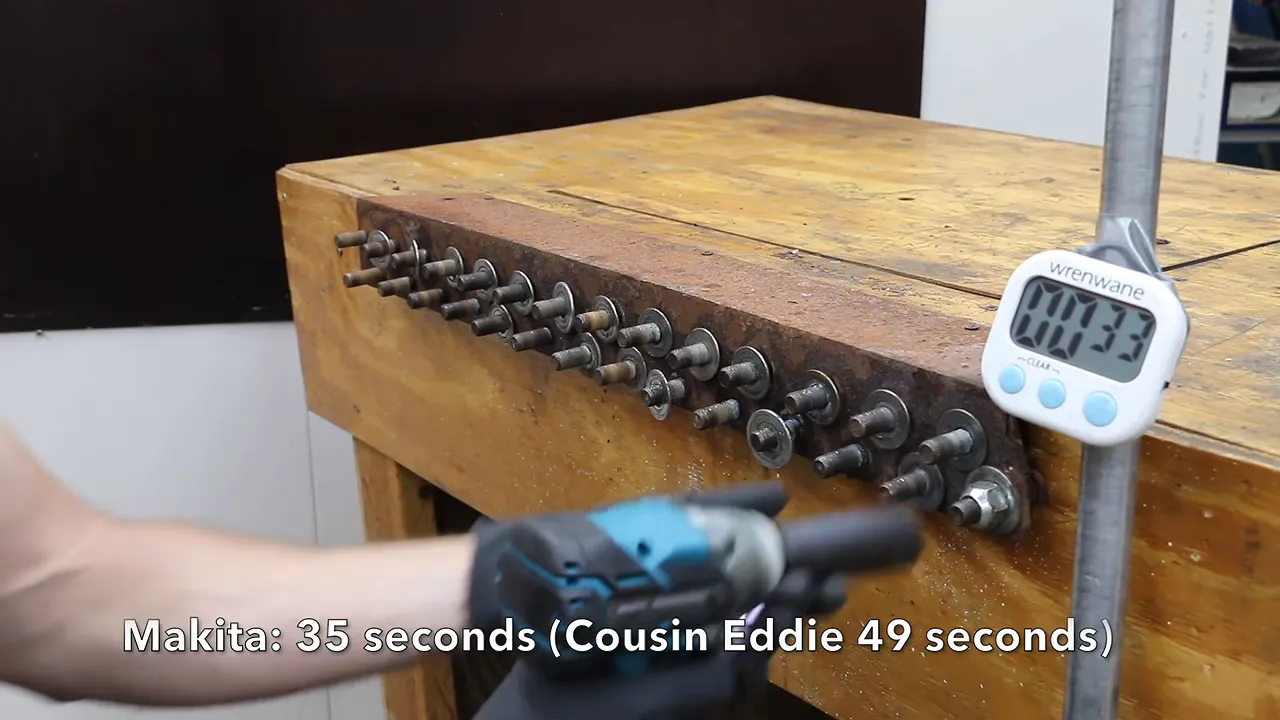
The Makita finished 14 seconds sooner. Side-by-side slow-motion testing showed why: its immediate trigger response and harder impacts broke the nut free sooner, then its higher speed spun the nut off more quickly.
Speed with auto-stop enabled
I repeated the comparison using reverse auto-stop, again with all nuts torqued to 100 foot-pounds.
- Cousin Eddie: approximately 34 seconds.
- Makita: approximately 25 seconds.
For a $30 impact wrench, Cousin Eddie's auto-stop worked very well. That's a genuinely useful feature at this price.
However, the Makita's response was especially noticeable after using the knockoff. In three side-by-side attempts, the Makita finished breaking the nut loose and completed its auto-stop sequence before Cousin Eddie's nut even began rotating. Trigger lag wasn't just something that showed up in a close-up comparison. It cost time on the job.
Working Against Continuous Resistance
Breaking a nut loose is only part of an impact wrench's job. A damaged or galled thread can keep resisting rotation after the fastener starts moving.
To compare work under repeated resistance, I used a small engine with its brake applied and its spark plug installed. The brake and engine compression resisted rotation. A green rope marker made it possible to count revolutions during a 30-second test.
- Cousin Eddie: 2.75 revolutions.
- Makita: 5.75 revolutions.
Both tools overcame the resistance, but the Makita completed a little more than twice as many revolutions. That's a substantial difference in work delivered over the same amount of time.
A direct head-to-head contest
I also coupled the tools together for a direct showdown, using fully charged batteries. To account for Cousin Eddie's trigger delay, I started the cheaper tool first.
Even with that head start, the Makita stopped Cousin Eddie and then overpowered it. Slow motion showed the knockoff picking up speed before coming to a sudden stop when the Makita kicked in.
After several matches, the Makita was only about four degrees cooler than Cousin Eddie. There wasn't a dramatic temperature difference in this short comparison, despite the clear difference in performance.
Concrete Drop Tests: Can They Take a Fall?
I can be a little clumsy, so durability matters. For the drop test, one pole acted as a guide while another was attached to the tool. This helped keep both tools oriented similarly when they hit the concrete from 10 feet up.
Cousin Eddie made quite a bounce. The housing picked up scratches, and a small rubber piece came off, but the piece could be put back into position. There wasn't any apparent major damage.
The Makita hit hard, too, although it didn't bounce quite as much. It also came away with just a few scratches.
Both tools survived the initial 10-foot concrete drop without obvious major damage.
A harder hit directly on the anvil
The next drop aimed the impact at the front of the anvil. With the battery and attached pipe adding load to the setup, this was a much harsher test of the housing.
Cousin Eddie's handle broke near the battery base. The tool still ran, but the broken handle was definitely a problem.
The Makita also took a hard blow to the anvil. Its handle visibly flexed near the battery, but it did not suffer the same snapped handle.
That flexing and bouncing also produced an unexpected dance contest. I'm trying to stay unbiased here, but Cousin Eddie clearly had the better moves. No trigger delay on the dance floor! Unfortunately, dancing doesn't make up for a broken handle.
Teardown: Similar Outside, Very Different Inside
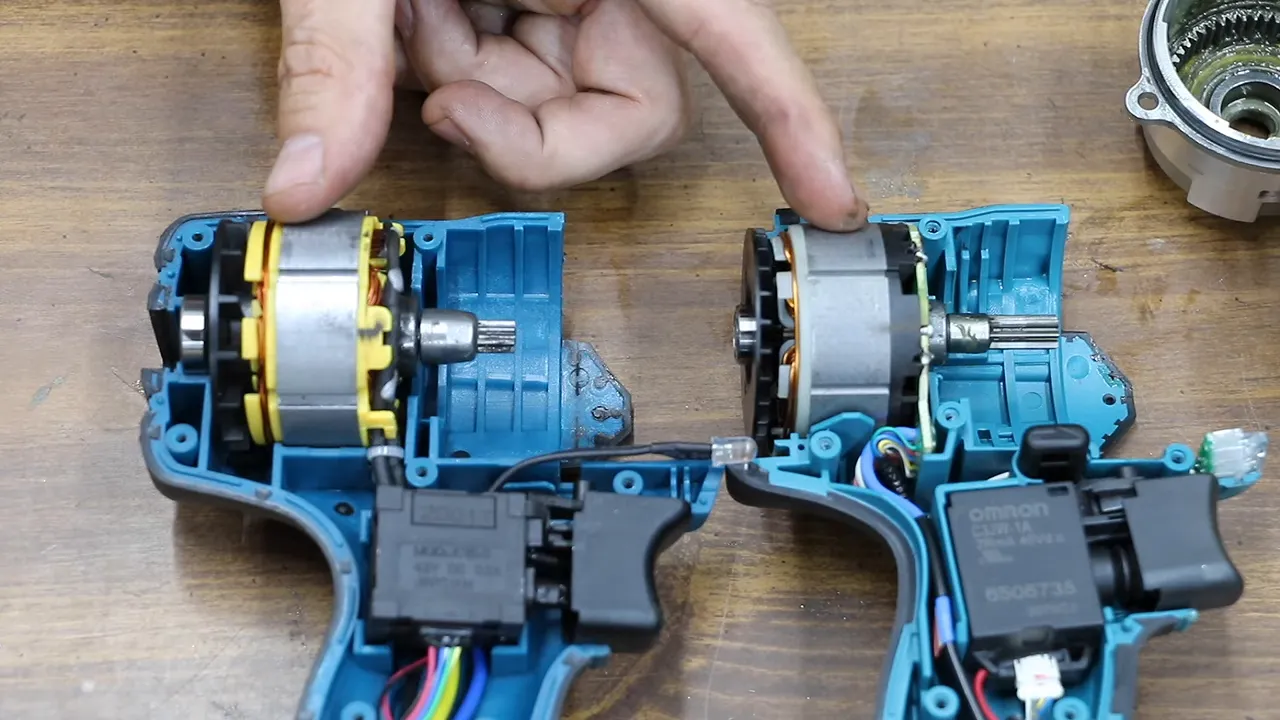
Taking the tools apart confirmed that Cousin Eddie really did have a brushless motor. At this price, that's worth noting.
However, the motors, electronics, construction materials, and internal layouts were very different. These were not the same tool with a different logo.
Housing strength
The Makita's plastic housing was visibly more robust. After examining the opened cases, Cousin Eddie's failure at the handle base wasn't much of a surprise. The difference in construction was much easier to appreciate with the shells apart.
Hammer weight
The impact mechanisms also differed:
- Cousin Eddie's hammer: 253 grams.
- Makita's hammer: 297 grams.
The Makita had a 44-gram heavier hammer, along with the higher measured operating speeds. Those differences help explain why it delivered stronger performance.
Anvil wear
Cousin Eddie's anvil showed considerably more wear after testing. Its impact edge had rounded noticeably, while the Makita showed only a small amount of wear.

The teardown backed up the test results: similar overall weight didn't mean the weight was distributed the same way, and similar exterior styling didn't mean similar component quality.
The Verdict: Not as Good as Makita, but Worth $30?
Is the $30 knockoff as good as the genuine Makita XWT11Z? Absolutely not. Makita delivered more torque in the high-power tests, removed lug nuts faster, offered much better trigger control, and completed more work against sustained resistance. It also had a stronger housing and showed less anvil wear after testing.
You're getting more than a name for the extra money. The difference shows up both in the measurements and in how quickly the tool responds.
But there's another question: Is Cousin Eddie worth $30? In my opinion, it's a very good value at that price. A working brushless impact wrench with reverse auto-stop for around $30 is hard to find. It completed the 100 foot-pound lug nut tests and survived the first concrete drop.
Just don't buy it expecting the advertised 384 foot-pounds or genuine Makita performance. Cousin Eddie is an inexpensive tool with real limitations, not a five-times-cheaper equivalent. Makita wins the tool contest. Cousin Eddie gets the dance trophy.


