Why spend hundreds of dollars on a torque wrench if a digital torque adapter costing around $30 can do the job? That sounds like a pretty good deal, but only if the adapter is accurate, consistent, and fast enough to tell you when to stop.
I purchased 13 half-inch-drive torque adapters and compared them against a torque wrench calibration tool at 25, 80, and 145 foot-pounds. I also tested how well their electronics captured a sudden torque spike, compared a $27 adapter with an $800 Snap-on torque wrench, and cycled every adapter 500 times before checking accuracy again.
The top three greatly exceeded my expectations. However, several adapters demonstrated why an accurate number on the display does not necessarily mean an accurately tightened fastener.
Quick Summary
- WORKPRO finished first overall, combining accurate readings, fast response, and consistent performance after 500 cycles.
- Fanwiike and LLAVETOR were close alternatives, delivering strong performance at prices near $30.
- Slow electronics caused overshoot even when an adapter’s final reading closely matched the reference tester.
- Higher prices and supplied calibration certificates did not guarantee better performance in these tests.
Table of Contents
- How I Tested the Torque Adapters
- The 13 Adapters: Prices, Ranges, and Features
- Accuracy at 25 Foot-Pounds: The Budget Adapters Start Strong
- The Electronics Speed Test: Can the Adapter Catch a Sudden Load?
- Accuracy at 80 Foot-Pounds: Reading Correctly Versus Stopping on Time
- Accuracy at 145 Foot-Pounds: The Same Difference Becomes Even Clearer
- After 500 Cycles: Do the Adapters Stay Accurate?
- Which Digital Torque Adapter Is Best?
- Can These Adapters Replace a Torque Wrench?
- Find More Product Test Results
How I Tested the Torque Adapters
For the accuracy tests, I installed each adapter on the calibration tool and set its target torque. Rather than looking at the adapter’s display as I applied force, I reacted to its buzzer. Each adapter received three attempts at each test setting.
That approach checks two different things:
- Measurement accuracy: How closely does the adapter’s reading match the reference tester?
- Target control: How close can I stop to the preset torque using the adapter’s warning?
Those are not the same measurement. An adapter can correctly report that I applied 84 foot-pounds, yet still do a poor job helping me stop at an 80-foot-pound target.
I also measured buzzer volume, weight, and dimensions. Those details help describe the tools, but they were not included in the final performance ranking. For the overall results, I converted the performance data into first-through-last-place finishes and averaged those rankings.
Most adapters advertised accuracy within ±2%, although the claimed operating ranges and directional specifications varied. It is important to keep those ranges in mind: the 25-foot-pound test was below the listed minimum for EPAuto, NEIKO, and Performance Tool. WAXTRON’s advertised ±2% accuracy applied from 20% to 100% of full scale, which also places 25 foot-pounds below that specified accuracy band.
The 13 Adapters: Prices, Ranges, and Features
Prices below are what I paid for the test samples. All adapters used a half-inch drive, but there were some meaningful differences in torque range, packaging, and controls.
The $27 to $36 Adapters
- YIYEIE, $27: Approximately 7.5 to 150 foot-pounds, 30 preset modes, storage for 500 readings, and automatic shutoff after three minutes. Its specifications included a 1% clockwise accuracy claim alongside a general ±2% claim. It used two AAA batteries and included an inspection certificate.
- WAXTRON, $27: A range of 7.5 to 147.5 foot-pounds, an audible buzzer, a flashing LED, and a calibration certificate. Its claimed clockwise accuracy was ±2% within the specified 20% to 100% full-scale band.
- ALAIAL, $30: A range of 2.2 to 147.5 foot-pounds, four selectable units, and peak and trace modes. In peak mode, its green warning activates at 85% of the target, yellow at 95%, and red at 100%, accompanied by buzzer alerts. It used two AAA batteries and included an inspection certificate.
- LLAVETOR, $30: Approximately 7.4 to 147.5 foot-pounds, claimed ±2% accuracy in both directions, four selectable units, and six preset modes. It used a buzzer and a light that changes from green to red, and it included a calibration report.
- ANPUDS, $32: A range of 2.9 to 147.6 foot-pounds, claimed ±2% accuracy, progressive buzzer alerts, and LED indicators. Its slim housing was intended for confined spaces, and it included an inspection certificate.
- Fanwiike, $32: Approximately 7.3 to 147.5 foot-pounds, four selectable units, a buzzer, and an LED indicator. It advertised ±2% accuracy, with the supplied calibration information reporting much smaller errors at its inspection points.
- WORKPRO, $36: A range of 7.38 to 147.5 foot-pounds, four selectable units, two AAA batteries, and a target buzzer. Unlike most competitors, WORKPRO advertised ±3% accuracy rather than ±2%.
All seven of these adapters were made in China. Most weighed around 195 to 222 grams and measured roughly three inches along their longer measured dimension. ANPUDS was the exception: it was the narrowest at about 1.56 inches, but approximately 4.91 inches long and the heaviest at 275.71 grams. Narrow does not always mean compact in every direction.
The $45 to $66 Adapters
- EPAuto, $45: A range of 29.5 to 147.5 foot-pounds, claimed ±2% accuracy, a target buzzer, a carrying case, and two AAA batteries.
- QUINN, $45: Sold at Harbor Freight, with a broader 25 to 250-foot-pound range, claimed ±2% accuracy, storage for the last 50 readings, and an inspection certificate.
- NEIKO, $49: A range of 29.5 to 147.5 foot-pounds, claimed ±2% accuracy, a buzzer, three LED indicators, and automatic shutoff after 80 seconds of inactivity. It used two AA batteries.
- Performance Tool, $57: A range of 30 to 150 foot-pounds, claimed ±2% accuracy, a buzzer, an LED torque indicator, and automatic shutdown after three minutes without activity. This was the first adapter in the comparison that did not include a calibration certificate.
- ACDelco Heavy Duty, $64: A range of 14.8 to 147.5 foot-pounds, claimed ±2% clockwise and ±3% counterclockwise accuracy, and buzzer and LED notifications. An intermittent warning begins at 90% of the target, followed by a high-frequency buzzer at the target.
- ACDelco ARM302, $66: A range of 12.5 to 250.7 foot-pounds, claimed ±1.5% clockwise and ±2.5% counterclockwise accuracy, a narrow housing, and a calibration certificate.
These six adapters were made in Taiwan. The ARM302 was relatively narrow at about 1.67 inches and weighed 185.22 grams. Performance Tool was the lightest adapter in the comparison at 182.59 grams. Most of these housings were just under three inches along the longer measured dimension.
Accuracy at 25 Foot-Pounds: The Budget Adapters Start Strong
The first test immediately showed that paying more did not guarantee better results.
YIYEIE’s first attempt showed 26.33 foot-pounds on the reference tester and 25.5 on the adapter. Its next two attempts also showed discrepancies, with its average error reaching 3.68%.
WAXTRON started with a 2.79% difference, then improved to 1.67% and about 1.8%. ALAIAL was less consistent, with one larger miss followed by better results.
LLAVETOR, Fanwiike, and WORKPRO separated themselves from the rest. Fanwiike stayed within half a foot-pound of the tester on all three attempts. LLAVETOR also stayed close, while WORKPRO comfortably beat its own advertised ±3% specification.
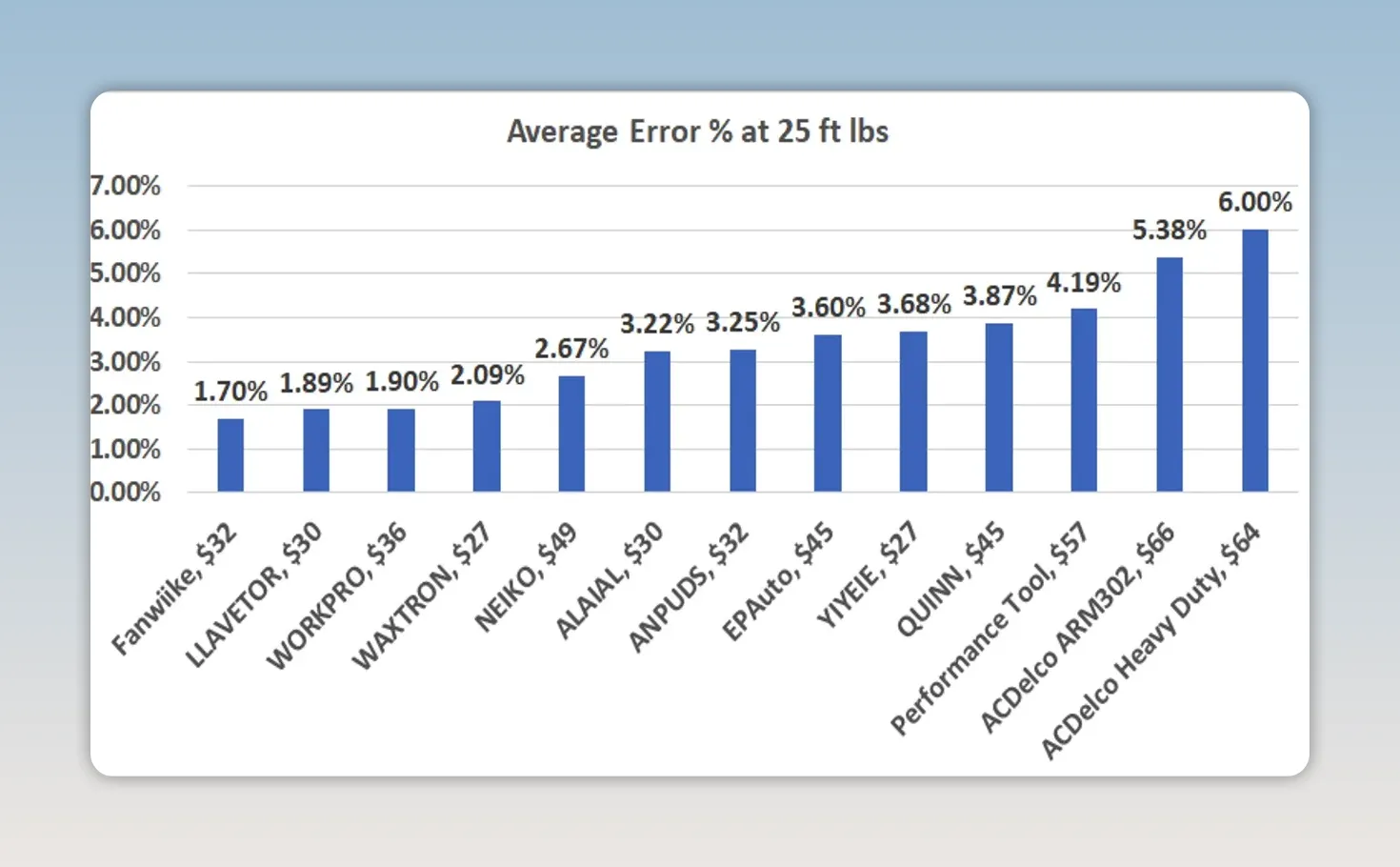
Here are the average reading discrepancies, from lowest to highest:
- Fanwiike: 1.70%
- LLAVETOR: 1.89%
- WORKPRO: 1.90%
- WAXTRON: 2.09%
- NEIKO: 2.67%
- ALAIAL: 3.22%
- ANPUDS: 3.25%
- EPAuto: 3.60%
- YIYEIE: 3.68%
- QUINN: 3.87%
- Performance Tool: 4.19%
- ACDelco ARM302: 5.38%
- ACDelco Heavy Duty: 6.00%
Both ACDelco adapters struggled here. The Heavy Duty model differed from the tester by more than two foot-pounds on one attempt. At a low torque setting, that is a substantial percentage difference.
Which Buzzer Was Loudest?
Performance Tool produced the loudest buzzer at 86.6 decibels, followed by LLAVETOR at 84.2 and NEIKO at 80.4. QUINN measured 78.2, EPAuto 78.1, Fanwiike 77.5, and WORKPRO 76.7 decibels.
The remaining readings were ALAIAL at 74.2, ACDelco Heavy Duty at 73.4, YIYEIE at 72.5, WAXTRON at 68.7, ACDelco ARM302 at 67.1, and ANPUDS at 66.1 decibels.
A loud warning is useful, but Performance Tool’s results already showed that volume alone does not make an adapter accurate.
The Electronics Speed Test: Can the Adapter Catch a Sudden Load?
Budget digital tools can suffer from slow electronics. If the adapter takes too long to recognize changing torque, it may miss a short peak or sound its alarm after you have already passed the target.
To compare response, I gave the wrench a quick bump and checked the peak captured by the adapter against the reference tester. This was a response challenge, not the normal controlled pull used for tightening.
The differences were enormous.
- WAXTRON: 142.2 foot-pounds versus 142.4 on the tester, only a 0.14% discrepancy.
- WORKPRO: 124.2 versus 123.6 foot-pounds, a 0.49% discrepancy.
- Fanwiike: 139.4 versus 140.4 foot-pounds, a 0.71% discrepancy.
- LLAVETOR: 151.8 versus 153.3 foot-pounds, approximately a 0.98% discrepancy.
- ANPUDS: 112.5 versus 128.5 foot-pounds, about a 12.45% discrepancy.
The other adapters had much larger misses. YIYEIE captured only 85.5 foot-pounds when the tester registered 149.5. EPAuto captured 90 versus 157.8, while QUINN recorded 53.5 versus 147.3.
NEIKO showed 73.8 versus 166.1 foot-pounds. Performance Tool captured 43.9 versus 146.1. The ACDelco Heavy Duty recorded 50.5 versus 148.6, and the ARM302 showed 53 versus 123.7.
ALAIAL struggled the most. It recorded 26.2 foot-pounds against 142.3 on the tester. A repeat attempt was even worse: just 2.7 foot-pounds against 107.4.
Some sudden-load readings exceeded the adapters’ listed upper ranges, so this test should not be treated as a certification of performance throughout or beyond their rated ranges. It did, however, reveal very large differences in the peaks these samples captured.
A $27 WAXTRON Versus an $800 Snap-on
The direct comparison with the Snap-on produced one of the biggest surprises. With the tester showing 83.25 foot-pounds, WAXTRON captured 82.7. The Snap-on showed only 74.2 foot-pounds.
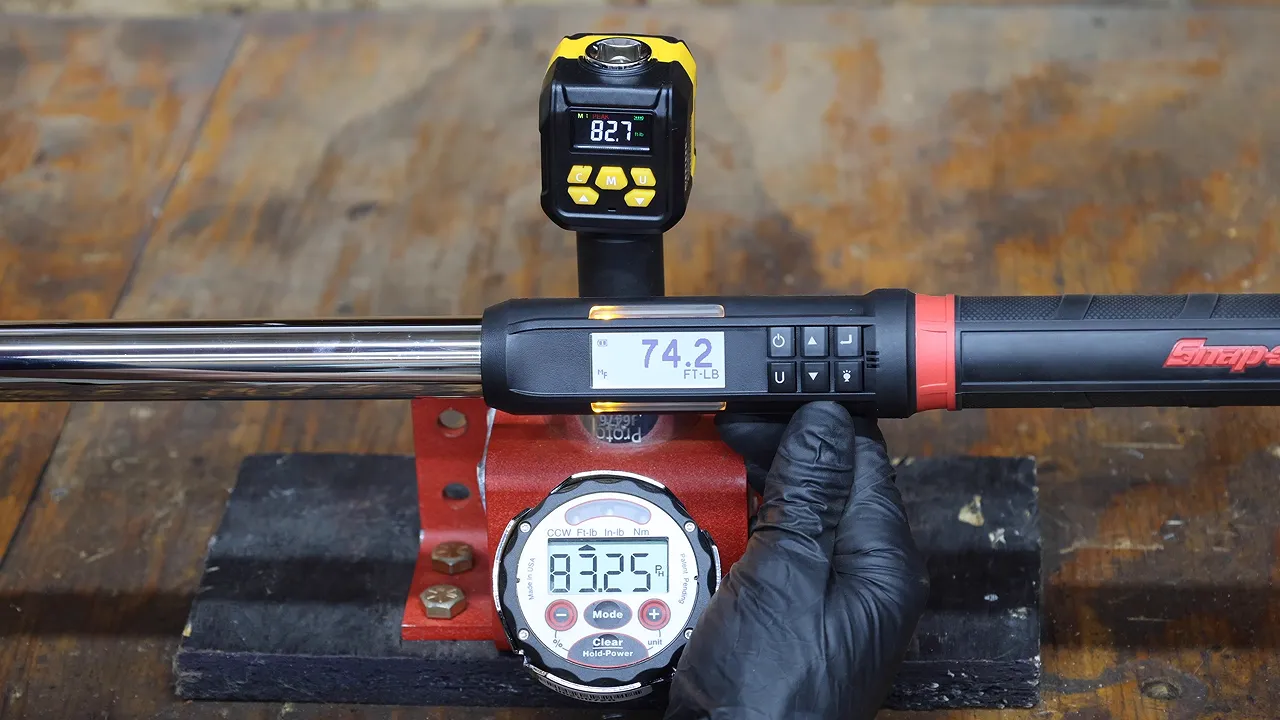
That does not establish that a $27 adapter beats an $800 torque wrench at every task. But in this particular response test, WAXTRON did an impressive job capturing a brief peak. Its electronics were the fastest-performing of the adapters tested.
Accuracy at 80 Foot-Pounds: Reading Correctly Versus Stopping on Time
At the 80-foot-pound setting, most adapters agreed much more closely with the tester. WORKPRO was outstanding, averaging only a 0.08% reading discrepancy across three attempts. One attempt differed by just 0.04%.
NEIKO finished second for reading accuracy at 0.65%, with EPAuto close behind at 0.67%. Fanwiike averaged 0.68%, and LLAVETOR averaged 0.70%.
The remaining average discrepancies were:
- WAXTRON: 0.89%
- ANPUDS: 1.05%
- QUINN: 1.09%
- ALAIAL: 1.38%
- ACDelco ARM302: 1.71%
- Performance Tool: 1.80%
- YIYEIE: 1.80%
- ACDelco Heavy Duty: 2.79%
Only the ACDelco Heavy Duty missed the 2% average-error benchmark in this round. However, several adapters with accurate readings still allowed considerable overshoot before I stopped.
NEIKO is a good example. On one attempt, the tester registered 84.43 foot-pounds and NEIKO displayed 84.3. Those readings agree very closely, but the applied torque was still more than four foot-pounds above the intended setting.
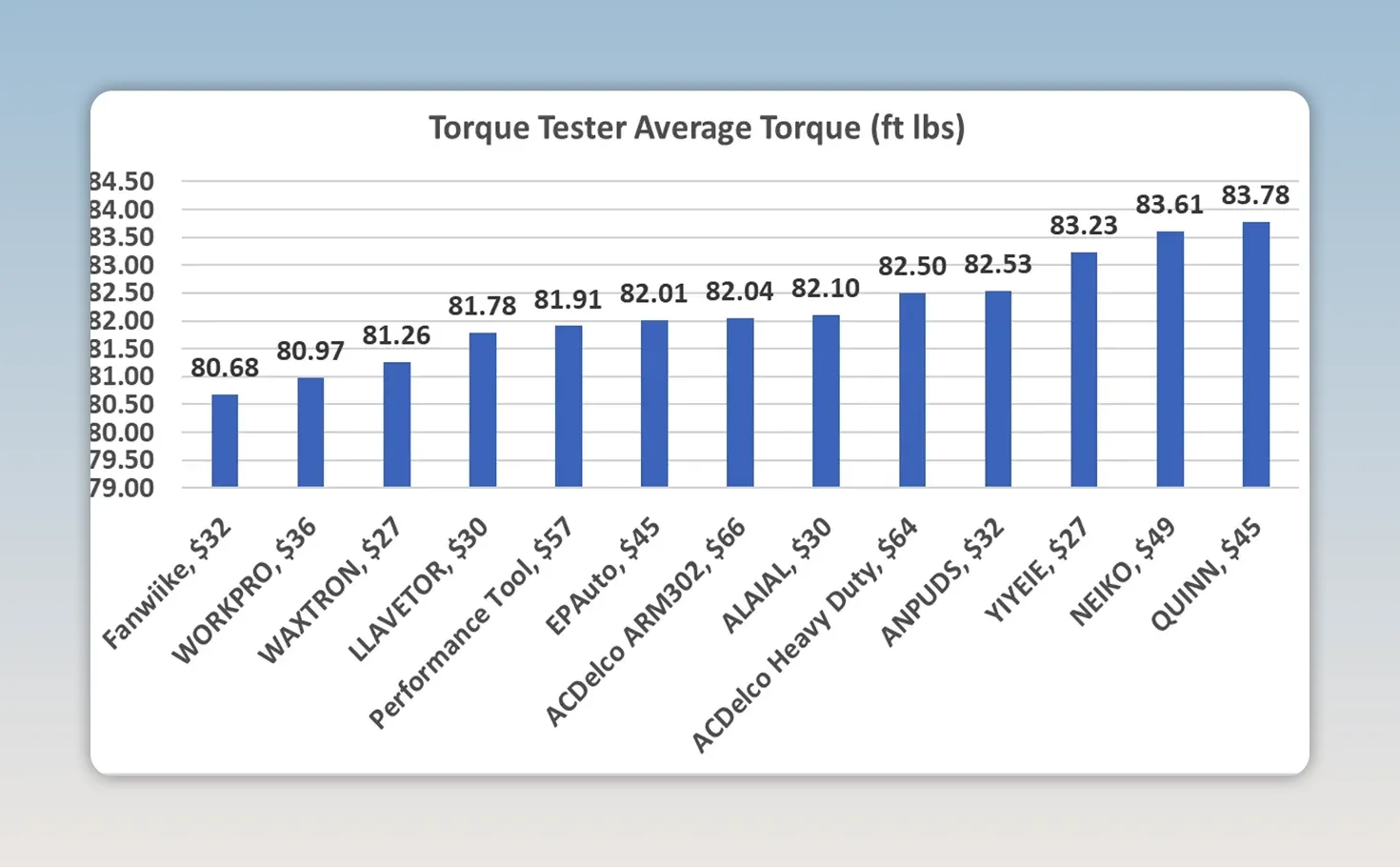
For actually approaching the 80-foot-pound target, the four fast-response adapters led the group:
- Fanwiike: 80.60 foot-pounds average applied torque.
- WORKPRO: 80.97 foot-pounds.
- WAXTRON: 81.26 foot-pounds.
- LLAVETOR: 81.78 foot-pounds.
At the other end, QUINN averaged 83.78 foot-pounds, YIYEIE 83.61, and NEIKO 83.23. Fast electronics made it much easier to stop near the requested torque.
Accuracy at 145 Foot-Pounds: The Same Difference Becomes Even Clearer
Next, I set every adapter to 145 foot-pounds, close to the upper end of most adapters’ listed ranges.
LLAVETOR had the smallest average difference from the tester at 0.45%. Fanwiike followed at 0.46%, then NEIKO and EPAuto at about 0.54% each. WORKPRO averaged 0.55%.
ANPUDS averaged 0.69%, WAXTRON 0.77%, QUINN 0.89%, and ALAIAL 0.92%. YIYEIE, Performance Tool, and the two ACDelco adapters had larger average discrepancies, ranging from approximately 1.61% to 1.79%.
Those are reasonably close readings, but the stopping torque once again told a different story.
YIYEIE’s tester readings were 151.6, 150.1, and 150.8 foot-pounds. The adapter was reasonably close to the tester’s readings, yet I consistently passed the 145-foot-pound target by several foot-pounds before stopping.
EPAuto reached 149.6 foot-pounds on the first attempt and 149.4 on the third. QUINN’s three attempts reached 151.2, 149.8, and 148.8. NEIKO reached 149, 149.8, and 148.4 foot-pounds.
Fanwiike and WORKPRO were much easier to control. Fanwiike’s tester readings were approximately 145.5, 145.6, and 144.6 foot-pounds. WORKPRO reached 145.7, 145.4, and exactly 145.
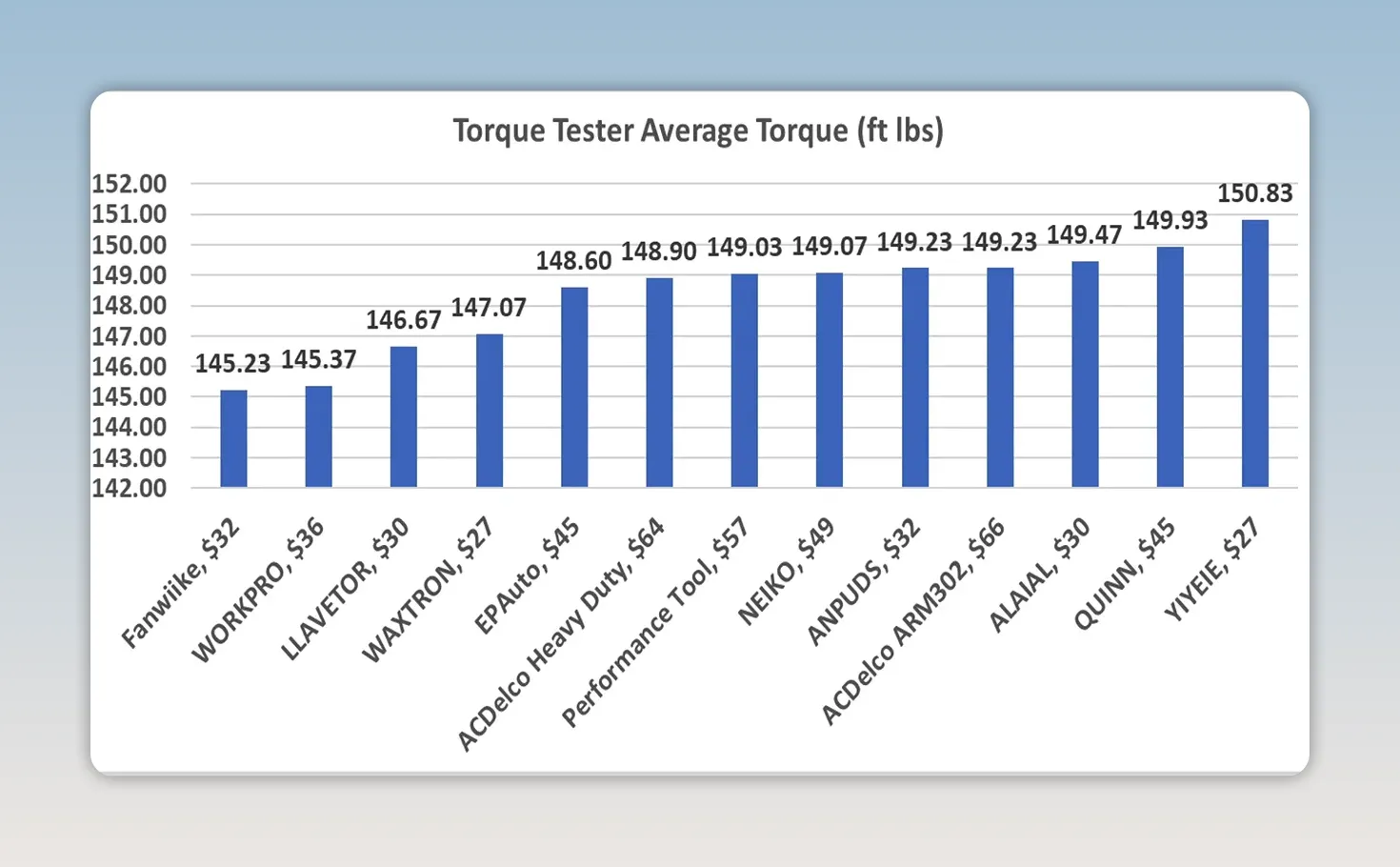
The closest average stopping results were:
- Fanwiike: 145.23 foot-pounds.
- WORKPRO: 145.37 foot-pounds.
- LLAVETOR: 146.67 foot-pounds.
- WAXTRON: 147.07 foot-pounds.
For comparison, YIYEIE averaged 150.83 foot-pounds. Both adapters can display fairly believable numbers, but one is much better at helping you stop where you intended.
After 500 Cycles: Do the Adapters Stay Accurate?
A good first impression is useful. Staying accurate after repeated use is even better.
I cycled every adapter 500 times, then repeated the 80-foot-pound accuracy test. Thirteen adapters multiplied by 500 cycles works out to 6,500 repetitions. Who needs a gym membership with a workout like that?
WORKPRO continued working like a pro. It nearly matched the tester on the first attempt, achieved an exact displayed match on the second, and finished very close again on the third. Its average reading discrepancy remained just 0.08%.
LLAVETOR was also accurate and consistent, while ANPUDS continued returning readings within 1% of the reference. Fanwiike stayed close to the target and remained within roughly 1% of the tester.
Here are the average reading discrepancies after 500 cycles:
- WORKPRO: 0.08%
- LLAVETOR: 0.76%
- NEIKO: 0.77%
- EPAuto: 0.78%
- ANPUDS: 0.79%
- Fanwiike: 1.00%
- ALAIAL: 1.14%
- QUINN: 1.34%
- WAXTRON: 1.34%
- YIYEIE: 1.99%
- ACDelco ARM302: 2.45%
- Performance Tool: 2.55%
- ACDelco Heavy Duty: 2.57%
Ten of the 13 adapters remained within the 2% average-error benchmark. Performance Tool and both ACDelco models finished outside it.
NEIKO’s small display was not especially easy to read, but its reading accuracy remained good. Unfortunately, its slower response still made stopping at the intended torque difficult. EPAuto and QUINN had the same basic problem: reasonably accurate readings did not eliminate overshoot.
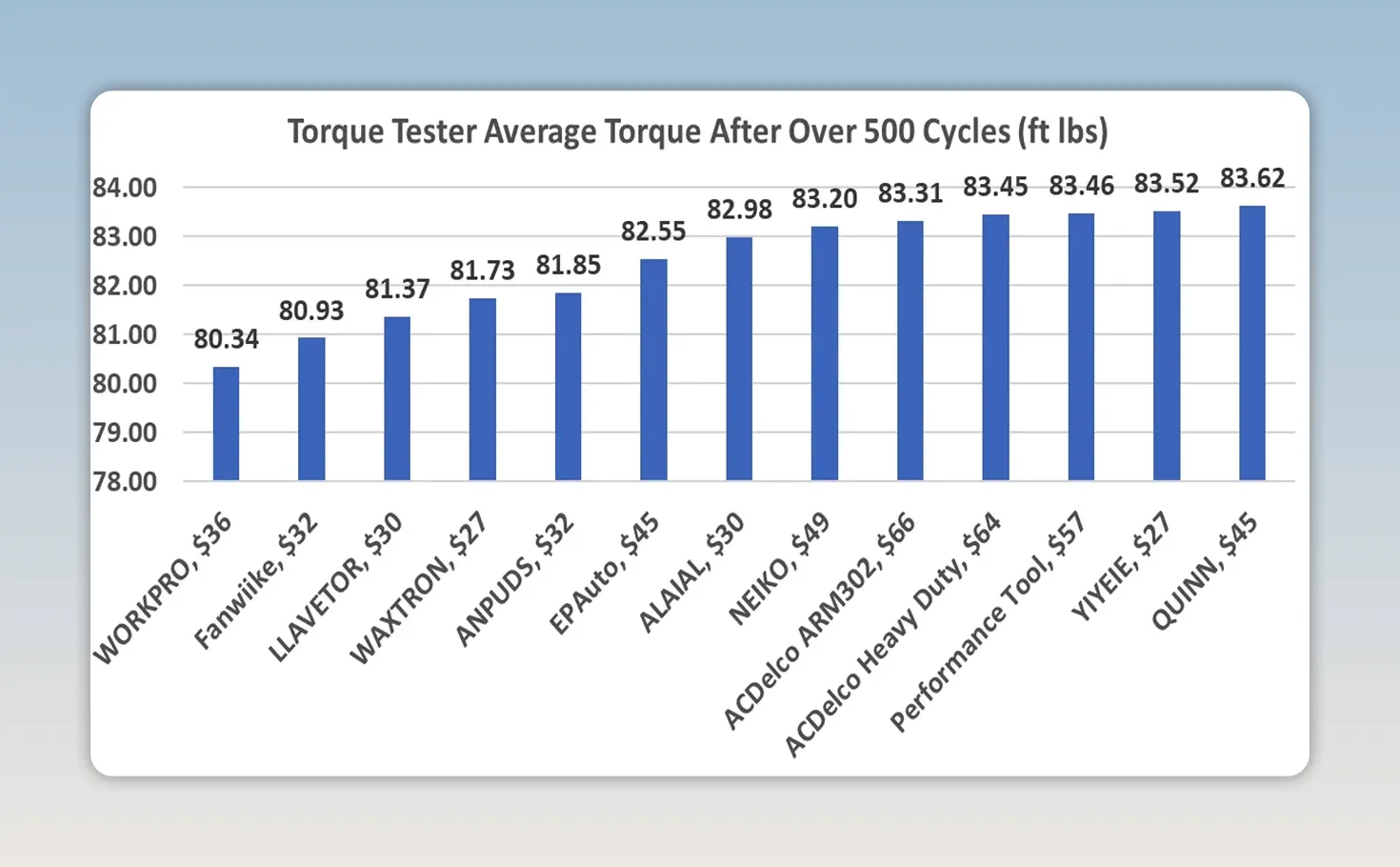
After cycling, the best average stopping results at the 80-foot-pound setting were:
- WORKPRO: 80.34 foot-pounds.
- Fanwiike: 80.93 foot-pounds.
- LLAVETOR: 81.37 foot-pounds.
Those results reinforce the main lesson of this comparison: fast electronics are not just helpful for capturing a peak. They also help prevent you from adding torque after the target has already been reached.
Which Digital Torque Adapter Is Best?
The final ranking used average finishes across the performance categories, not price, weight, size, or buzzer volume. Three adapters clearly stood out.
Best Overall: WORKPRO
The WORKPRO torque adapter finished first overall with an average category placement of 2.2. It placed first, second, or third in every performance category except one.
For just $36, its combination of reading accuracy, fast response, and repeatability was very impressive. It averaged only a 0.08% reading discrepancy at 80 foot-pounds both before and after the 500-cycle test, and it remained easy to stop close to the target.
Despite advertising a less ambitious ±3% accuracy specification than most competitors, this sample delivered outstanding results. Without a doubt, it would be my top pick.
A Very Close Second: Fanwiike
The Fanwiike torque adapter finished just behind WORKPRO with an average placement of 2.3. It won four performance categories and finished above average in all the others.
At $32, it was the most accurate adapter at 25 foot-pounds and the closest to the 145-foot-pound target. Its fast electronics also helped keep stopping torque close to the 80-foot-pound setting after repeated use.
If WORKPRO were not available, Fanwiike would be my next choice.
Another Strong Choice: LLAVETOR
The LLAVETOR torque adapter finished third with an average placement of 2.9. It combined fast electronics with precise readings and consistent performance.
It had the smallest reading discrepancy at 145 foot-pounds and finished second for reading accuracy after 500 cycles. At $30, it is another very good option if WORKPRO and Fanwiike are unavailable.
WAXTRON deserves recognition for its excellent response-test performance, including the direct comparison with the Snap-on. However, it did not match the top three across the full set of tests, and it was listed as no longer available when the product information was prepared.
As an Amazon Associate, I earn from qualifying purchases through the product links above.
Can These Adapters Replace a Torque Wrench?
The best adapters performed every bit as well as many torque wrenches I have tested. I definitely did not expect this level of performance from tools costing $30 to $36.
However, these results do not mean every digital torque adapter is a suitable replacement for every torque wrench. The testing covered specific samples, three torque settings, a response challenge, and 500 use cycles. It did not establish performance at every torque value, in every working position, or in both directions.
A calibration certificate also does not tell the whole story. Most of these adapters came with inspection paperwork, yet their actual results varied considerably. For broader context on measurement calibration, NIST’s calibration resources are a useful reference.
My choice is WORKPRO, followed closely by Fanwiike and LLAVETOR. The important combination is accurate measurement, fast feedback, and repeatable stopping torque. These three delivered it at a surprisingly affordable price.
Find More Product Test Results
The Project Farm test catalog is now available for finding past comparisons by category or brand. A big thank you to my friend David Geller from the Seattle area for building it. I hope it helps save you time and money.
|