Diagonal cutting pliers are a must-have tool in my shop. But is an $8 pair anywhere near as good as a $65 pair of Snap-on pliers? And do German-made wire cutters outperform American-made tools?
I bought 15 pairs of pliers and tested how much handle force each needed to cut a nail, a deck screw, and a 3/16-inch drill bit. Then I pushed the surviving tools against a socket adapter to find out what would bend, break, or hold together.
The big lesson: easy cutting and extreme durability are two different things. Some affordable pliers offered excellent leverage and very hard cutting edges. Some expensive tools required considerably more effort. And the tools that held together under the greatest loads were not necessarily the easiest to use.
Key Takeaways
- Channellock required the least nail-cutting force, while Southwire needed the least force on the deck screw.
- Irwin combined affordable pricing, low cutting effort, and excellent cutting-edge durability across the first three tests.
- Knipex demonstrated exceptional overload toughness but required more cutting effort than the leading high-leverage alternatives.
- Higher prices and country of manufacture did not reliably predict cutting performance.
The Pliers: Prices, Origins and Initial Quality
All the pliers tested were nominally 8 inches long except the Kobalt, which measured 7 inches. Prices below are what I paid for the tools used in this comparison.
- Illinois Industrial Tools, $8: Made in China. Advertised drop-forged, heat-treated steel and precision-machined jaws. The pivot was very loose right out of the package.
- Kobalt, $11: Made in China. Chrome nickel steel, induction-hardened edges, and a high-leverage design. The joint had a very nice, tight fit.
- Craftsman, $15: Made in China. A compound-action design with drop-forged steel and induction-hardened cutting edges. There was quite a bit of joint wobble.
- Doyle, $16: Made in Taiwan and sold at Harbor Freight. Advertised for ACSR, screws, nails, and most hardened wire. Despite the packaging’s no-wobble claim, the joint had considerable play.
- DeWalt, $18: Made in China. Compound-action pliers claiming 70% more cutting power. The fit was tight, but the jaw opening was limited.
- Irwin, $18: Made in China. Nickel chromium steel construction with induction-hardened edges. Less wobble than the Doyle, but still a noticeable amount.
- Channellock, $21: Made in the USA. C1080 high-carbon steel with knife-and-anvil cutting edges. Very good craftsmanship, with no detectable wobble.
- C.S. Osborne, $24: Made in the USA. Drop-forged nippers marketed for hog rings or wire. The joint was not as tight as some competitors.
- Milwaukee, $26: Made in China. Advertised an iron carbide edge and up to twice as many cuts. The joint fit was nice and tight.
- Klein Tools, $27: Made in the USA. Induction-hardened knives and a high-leverage design claiming 36% more cutting power. The joint was not quite as tight as the best examples.
- Southwire, $28: Made in China. Advertised 15% easier cuts, induction-hardened blades, and suitability for nails, screws, and ACSR wire. Some joint play was present.
- Wiha, $33: Manufactured in Vietnam with global components. Advertised a dynamic joint requiring 40% less effort and 64 HRC induction-hardened edges. No wobble.
- Knipex, $33: Made in Germany. High-leverage diagonal cutters with induction-hardened edges, intended for tough continuous use. A nice, tight joint.
- Mac Tools, $44: Forged alloy steel with heat treatment. I could not establish the country of manufacture. The joint was noticeably less tight than several competitors.
- Snap-on, $65: Made in the USA. Advertised a small joint and longer handles for 19% more leverage, with parallel cutting edges intended for hard wire and spring steel. The initial fit was tight.
Weight did not neatly follow price. Illinois Industrial Tools was the lightest at 215.3 grams, followed by DeWalt at 253 grams. C.S. Osborne was the heaviest at 361.7 grams, with Snap-on next at 343.6 grams. Most of the others fell between roughly 275 and 317 grams.
A tight joint matters because side-to-side movement can let the cutting edges move out of alignment. However, the cutting tests would show that initial joint fit alone does not predict cutting effort or edge durability.
How I Measured Cutting Force
For the first test, I used a 16-penny nail made from low-carbon steel. Each pair of pliers was secured in a holder, and two bolts kept the nail positioned against the cutters for maximum available leverage. A hydraulic press applied force at the very end of the handle.
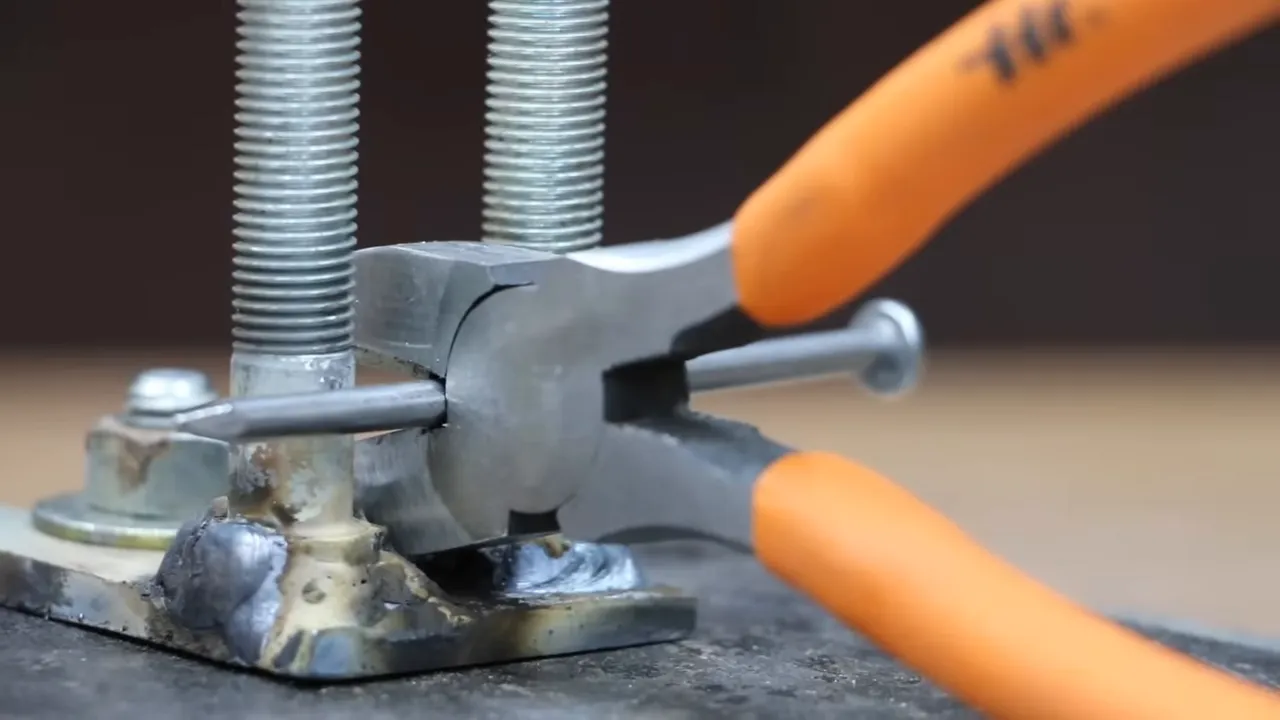
I attached locking pliers to the loose end of the material to keep the cut piece from becoming a projectile. The measured values are pounds of force applied to the handle, not force at the cutting edges.
For context, I used roughly 100 pounds as a reference for average adult male grip strength. That makes leverage a very important part of this comparison. A tool requiring 75 pounds is a very different proposition from one requiring nearly 200.
The later tests deliberately pushed the tools toward destruction. None of these pliers was designed to cut the socket adapter. Those results are overload comparisons, not recommended working capacities.
Test 1: Cutting a 16-Penny Nail
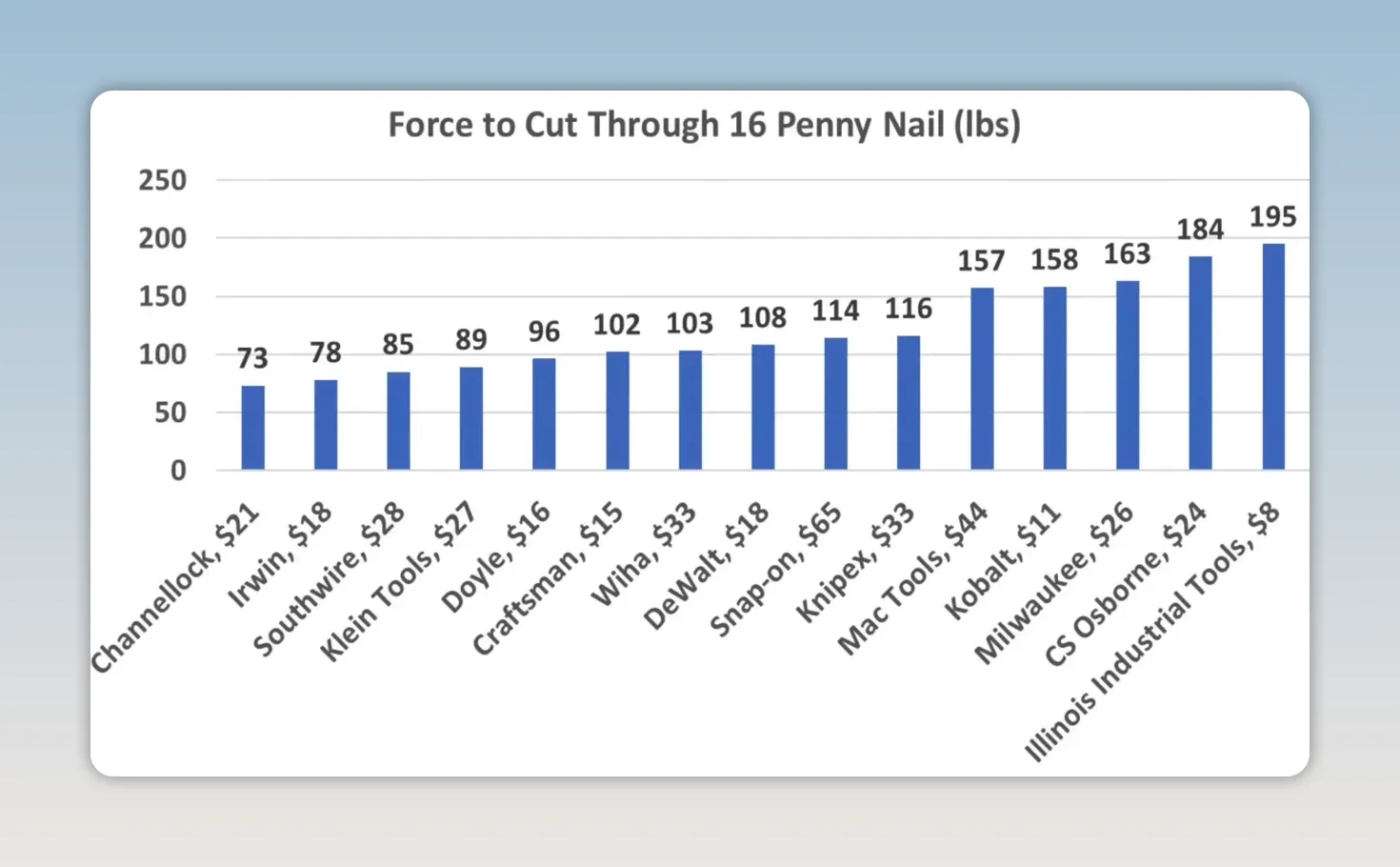
Every pair cut through the nail, and none suffered cutting-edge damage. The amount of effort required, however, varied dramatically.
The easiest nail cutters
- Channellock: 73 pounds
- Irwin: 78 pounds
- Southwire: 85 pounds
- Klein Tools: 89 pounds
- Doyle: 96 pounds
Very impressive performance by Channellock. At $21, it required substantially less force than either the $33 Knipex or the $65 Snap-on.
The middle group included Craftsman at 102 pounds, Wiha at 103, DeWalt at 108, Snap-on at 114, and Knipex at 116.
The remaining tools needed considerably more force: Mac Tools required 157 pounds, Kobalt 158, Milwaukee 163, C.S. Osborne 184, and Illinois Industrial Tools 195.
Why leverage made such a difference
The distance between the pivot and the cutting location has a huge effect on cutting effort. Keeping the material close to the pivot improves the leverage available from the handles.
Irwin had the shortest measured distance from the pivot center to the cutter opening at 6.28 millimeters. Southwire was close at 6.48 millimeters. Kobalt measured 7.24 millimeters, but its handles were an inch shorter than the other tools.
Channellock measured 8.01 millimeters, but its slightly longer handles helped it deliver the lowest nail-cutting force.
Jaw access also matters. The Illinois Industrial Tools cutting edges did not extend inward to the pivot, so the nail could not sit as far back as desired. DeWalt’s limited jaw opening likewise kept the nail farther from the pivot. A compound-action mechanism can help, but only within the geometry the tool allows.
Test 2: Cutting a Deck Screw
Deck screws are much harder than the low-carbon steel nails used in the first test. This round began separating good cutting leverage from the ability to keep the tool and its edges intact.
The $8 Illinois Industrial Tools pliers failed first. At 344 pounds of handle force, they still had not cut the screw. The pliers were badly bent and no longer serviceable.
Southwire and Irwin lead the field
- Southwire: 133 pounds. No cutting-edge damage, and the pliers appeared as good as new.
- Irwin: 135 pounds. No cutting-edge damage, with no apparent increase in joint wobble.
- Channellock: 145 pounds. No cutter damage, and the pliers remained in great shape.
- Klein Tools: 153 pounds. No cutter damage or apparent deterioration.
- DeWalt: 154 pounds. Still in good shape, with no visible cutting-edge damage.
- Doyle: 156 pounds. Some additional joint looseness and a small amount of cutter wear.
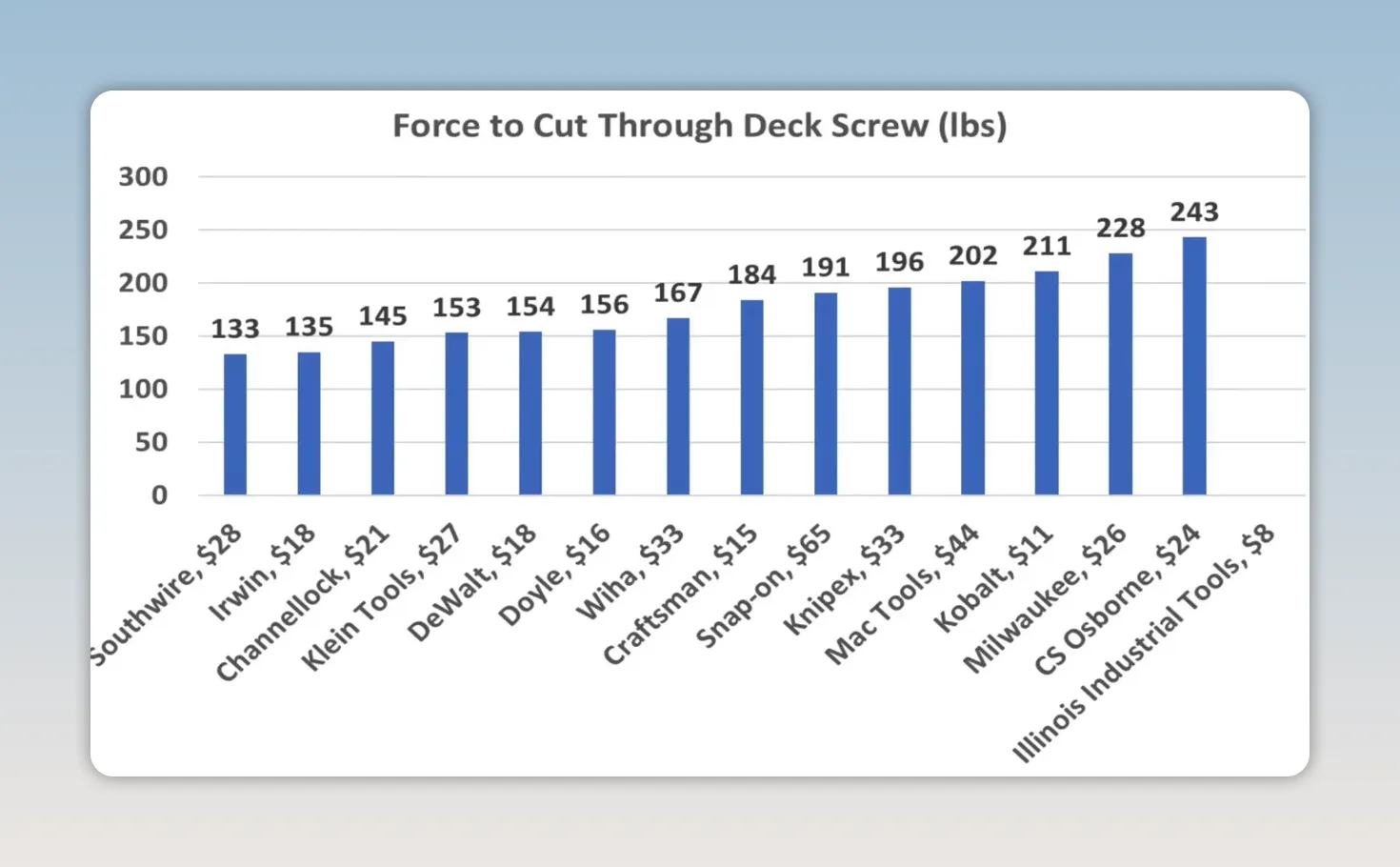
Wiha followed at 167 pounds and remained undamaged. Craftsman needed 184 pounds; its edges were still in great shape, although there was considerable handle wobble.
Snap-on cut the screw at 191 pounds. Its cutting edges were in great shape, but a gap had developed between them with the handles fully closed. Something in the rivet or plier body appeared to have bent.
Knipex required 196 pounds and still looked as good as new. Mac Tools needed 202 pounds, but the screw damaged its cutters, and some joint wobble remained.
The shorter Kobalt cut at 211 pounds, leaving a clean cut with no cutter damage, although the joint had loosened slightly. Milwaukee required 228 pounds and retained undamaged, properly aligned cutters. C.S. Osborne needed 243 pounds and suffered a small amount of damage to one cutting edge.
Paying more did not buy an easier cut. The $18 Irwin required 56 fewer pounds of handle force than the Snap-on, and its cutters stayed undamaged.
Test 3: Cutting a 3/16-Inch Drill Bit
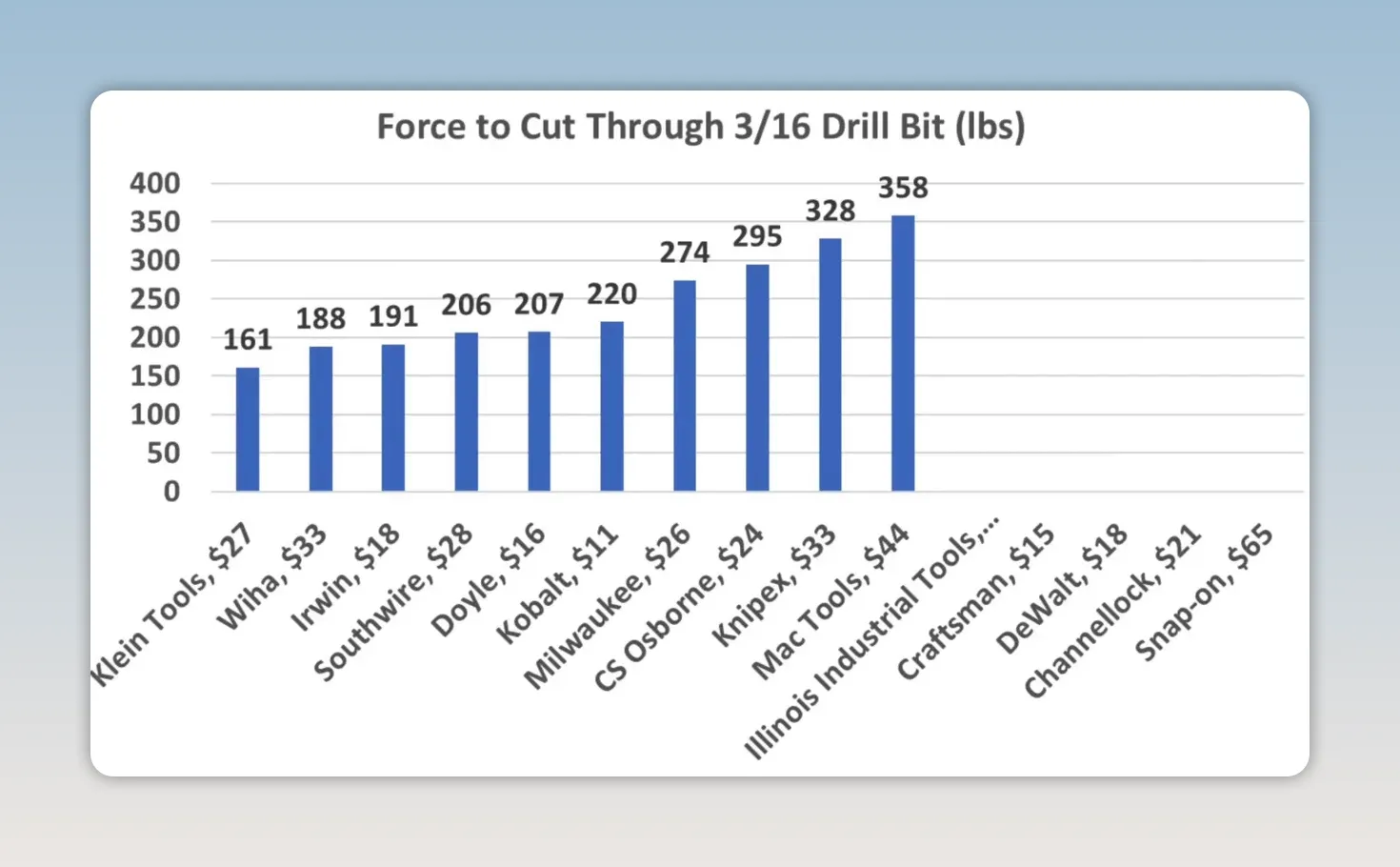
The drill bit brought a much tougher challenge. Illinois Industrial Tools was already out of the comparison, and four more tools failed to complete this cut.
The successful cuts
- Klein Tools: 161 pounds. The lowest force by a substantial margin, though there was minor cutter damage.
- Wiha: 188 pounds. The cutting edges still looked as good as new.
- Irwin: 191 pounds. Another very strong result, with no cutter damage.
- Southwire: 206 pounds. The cutters still looked as good as new.
- Doyle: 207 pounds. The cutters remained aligned and in great shape.
- Kobalt: 220 pounds. No damage to the cutting edges.
- Milwaukee: 274 pounds. Its compact head survived the load with no cutter damage.
- C.S. Osborne: 295 pounds. Both cutting edges sustained some damage.
- Knipex: 328 pounds. Completed the cut, with minor cutter damage.
- Mac Tools: 358 pounds. Completed the cut, but with considerable damage to the cutters.
The tools that failed
- Craftsman broke at 268 pounds without cutting through the drill bit.
- DeWalt failed at 327 pounds. One handle bent, the pliers no longer closed correctly, and the cutters suffered damage.
- Channellock’s rivet failed at 256 pounds. Its cutting edges were also damaged.
- Snap-on’s rivet failed at 345 pounds. There was a small amount of cutter damage as well.
Channellock had excellent leverage in the first two rounds, but its relatively small rivet could not survive this test. Its edge damage also suggested the cutters were less resistant to this material than the Kobalt, Doyle, and Irwin cutters.
Knipex presented the opposite tradeoff. It would not give up structurally, but it took much more force to finish the cut than the leaders.
This is where it helps to judge the results in two parts: how much effort made the cut, and what condition the tool was in afterward. Klein Tools won on effort. Wiha, Irwin, Southwire, Doyle, and Kobalt all completed the cut without visible cutter damage.
Test 4: Socket Adapter Overload Test
None of these diagonal cutters was designed to cut through the socket adapter. The purpose here was to find out how the surviving tools handled an extreme overload and where they eventually failed.
No pair completed the cut. Some snapped a jaw, others lost a rivet, and two held together while deforming badly.
How the surviving tools failed
- Irwin, 320 pounds: One jaw broke. Even after all the testing, the cutting edges themselves were still in great shape.
- Milwaukee, 379 pounds: One jaw broke off. Both cutting edges showed a small amount of damage. A respectable result considering the compact head.
- Southwire, 412 pounds: The jaws broke, but the cutting edges remained nearly as good as new.
- Wiha, 449 pounds: The tool broke at the pivot area, and the cutters sustained damage.
- Kobalt, 462 pounds: One jaw broke off after leaving a sizable dent in the adapter. The cutting edges held up very well.
- C.S. Osborne, 469 pounds: A handle snapped. The cutters showed only a small amount of additional damage.
- Klein Tools, 485 pounds: The rivet came out, but the handles and jaws did not bend or break. The cutters had minor damage.
- Doyle, 550 pounds: The rivet broke, and the cutters suffered considerable damage. Very impressive overload strength for a $16 tool.
Knipex bent instead of breaking
Knipex reached 579 pounds before a handle began to bend. It never broke apart. Considering the load applied, the cutting edges were still in very good shape.
That is a very impressive result. Knipex was not among the easiest cutters to squeeze, but it proved extremely tough when pushed well beyond normal use.
Mac Tools stayed in one piece at 985 pounds
The Mac Tools jaws began to hyperextend at around 550 pounds, but the tool stayed together as the load increased. At 985 pounds, a loud pop accompanied severe jaw hyperextension.
The hydraulic press was nearly out of travel, so I ended the test. The jaws were badly bent and the cutting edges badly damaged, but the pliers remained in one piece.
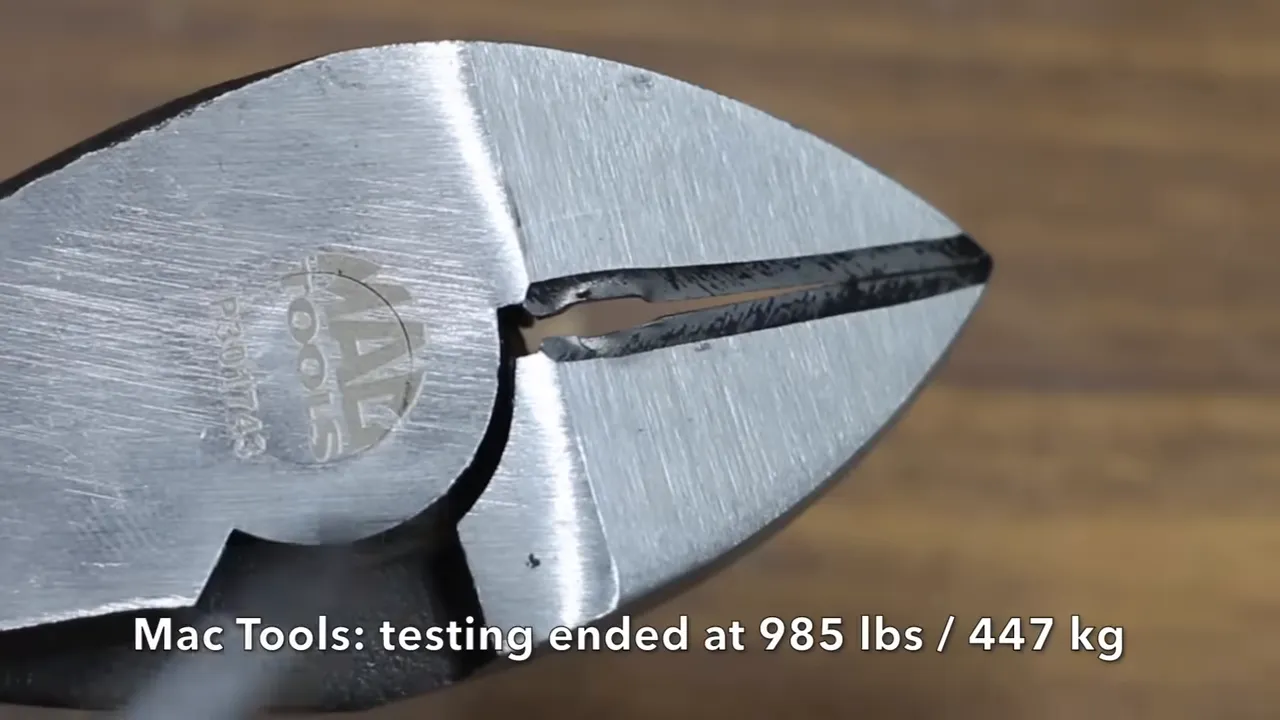
That 985-pound result is not a usable load rating. Mac Tools had already started deforming at a much lower force. It demonstrated an impressive ability to stay together, not an ability to keep cutting normally under that load.
Which Diagonal Cutting Pliers Would I Choose?
Most of these tools are more than durable enough for normal use. The best choice depends on whether you value low cutting effort, cutting-edge durability, purchase price, or resistance to extreme overload.
For affordable, easy cutting: Irwin and Channellock
I like pliers that provide a real leverage advantage, and Irwin at $18 made a very strong case. It finished near the top on nails, screws, and the drill bit, while keeping its cutters in excellent condition. Its joint was not the tightest, but the cutting performance was impressive.
Channellock at $21 was the easiest tool to use on the nail and finished third on the screw. Its initial fit and craftsmanship were excellent. The drill-bit test exposed its limits, but for the easier materials in this comparison, it offered outstanding leverage.
For a little more money: Klein Tools and Southwire
Klein Tools at $27 is a very nice pair of pliers. It performed well on nails and screws, required the least force on the drill bit, and reached 485 pounds in the overload test before losing its rivet. I would expect it to last a long time in appropriate use.
Southwire at $28 also impressed me. It had the lowest screw-cutting force, performed well on the nail and drill bit, and its very hard cutting edges remained nearly undamaged even after contact with the socket adapter.
For exceptional toughness: Knipex
If longevity and build quality are the priorities, Knipex at $33 would be very high on my list. Based on how it handled this testing, it would be my pick for likely long service life.
The tradeoff is effort. It required 116 pounds on the nail, 196 on the screw, and 328 on the drill bit. It costs more than the affordable leverage leaders, and your hand has to work harder.
Other results worth considering
Doyle deserves credit for its value. At $16, it offered good cutting leverage, completed the drill-bit cut, and survived until 550 pounds in the overload test. The joint looseness and cutter wear are worth keeping in mind.
Wiha combined a tight initial joint with a second-place drill-bit result and undamaged edges through that round. Kobalt also held up surprisingly well for an $11, 7-inch tool, although its shorter handles meant more cutting effort.
Snap-on did not justify its highest-in-test price through these results. It required more effort than several less expensive tools, developed a cutting-edge gap after the screw test, and lost its rivet on the drill bit. Mac Tools stayed together under an extraordinary load, but its relatively high cutting effort and earlier edge damage kept it from being my preferred everyday cutter.
The Bottom Line: Buy the Performance You Need
There was no simple US-versus-Germany winner. American-made Channellock and Klein Tools delivered excellent leverage. German-made Knipex demonstrated exceptional structural toughness. Chinese-made Irwin and Southwire combined strong cutting performance with very durable edges.
The $8 Illinois Industrial Tools pliers were not just as good as the better tools. But spending $65 did not guarantee the best performance, either.
For my shop, I would put Irwin, Channellock, Klein Tools, and Southwire on the shortlist for easier cutting, with Knipex standing out when toughness is the priority. Choose for the material you actually need to cut, and keep the socket adapters out of the jaws.


