Milwaukee now offers diagonal cutters made in the USA. At $35, they cost less than half as much as the $78 Snap-on pair. So, does spending more buy easier cuts, better cutting edges, or a tougher tool?
I purchased all 16 pairs of diagonal cutters for this comparison. Prices ranged from $10 to $78, and most were about 8 inches long. The tests started with a 16-penny nail, moved up to a number 10 deck screw, and then got much tougher with a drill bit shaft and a hardened hex key.
The affordable brands were very impressive. SK earned the best overall average finish, WORKPRO delivered tremendous cutting performance for $13, and KNIPEX was the only pair in this group to cut completely through the hex key without breaking. Those are three very different accomplishments, and the distinction matters when choosing a pair.
Quick Summary
- SK earned the best overall average finish and was my budget pick at $18.
- WORKPRO delivered outstanding $13 cutting performance, including the lowest force on the drill bit shaft.
- Wiha required the least force to cut the deck screw using its high-leverage setting.
- KNIPEX alone cut completely through the hardened hex key without breaking.
Table of Contents
- What Makes Diagonal Cutters Easy to Use?
- The Diagonal Cutters Tested
- Test 1: Cutting a 16-Penny Nail
- Test 2: Cutting a Number 10 Deck Screw
- Test 3: How Freely Do the Handles Move?
- Test 4: Cutting a 3/16-Inch Drill Bit Shaft
- Test 5: A Hardened Hex Key Pushes the Tools to Failure
- Milwaukee vs. Snap-on: Was the Extra Money Worth It?
- Which Diagonal Cutters Would I Choose?
What Makes Diagonal Cutters Easy to Use?
A sharp cutting edge helps, but it is only part of the story. Pivot location, handle length, blade geometry, edge hardness, and joint resistance all affect how much effort a cut requires.
For maximum leverage, the material needs to sit as close to the pivot as possible. However, your hand has to reach around the handles. A large maximum jaw opening is not especially useful for one-handed cutting if the handles are spread too far apart.
To compare the tools on the same basis, I set the handles 5 inches, or 12.7 centimeters, apart and measured the jaw opening near the pivot. A smaller opening at that fixed handle spread generally indicated a stronger leverage profile, although the cutting tests would determine how well the complete design worked.
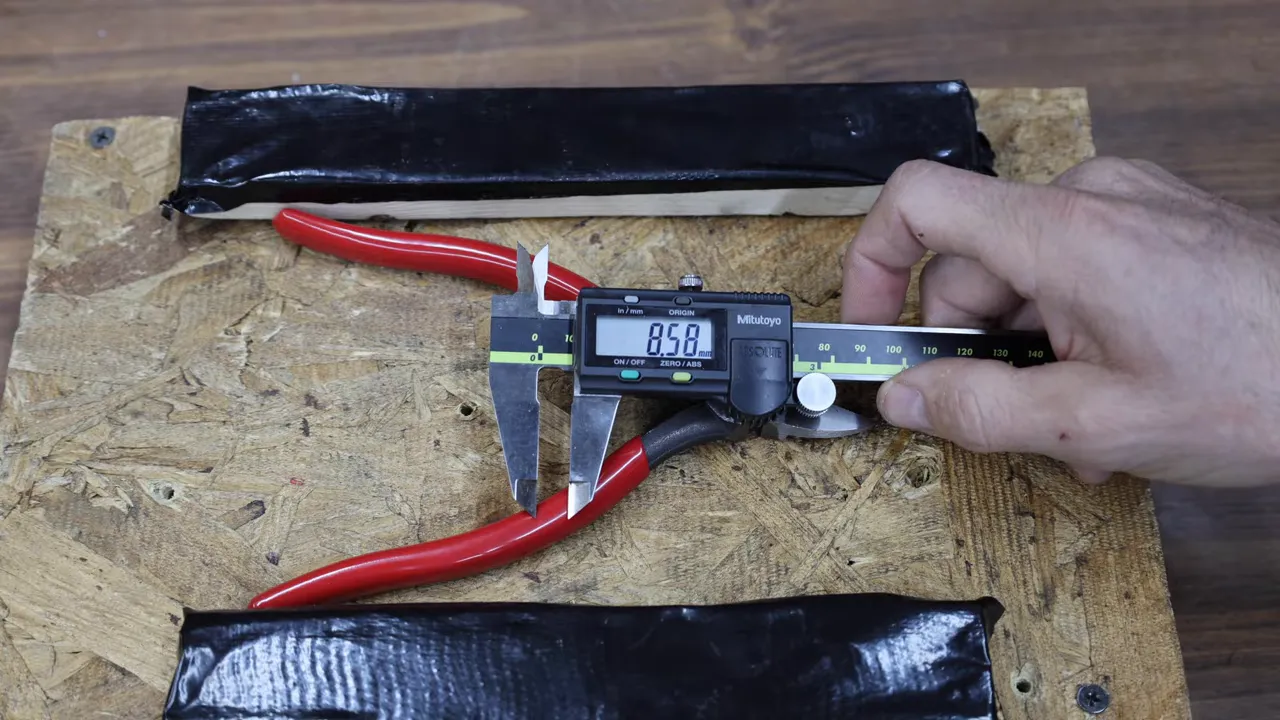
The differences were substantial:
- Wiha: 2.04 mm in its maximum-leverage setting, compared with 4.92 mm in its wider-opening setting.
- Craftsman and Crescent: 2.58 mm and 2.82 mm, respectively, using compound-action designs.
- Channellock, GEARWRENCH, and Southwire: 3.43 mm, 3.56 mm, and 3.95 mm.
- WORKPRO and SK: Nearly identical at 4.25 mm and 4.26 mm.
- Milwaukee, Snap-on, and Irwin: 4.64 mm, 4.80 mm, and 4.89 mm.
- Klein Tools, GEDORE, KNIPEX, and Engineer: 5.31 mm, 5.94 mm, approximately 6.03 mm, and 6.72 mm.
- Utoolmart: The largest opening at 8.58 mm, putting it at a significant leverage disadvantage.
The Craftsman could open to about 5.66 mm near the pivot with the handles spread farther apart, but that wider opening would call for two-handed use. Wiha took a different approach, using a push-button mechanism to switch between jaw capacity and leverage.
These measurements help explain performance, but they do not predict the winner by themselves. Several tools with excellent leverage profiles still required more cutting force than simpler designs.
The Diagonal Cutters Tested
These were the purchase prices and stated origins of the specific pairs tested, not a statement about every tool sold under each brand. Manufacturer performance claims were treated as claims to test.
Budget Models: $10 to $26
- Utoolmart, $10: Made in Japan, with claimed carbon-steel construction and spring-loaded handles. At 215.86 grams, it was the lightest pair tested.
- WORKPRO, $13: Made in China. It claimed a high-leverage design requiring 30% less effort, beveled cutting edges, and a corrosion-resistant coating.
- SK, $18: Made in China, with claimed high-carbon-steel construction, laser-hardened edges, and anti-slip comfort grips.
- Craftsman, $23: Made in Vietnam and finished in China. It used compound action, drop-forged steel, and carried a lifetime warranty.
- Engineer, $23: Made in Japan and designed for nails and screws, with a claimed cutting-edge hardness of 58 HRC.
- Irwin, $26: Made in China, with an angled head, laser heat-treated cutting edges, and cushioned two-zone grips.
Midpriced Models: $29 to $41
- Channellock, $29: Made in the USA, with a design marketed as offering extreme leverage and reduced cutting effort.
- Southwire, $29: Made in China, with an angled head, induction-hardened blades, and a lifetime warranty.
- Crescent, $30: Made in China. It claimed 40% less cutting effort through compound action and a half-inch jaw capacity. At 362.8 grams, it was the heaviest pair.
- GEARWRENCH, $35: Made in Vietnam and finished in China. It claimed laser-hardened cutting edges, 35% less cutting effort, and reaming edges for deburring pipe.
- Milwaukee, $35: Made in the USA from press-forged steel, with claimed optimized pivot geometry, laser-hardened edges, smooth joint action, and a lifetime guarantee.
- Wiha, $37: Made in Vietnam, with a selectable leverage mechanism and a claimed dynamic joint requiring 40% less effort.
- KNIPEX, $38: Made in Germany, with a claimed cutting-edge hardness of approximately 64 HRC and a design intended for tough, continuous use.
- Klein Tools, $41: Made in the USA, with induction-hardened knives designed for ACSR, screws, nails, and most hardened wire.
Premium-Priced Models
- GEDORE, $70: Made in Austria, with claimed induction-hardened precision edges rated at 63 to 65 HRC.
- Snap-on, $78: Made in the USA. It claimed that a small joint and longer handles increased leverage by 19%, with cutting capability extending to spring steel.
Test 1: Cutting a 16-Penny Nail
For the first cutting test, a bracket held the nail against the pivot to give each tool the best leverage available. Locking pliers helped restrain the cut piece, and a force gauge measured the load required to close the handles through the cut.
This was a controlled comparison, not a recommendation to push diagonal cutters beyond their rated capacity. The later tests deliberately destroyed tools. For practical handling guidance, the CCOHS pliers safety guide provides useful precautions.
SK made the nail cut at just 66 pounds of peak force. WORKPRO was right behind at 68 pounds, and GEARWRENCH needed 69 pounds. That is very impressive performance from an $18 tool and a $13 tool.
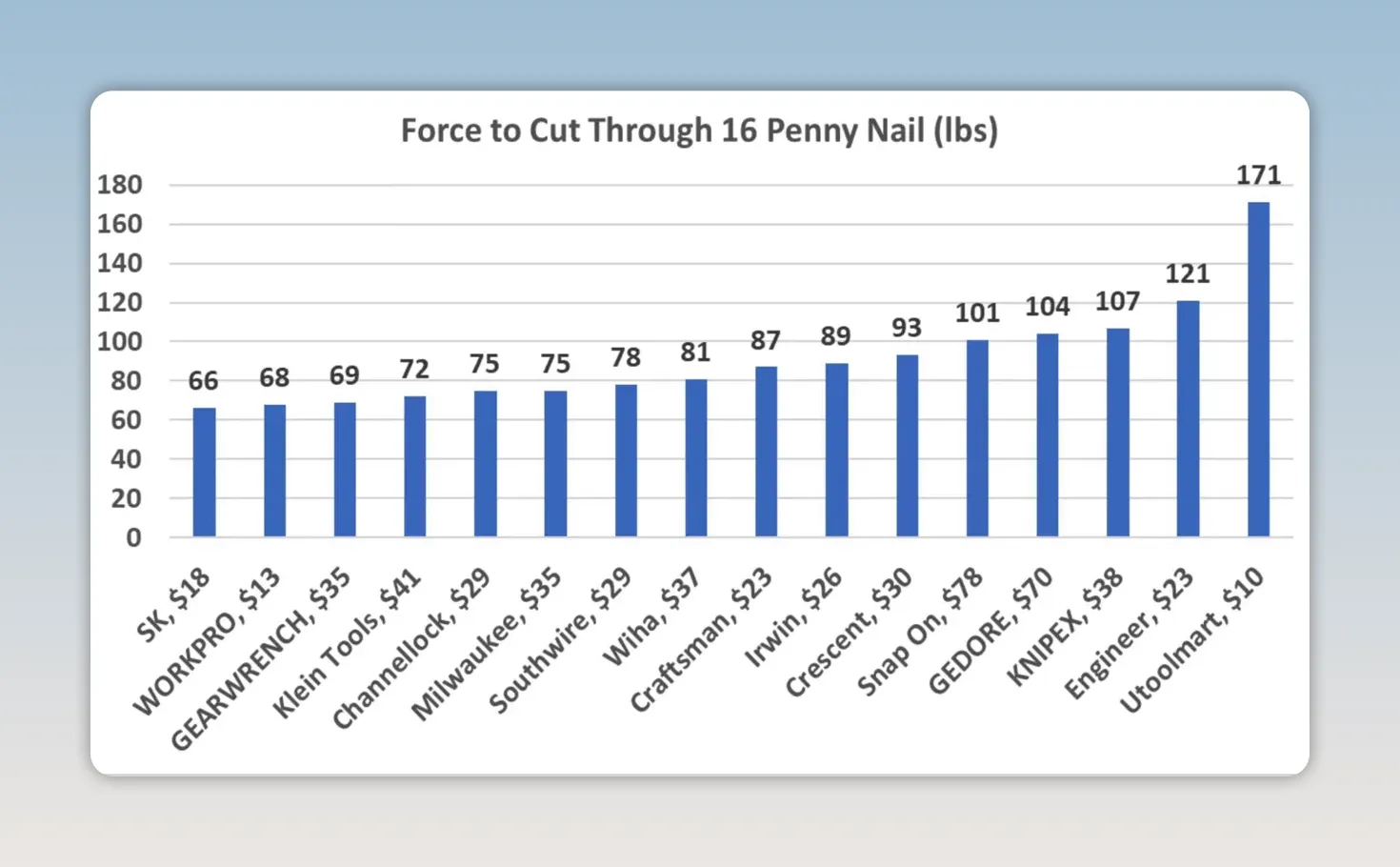
Results, from lowest to highest peak cutting force:
- SK: 66 lb
- WORKPRO: 68 lb
- GEARWRENCH: 69 lb
- Klein Tools: 72 lb
- Channellock and Milwaukee: 75 lb each
- Southwire: 78 lb
- Wiha: 81 lb
- Craftsman: 87 lb
- Irwin: 89 lb
- Crescent: 93 lb
- Snap-on: 101 lb
- GEDORE: 104 lb
- KNIPEX: 107 lb
- Engineer: 121 lb
- Utoolmart: 171 lb
The Utoolmart edges looked sharp, but the leverage disadvantage really hurt. Worse, the relatively soft nail caused visible damage to the cutting edges. WORKPRO required far less force, and its edges still looked very good afterward.
Klein Tools also deserves credit here. Despite a less favorable leverage measurement than several competitors, it finished near the top. Milwaukee performed better than average, too, beating Snap-on by 26 pounds of required force.
The compound-action Craftsman and Crescent did not lead the group. Their results reinforce an important point: extra leverage cannot fully compensate for cutting-edge geometry, sharpness, and the rest of the mechanism.
Test 2: Cutting a Number 10 Deck Screw
A deck screw is harder than a nail, so this round increased the demand on both the cutting edges and the tool bodies.
Wiha’s high-leverage setting really paid off. It took approximately 120 pounds to cut the screw, comfortably ahead of SK at 137 pounds and Channellock at 140 pounds.
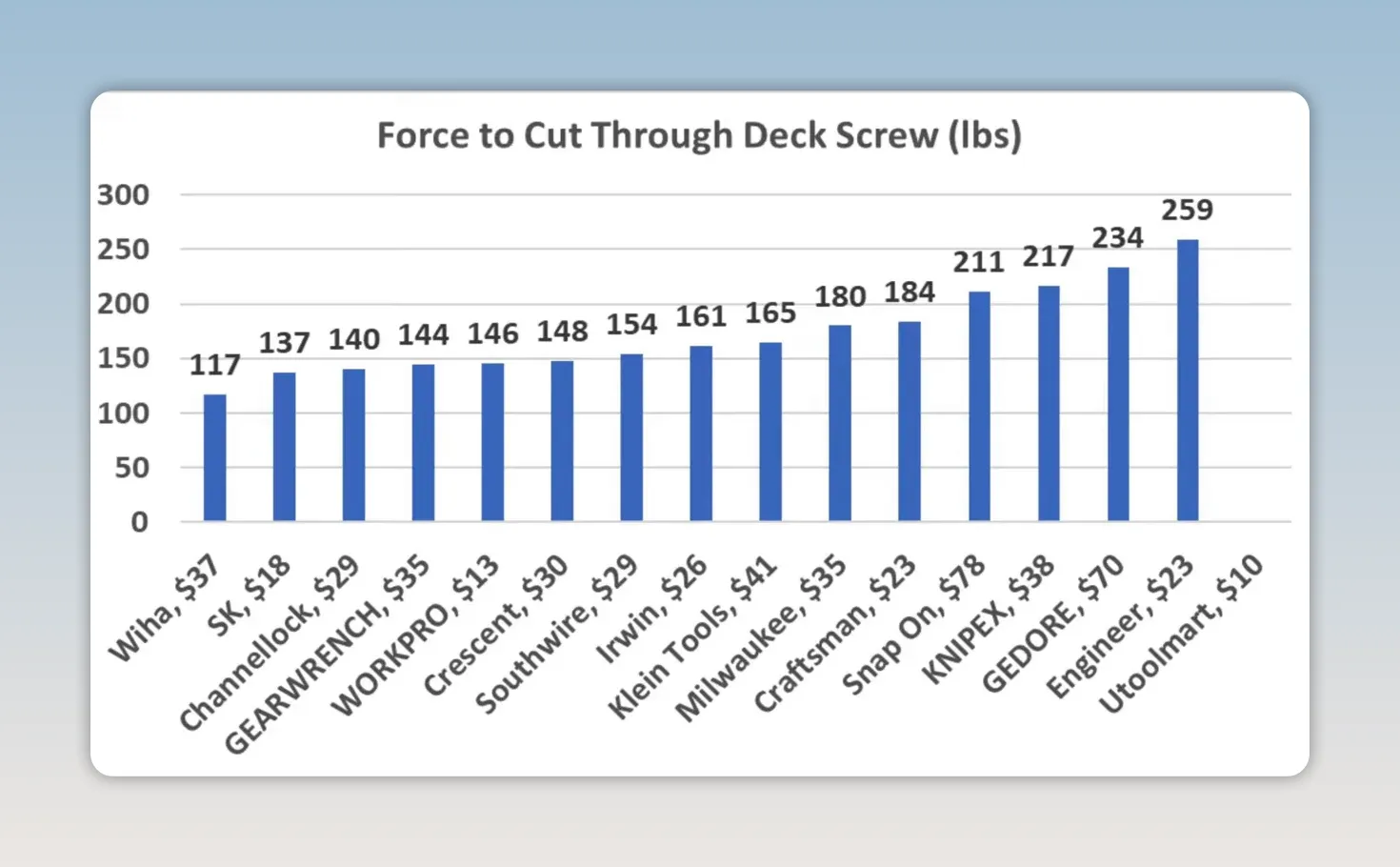
The remaining results showed how competitive the affordable tools had become:
- GEARWRENCH: 144 lb
- WORKPRO: 146 lb
- Crescent: 148 lb
- Southwire: 154 lb
- Irwin: 161 lb
- Klein Tools: 165 lb
- Milwaukee: 180 lb
- Craftsman: 184 lb
- Snap-on: 211 lb
- KNIPEX: 217 lb
- GEDORE: 234 lb
- Engineer: 259 lb
- Utoolmart: 290 lb, with catastrophic cutting-edge damage
WORKPRO was working like a pro once again. It remained close to the leaders despite costing a fraction of several competitors. SK followed its nail-cutting win with another excellent result, while Channellock delivered a strong combination of leverage and cutting performance.
The Utoolmart suffered tremendous damage under the microscope and did not continue into the tougher cutting rounds. The premium-priced Snap-on and GEDORE pairs required substantially more force than several tools costing less than $30.
Test 3: How Freely Do the Handles Move?
Cutting force is not the only kind of effort that matters. A stiff joint adds resistance every time the handles move, even before the cutting edges contact anything.
I opened and closed each pair 100 times to help break in the joint, then used a digital push-pull meter to measure the force needed to close the handles.
Nine pairs closed without noticeable resistance registering on the meter:
- SK
- Engineer
- Irwin
- Channellock
- Southwire
- Milwaukee
- Wiha
- Klein Tools
- GEDORE
Milwaukee performed as advertised on smooth joint action. SK also felt much more refined than its low price might suggest.
The other pairs required measurable closing force:
- KNIPEX: 280 grams, approximately 0.6 lb.
- Crescent: 400 grams, approximately 0.9 lb.
- Utoolmart: 450 grams, approximately 1 lb, including its spring resistance.
- GEARWRENCH: 640 grams, approximately 1.4 lb.
- WORKPRO: 1,170 grams, approximately 2.6 lb.
- Craftsman: 1,290 grams, approximately 2.8 lb.
- Snap-on: About 2.4 kilograms, with the reported result around 5.5 lb.
The Snap-on pair was purchased new directly from Snap-on, yet it was the stiffest after the break-in cycles. WORKPRO’s stiffness was its most obvious drawback up to this point. It cut extremely well, but SK offered much freer movement.
Test 4: Cutting a 3/16-Inch Drill Bit Shaft
The next challenge was the shaft of a 3/16-inch drill bit, approximately 4.7 mm in diameter.
WORKPRO won this round at only 158 pounds. SK finished second at 187 pounds, followed by Wiha at 196 pounds and Channellock at 197 pounds. Once again, the $13 tool was making a very strong case for itself.
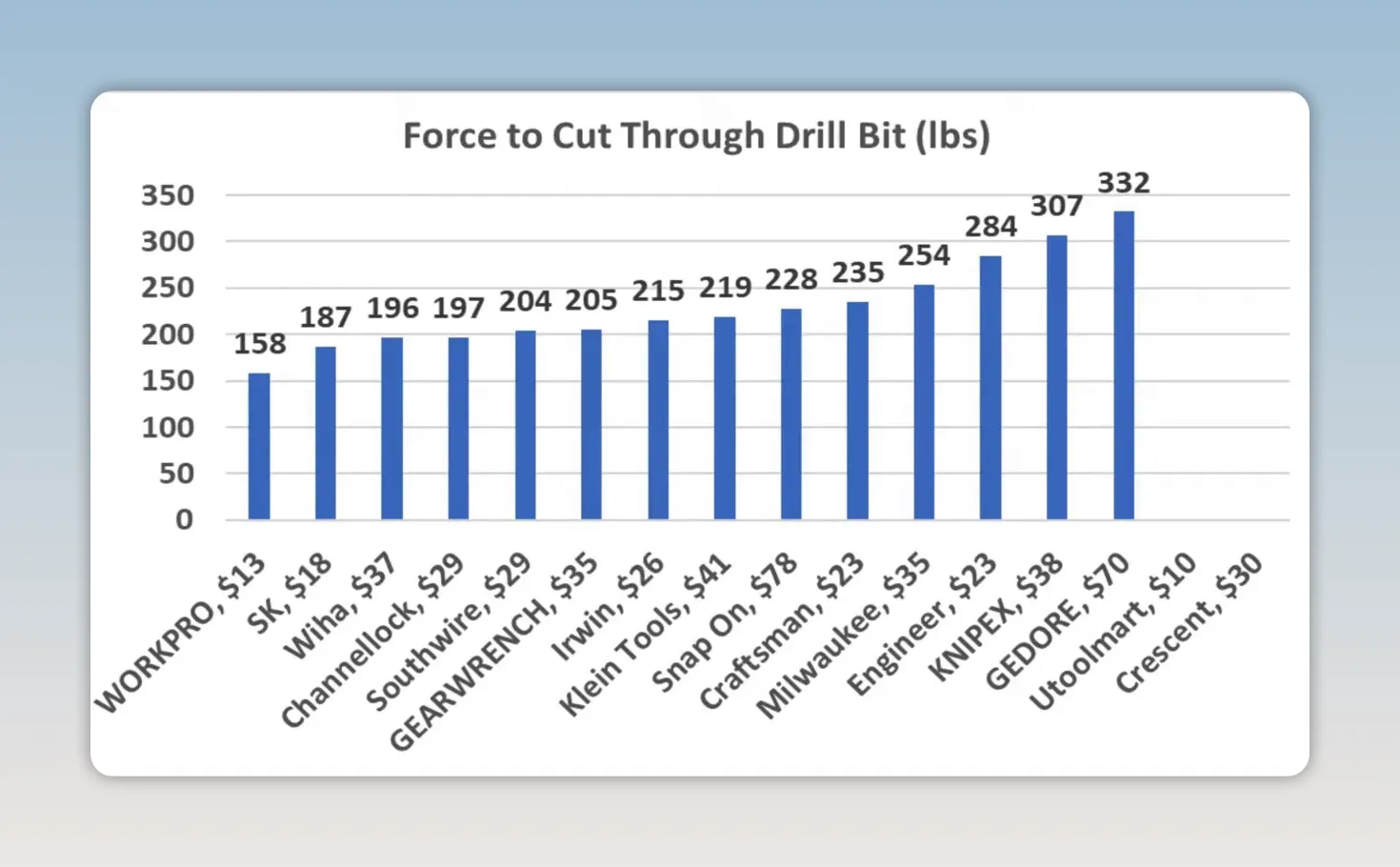
Results for the tools that completed the cut:
- WORKPRO: 158 lb
- SK: 187 lb
- Wiha: 196 lb
- Channellock: 197 lb
- Southwire: 204 lb
- GEARWRENCH: 205 lb
- Irwin: 215 lb
- Klein Tools: 219 lb
- Craftsman: Approximately 225 lb
- Snap-on: 228 lb
- Milwaukee: 254 lb
- Engineer: 284 lb
- KNIPEX: 307 lb
- GEDORE: 332 lb
Crescent could not complete the cut. Its main body experienced catastrophic damage, although the cutting edges held up well.
KNIPEX and GEDORE required considerable force, but both survived this round. That distinction would become important in the final test: a tool can require more handle force and still have a very durable body and cutting edges.
Test 5: A Hardened Hex Key Pushes the Tools to Failure
In roughly five years of previous testing, only one pair of pliers had successfully cut through a 3/16-inch hex key. This was an extreme destructive test, not an ordinary cutting task.
I measured both the maximum applied load and the progress each tool made into the hex key. Those measurements answer different questions. A tool might withstand a tremendous load without cutting very deeply, while another might penetrate farther before its body or jaw fails.
Affordable Cutting Performance Did Not Guarantee Survival
WORKPRO finally broke at 235 pounds. Its main body failed, with relatively little cutting-edge damage, after making 0.11 mm of progress. SK failed at 233 pounds and made about 0.10 mm of progress.
Both had been excellent in the earlier cutting tests. Neither survived this much harder material.
Craftsman lasted longer, reaching 353 pounds before a jaw failed. It made 0.35 mm of progress, considerably more than WORKPRO or SK.
Engineer and GEDORE Withstood High Loads
Engineer had struggled in the cutting-force tests, but it proved very difficult to break. Its body finally failed at 528 pounds, with the cutting edges still in good condition. It made 0.46 mm of progress.
GEDORE also withstood a very high load, reaching just under 500 pounds before its body broke. It made 0.37 mm of progress, although its cutting edges suffered considerable damage.
The remaining failures showed a wide range of outcomes:
- Irwin: A jaw broke at 287 lb, after about 0.10 mm of progress.
- Channellock: The main body broke at 263 lb, after 0.26 mm of progress.
- Southwire: Broke into two pieces just above 300 lb, with substantial edge damage and 0.24 mm of progress.
- GEARWRENCH: A jaw broke just above 300 lb, with badly damaged edges and 0.16 mm of progress.
- Milwaukee: Became badly bent at approximately 272 lb, but made 0.40 mm of progress.
- Wiha: The main body broke and a jaw bent at 243 lb. Its edges remained in fairly good shape after 0.24 mm of progress.
- Klein Tools: The main body failed at 387 lb, after an impressive 0.75 mm of progress.
- Snap-on: The main body cracked at 299 lb, after 0.18 mm of progress.
KNIPEX Was the Only Pair to Complete the Cut
KNIPEX required 531 pounds of force, but it cut completely through the hex key and remained in relatively good condition. Very impressive!
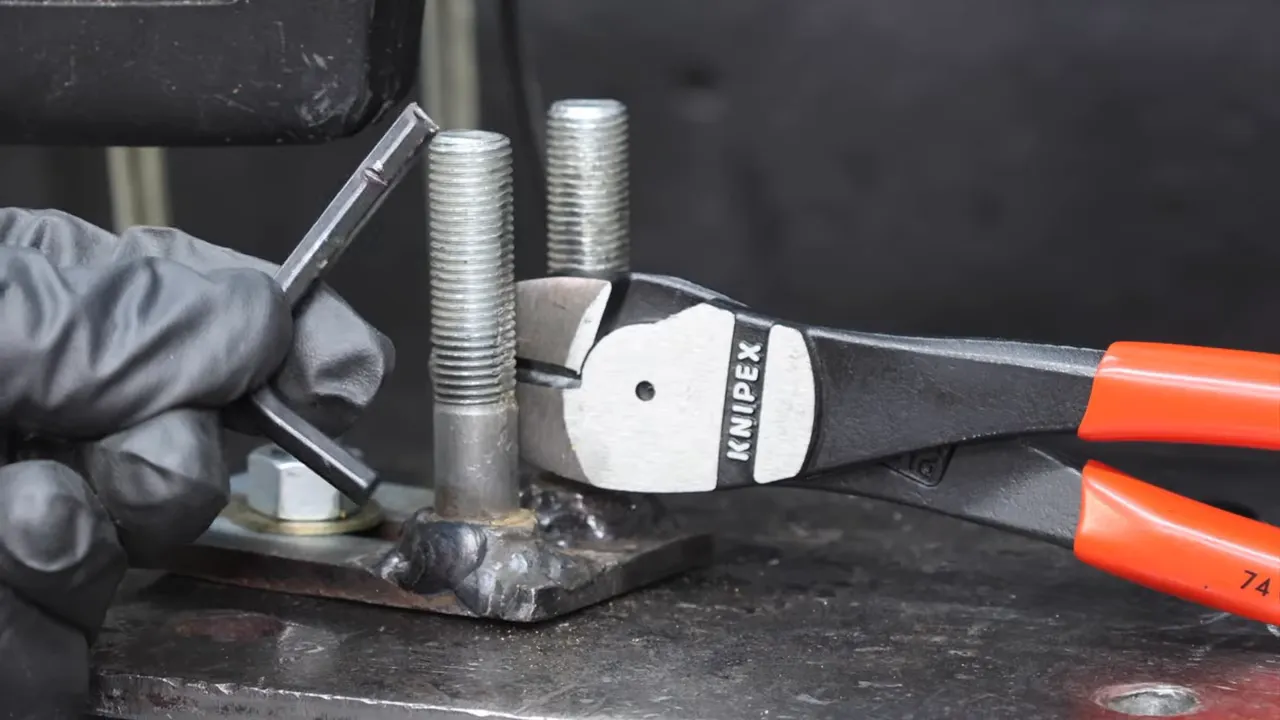
It became only the second pair I had ever tested to accomplish that cut. Klein Tools made the next-deepest cut at 0.75 mm, but it did not come close to cutting all the way through.
KNIPEX was not the easiest-cutting tool in the earlier rounds, but it was the clear survivor of this extreme test. Cutting efficiency and resistance to destruction are not the same thing.
Milwaukee vs. Snap-on: Was the Extra Money Worth It?
The original question was whether the $35 USA-made Milwaukee diagonal cutters could compete with the $78 USA-made Snap-on pair.
Milwaukee required less force for two of the three completed cutting comparisons:
- 16-penny nail: Milwaukee needed 75 lb; Snap-on needed 101 lb.
- Deck screw: Milwaukee needed 180 lb; Snap-on needed 211 lb.
- Drill bit shaft: Snap-on needed 228 lb; Milwaukee needed 254 lb.
Milwaukee’s joint moved freely, while Snap-on’s was the stiffest tested. Neither survived the hex key test. Snap-on reached a somewhat higher load before cracking, but Milwaukee made more progress into the hex key before becoming badly bent.
For these specific pairs and tests, Snap-on’s higher price did not deliver a consistent performance advantage. Milwaukee was competitive, but several less expensive tools also required less cutting force than either one.
Which Diagonal Cutters Would I Choose?
For the overall comparison, I converted the graded results into first-to-last-place rankings and averaged those finishes. Basic information such as price, weight, jaw-opening measurements, and raw hex-key failure load was shown separately rather than directly included in the average.
Best Overall Average and My Budget Pick: SK
The SK diagonal cutters earned the best average finish at 3.8. They won the nail test, finished second on the deck screw and drill bit shaft, and moved freely without noticeable joint resistance.
At $18, they would definitely be my budget pick. They made the nail and screw cuts look easy, and the smooth joint was a real advantage over WORKPRO.
Strong USA-Made Choice Under $30: Channellock
The Channellock diagonal cutters finished second overall with an average finish of 4.0. They combined strong cutting results with free-moving handles and a useful high-leverage design.
They did not survive the destructive hex key test, but their performance across the comparison made them very hard to beat for less than $30.
Best Deck Screw Performance: Wiha
The Wiha diagonal cutters finished close behind with an average finish of 4.2. Their selectable mechanism delivered the lowest deck screw cutting force, a third-place drill bit result, and smooth handle movement.
That unusual design delivered a measurable benefit, especially on the screw.
Outstanding Cutting Value at $13: WORKPRO
The WORKPRO diagonal cutters were a fantastic deal. They finished second on the nail, fifth on the deck screw, and first on the drill bit shaft.
The stiff joint and failure in the final destructive test are worth remembering. Even so, the cutting performance at this price was extremely impressive.
Extreme Durability Standout: KNIPEX
The KNIPEX diagonal cutters were the only pair in this group to complete the hardened hex key cut and remain intact. If the priority is the ability to withstand that kind of extreme loading, they delivered a result nobody else matched.
They required more effort on nails, screws, and the drill bit shaft than the cutting-force leaders. That is why the toughest survivor was not the overall average winner.
My bottom line: SK offered the best overall combination in this comparison, Channellock was a very strong USA-made option under $30, Wiha’s leverage mechanism proved effective, and WORKPRO delivered remarkable cutting performance for $13. KNIPEX earned a separate distinction by surviving the hardest test of all.
Nearly five years after the previous diagonal-cutter comparison, the improvement among the budget brands was especially impressive. A higher price certainly did not guarantee an easier cut.


