Gas chainsaws bring plenty of noise and two-stroke smoke. But can a lithium battery chainsaw actually cut faster? And if it can, how much runtime do you give up?
I compared five cordless chainsaws from Worx, Ryobi, DeWalt, Makita and Milwaukee against a Stihl MS 170 gasoline saw. The testing covered cutting speed in stacked 4x4 lumber, cutting performance in honey locust hardwood, user effort, noise, weight, no-load runtime and battery recharge time.
DeWalt delivered the most impressive cutting performance, but Makita was my favorite all-around saw. Milwaukee had outstanding no-load runtime, and Ryobi made a strong case for occasional, light-duty use. The differences were much larger than the specifications alone suggested.
Key Takeaways
- DeWalt delivered the fastest operator-fed cuts in stacked lumber and honey locust hardwood.
- Makita was my favorite all-around saw for balance, construction, controls and its included battery package.
- Milwaukee led single-pack no-load runtime but was the heaviest saw tested.
- Ryobi offered a strong lower-cost option for occasional light-duty cutting.
The Chainsaws: Price, Batteries and Build Quality
These are the kits and prices used for this comparison, not current price quotes. All five battery saws have brushless motors, but their battery packages, controls and construction differ quite a bit.
Worx: $199.99
The Worx combines a 14-inch bar with two 20V Max, 2Ah batteries for its advertised 40V Max system. It is made in China and comes with a dual-battery charger.
The Oregon bar and chain looked good. The chain uses a 3/8-inch pitch, a .043-inch gauge and 52 drive links. Under the cover, the six-tooth steel sprocket, two steel pins and single stud appeared fairly well manufactured.
I liked the charge indicator on top of the saw and the trigger-lock location. The self-tightening chain system is another convenient feature. However, the trigger is not variable speed, and there is roughly a one-second delay between pulling it and reaching full chain speed.
Ryobi: $200
The Ryobi also has a 14-inch bar, but its kit includes one 40V, 4Ah battery. It is made in Vietnam and carries a five-year warranty. Its advertised features include gas-like power and load-sensing technology that adjusts output under load.
The bar and chain appeared to be Oregon-made. Like Worx, the chain has a 3/8-inch pitch and 52 drive links, but Ryobi uses a .050-inch gauge. A tool for servicing the bar and chain stores at the rear of the saw.
The six-tooth steel sprocket looked solid. Ryobi uses a two-stud bar mount, although much of the surrounding structure is plastic.
DeWalt: $349
The DeWalt steps up to a 16-inch bar and a 60V Max battery system. Its FlexVolt battery is rated at 3Ah when configured for 60V Max use, or 9Ah at 20V Max. The kit includes a charger and a three-year warranty.
The bar and chain appeared to be made by Oregon. The chain has a 3/8-inch pitch, .043-inch gauge and 56 drive links. Like Worx and Ryobi, DeWalt uses a six-tooth sprocket.
The bar-mount arrangement, with one steel stud and one pin, did not look as robust to me as the Worx or Ryobi setups. I also did not like the safety-switch location. It felt unnatural and needed quite a bit of downward pressure.
The tool and accessories are labeled as made in China. The packaging lists China or Thailand for the charger and several possible countries of manufacture for the battery.
Makita LXT: $406.55
The Makita uses two 18V batteries for a 36V system and has a 16-inch bar. This particular kit included four 5Ah batteries, enough for two complete sets, plus a dual charger. It carries a three-year warranty and advertises a 45-minute charge time.
Build quality stood out immediately. The six-tooth sprocket, two pins and stud are supported by metal components, and the chain cover also incorporates metal. It comes with an Oregon chain using a 3/8-inch pitch and .043-inch gauge, along with metal bumper spikes and a chain catcher.
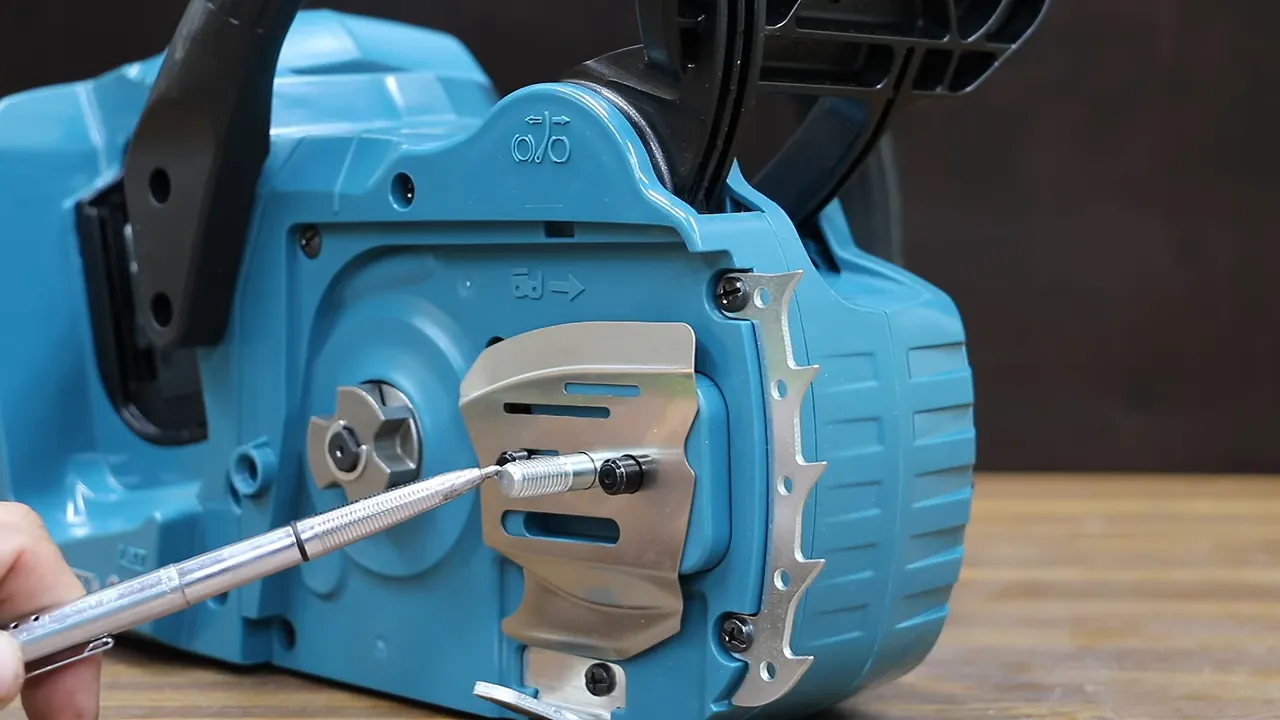
I liked Makita’s trigger-safety arrangement best. Gripping the handle naturally operates the lockout. There is also a power button, a dual-battery charge indicator and a variable-speed trigger. The chain reached speed noticeably faster than the other cordless saws.
The saw and charger are made in China. The battery labeling lists several possible cell-manufacturing countries, with further processing in China, Vietnam or Korea.
Milwaukee M18 FUEL: About $445
The most expensive kit includes a 16-inch saw, one M18 High Output 12Ah battery and an M18/M12 rapid charger. Milwaukee advertises hardwood-cutting power, performance faster than a standard gas competitor and up to 150 cuts through 6x6 cedar per charge. Those are packaging claims, not results from this comparison.
The Oregon bar, Oregon chain and saw are made in China. Milwaukee uses a six-tooth sprocket, a two-stud bar mount, metal bumper spikes and a chain catcher. The two-stud arrangement looked more durable than DeWalt’s setup, and the trigger-safety location felt better, too.
Stihl MS 170: The Gas Benchmark
The Stihl MS 170 typically cost between $180 and $200 at the time of testing. It has a 16-inch bar and a 30.1cc engine rated at 1.7 horsepower.
To give the gas saw a fair chance against the new cordless saws, I installed a new chain. This comparison is against that particular small gas saw, not every gasoline chainsaw on the market.
Chain Speed, Noise, Usable Bar Length and Weight
No-load speed varied dramatically
The tachometer measurements showed a huge spread in no-load rotational speed:
- Stihl: 15,800 rpm
- Ryobi: approximately 11,690 rpm
- Makita: 10,726 rpm
- DeWalt: 8,156 rpm
- Milwaukee: 6,470 rpm
- Worx: approximately 4,300 rpm
Ryobi was turning about two and a half times as fast as Worx. Milwaukee also ran relatively slowly, but it felt geared toward strong torque. The cutting tests would show whether that tradeoff helped.
Every battery saw was quieter than the Stihl
I positioned the sound meter 30 inches directly above the saw handle. The measured noise levels were:
- Worx: 90 dB
- Milwaukee: 93 dB
- Makita: 98 dB
- Ryobi: 99 dB
- DeWalt: 99 dB
- Stihl: 105 dB
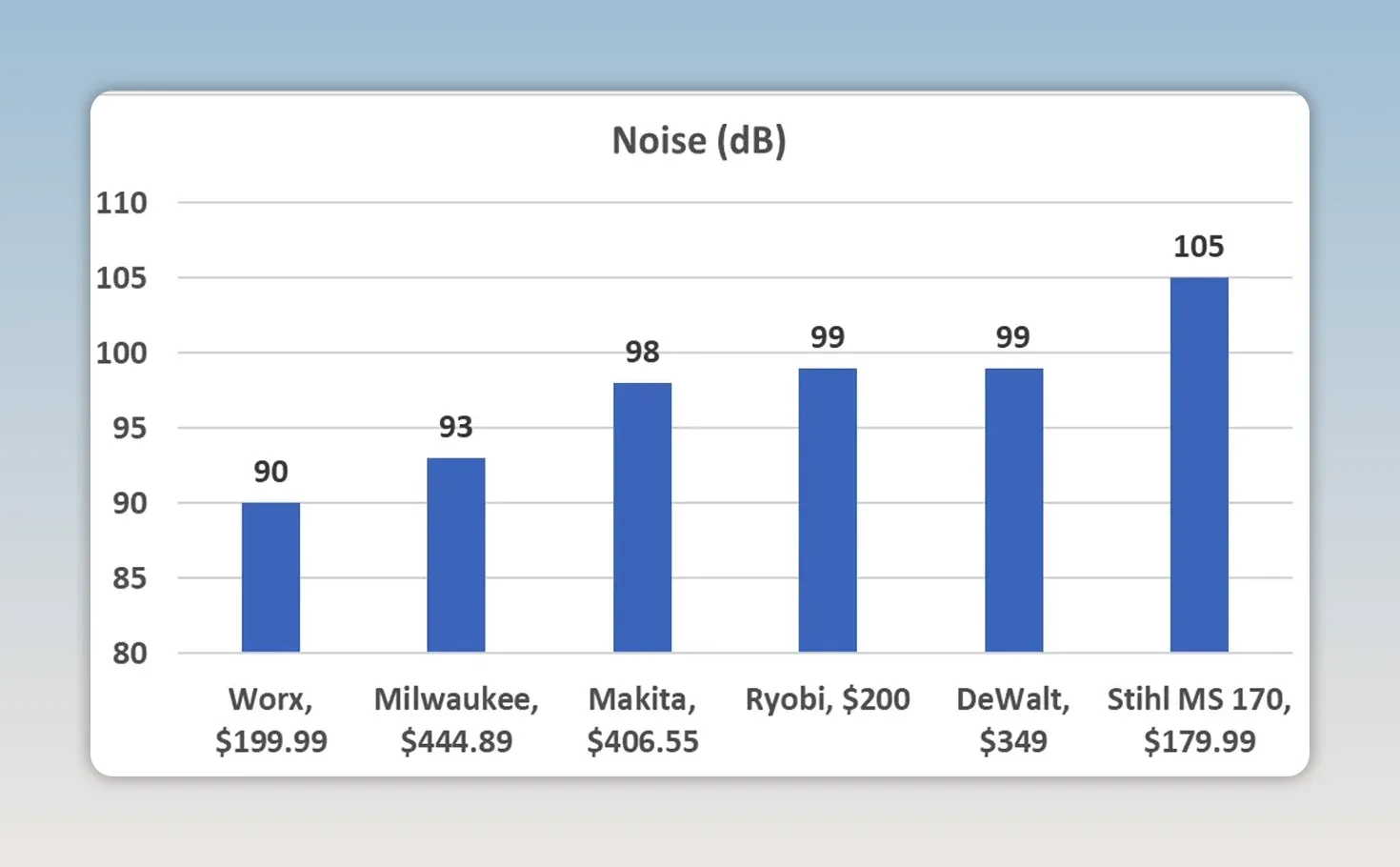
Worx and Milwaukee were the quietest, and they also had the lowest no-load speeds. Makita, Ryobi and DeWalt were very close together. None of the battery saws matched the gas saw’s noise level.
Advertised bar length is not usable bar length
A 16-inch label does not mean there are 16 inches of exposed bar available for the cut. With the new chains installed, I measured:
- Stihl and Milwaukee: 15 inches usable from their 16-inch bars
- DeWalt: 14.75 inches usable from a 16-inch bar
- Makita: 14.5 inches usable from a 16-inch bar
- Worx: 13.25 inches usable from a 14-inch bar
- Ryobi: 12 inches usable from a 14-inch bar
The difference between Worx and Ryobi is worth noting. Both advertise a 14-inch bar, yet Worx provides another 1.25 inches of usable length in this setup.
Milwaukee carried a substantial weight penalty
With batteries installed in the cordless saws, measured weights were:
- Worx and Stihl: 10.6 pounds each
- Ryobi and Makita: 11.4 pounds each
- DeWalt: 12.6 pounds
- Milwaukee: 14.4 pounds
Makita and Ryobi weighed less than a pound more than Worx despite having at least twice its battery capacity. Milwaukee was easily the heaviest saw here.
Cutting Test 1: Nine Stacked 4x4s
For the cutting tests, I used Stihl Platinum bar and chain lubricant in each saw. The first challenge was a crosscut through nine 4x4s arranged in a three-by-three stack. Each saw made three timed passes.
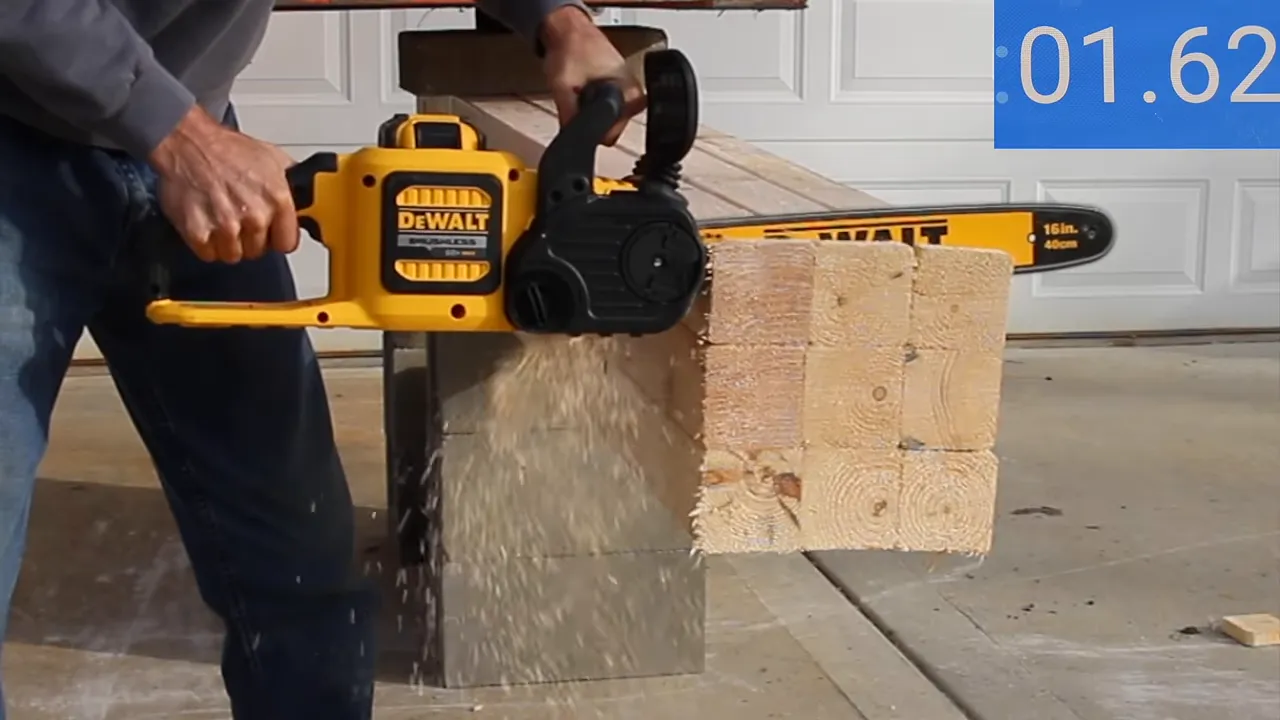
- DeWalt: 12.2, 10.9 and 10.3 seconds
- Makita: approximately 15.0, 13.4 and 14.4 seconds
- Stihl: 13.8, 13.8 and 13.5 seconds
- Milwaukee: 16.7, 13.7 and 13.9 seconds
- Ryobi: 14.4, 16.8 and 14.1 seconds
- Worx: 17.14, 18.5 and 17.9 seconds
DeWalt was clearly the fastest. Even with a stall during the first pass, it finished in 12.2 seconds. The final 10.3-second pass was very impressive. It cut smoothly, with little vibration, and felt every bit as capable as my small gas saw.
Makita stalled during the first and third passes. Its best time of 13.4 seconds narrowly beat the Stihl, but its balance was what I enjoyed most. I preferred using it even though DeWalt cut faster.
Milwaukee stalled on the first pass and then settled into the high-13-second range. It felt powerful, but its slower chain did not seem to be an advantage in this softer lumber.
Ryobi was a big improvement over Worx. It needed less downward pressure and produced less vibration. Too much pressure caused two stalls during the second pass, but its best result was about three seconds faster than Worx.
Worx required the most effort to keep moving through the wood. Its slow chain speed was very noticeable. The Stihl, by contrast, cut smoothly with little vibration and delivered very consistent times.
Cutting Test 2: Comparing User Effort
Fast cutting is important, but so is how hard the operator has to work. To reduce differences in applied pressure, I added 2.5 pounds to the front of each saw and timed cuts through six stacked 4x4s without adding downward force by hand.
This was a controlled comparison of feed pressure, not a recommended operating setup. The finishing order changed quite a bit:
- Stihl: 8.3 seconds
- DeWalt: 8.6 seconds
- Ryobi: 9.9 seconds
- Makita: 10.3 seconds
- Worx: 17.7 seconds
- Milwaukee: 18.6 seconds
The Stihl’s high chain speed helped it finish first, but DeWalt was only three-tenths of a second behind. Ryobi also did very well, finishing ahead of Makita.
Worx and Milwaukee took much longer under this limited-pressure setup. Milwaukee’s strong torque did not translate into a fast cut when it could not be worked more aggressively.
Chain speed influenced both cutting time and the amount of operator input required. In this test, the gas saw needed the least added effort to move through the wood, with DeWalt a very close second.
Hardwood Test: Honey Locust Separates the Field
Honey locust was a much tougher challenge than the 4x4 lumber. This was the opportunity for a high-torque, lower-speed saw like Milwaukee to improve its standing.
The best passes put the saws in this order:
- DeWalt: approximately 15.5 seconds
- Milwaukee: 19.7 seconds
- Stihl: 21.1 seconds
- Makita: 21.4 seconds
- Ryobi: 24.1 seconds
- Worx: approximately 33 seconds
DeWalt made the hardwood look easy. Its first pass took 17 seconds, and its second was faster still. It had an excellent combination of torque and chain speed.
Milwaukee moved into second place. The first pass took 22.9 seconds after I pushed too aggressively and stalled it twice. On the second pass, making better use of its bumper spikes and torque brought the time down to 19.7 seconds. Its stronger hardwood showing was a substantial improvement over the low-pressure lumber test.
The Stihl needed very little effort. Letting the saw’s weight feed the chain produced a 21.9-second first pass and a 21.1-second second pass.
Makita had plenty of chain speed, but it did not feel as torquey as DeWalt. Two stalls slowed its first pass to 23.9 seconds. The second improved to 21.4 seconds, very close to the Stihl.
Ryobi stalled once on the first pass and took 29 seconds. Without a stall on the second pass, it improved to 24.1 seconds. It was considerably smoother and easier to advance than Worx, which struggled and needed much more operator input.
After the cutting tests, Worx showed only one charge-indicator bar remaining. Ryobi showed two, while DeWalt and Milwaukee still showed three. Makita’s batteries showed four and three bars. Those indicators offered a rough look at remaining charge, but a separate runtime test was needed for a more useful comparison.
Battery Runtime: Milwaukee Lasted the Longest
I fully recharged the batteries before testing continuous no-load runtime. The saws were kept separated during the test.
No-load runtime is not cutting runtime. Cutting wood drains the batteries much faster, so these results should not be interpreted as continuous working time. They do show how long each included battery setup could keep its saw running without a cutting load.
- Worx: 20 minutes
- Ryobi: 22 minutes, 27 seconds
- Makita: 31 minutes on one pair of batteries
- DeWalt: 37 minutes, 12 seconds
- Milwaukee: 63 minutes, 4 seconds
Milwaukee really stood out, running for more than an hour on its single 12Ah pack. Makita’s extra pair of included batteries would bring its total to approximately 62 minutes, nearly matching Milwaukee, but requiring a battery change.
There was also an important lubrication observation: after about ten minutes, every saw except Worx had emptied its bar-oil reservoir. I manually applied oil about once a minute afterward to keep the bars and chains lubricated. Battery capacity was not the only limit on uninterrupted operation.
Recharge Times: Makita’s Charger Adds Real Value
Using the included chargers, the depleted batteries took:
- Worx: approximately 60 minutes
- Makita: approximately 60 minutes, 13 seconds
- Milwaukee: approximately 129 minutes
- DeWalt: 139 minutes, 23 seconds
- Ryobi: 157 minutes, 34 seconds
Worx finished first, but it was charging relatively small 2Ah packs. Makita finished only 13 seconds later with its pair of 5Ah packs. Its measured charging time was longer than the advertised 45 minutes, but it was still a very strong result in this group.
Comparing no-load runtime with recharge time gives another way to judge the battery-and-charger package:
- Makita and Milwaukee: roughly two minutes charging for each minute of no-load running
- Worx: roughly three minutes charging for each minute running
- DeWalt: roughly four minutes charging for each minute running
- Ryobi: roughly seven minutes charging for each minute running
These are favorable, no-load ratios, not real cutting-duty ratios. Even so, Makita’s combination of an extra battery set and relatively quick charging made its kit especially appealing.
Which Chainsaw Would I Choose?
Best cutting performance: DeWalt
DeWalt crushed the cutting portion of this comparison. It won the operator-fed lumber test and the honey locust test, and it came very close to the gas saw in the limited-pressure test. Its mix of torque and chain speed was excellent.
The safety-switch position and lighter-looking bar-mount arrangement were drawbacks, but neither kept it from delivering the strongest cutting results.
My favorite all-around saw: Makita
Makita was not the fastest, but it was the saw I enjoyed using most. It felt light, balanced and well constructed. The natural trigger-safety arrangement, variable-speed control, quick acceleration, metal components and four-battery kit made a very good overall package.
Best lower-cost choice for occasional use: Ryobi
If spending around $350 on DeWalt is too much, Ryobi did a good job for a roughly $200 saw. It was smoother, faster and easier to use than Worx. For occasional light-duty work, it would be my choice between those two. Its slow included charger is the biggest drawback shown by these tests.
Longest single-pack no-load runtime: Milwaukee
Milwaukee’s 12Ah battery delivered outstanding endurance, and the saw finished second in hardwood. However, it was also the heaviest and most expensive cordless kit here. Its low chain speed hurt performance when little feed pressure was applied.
Where Worx fits
Worx tied the Stihl for the lightest measured weight and was the quietest saw tested. Its controls and construction had some good points, too. But the slow chain speed made cutting harder work, and it finished last in both operator-fed cutting challenges. At almost the same price, I preferred Ryobi.
The small gas saw still had strengths: low weight, high chain speed, consistent cutting and very little required feed effort. But these tests made one thing clear: a battery chainsaw can outperform a small gasoline saw in cutting speed. DeWalt proved that, while Makita showed why the fastest saw is not always the one I would most want to use.


