Is a $35 compact battery chainsaw just as good as one that costs nearly $280? And can a bargain saw that accepts Milwaukee batteries keep up with the genuine Milwaukee? There is only one way to find out: put them to work.
I bought 13 compact chainsaws and compared cutting speed in softwood lumber and Osage orange hardwood, resistance to stalling, back-to-back cutting endurance, battery efficiency, noise, and ease of servicing. The genuine Milwaukee turned out to be quite a beast. But a much less expensive saw delivered a surprisingly strong performance.
The biggest lesson: unloaded speed does not tell you how well a chainsaw will cut. Some of the fastest-spinning saws struggled under pressure, while a relatively slow-spinning Milwaukee absolutely shredded the test material.
Quick Summary
- Milwaukee led the tests for cutting speed, load resistance, and completed cuts per amp-hour.
- Kobalt delivered strong name-brand performance at a substantially lower tested kit price.
- The knockoff Milwaukee offered surprisingly capable occasional-use performance for its price.
- Unloaded sprocket speed and battery runtime alone did not predict useful cutting performance.
Table of Contents
- The Lineup: What You Get for Your Money
- Startup Speed and Maintenance: Convenient Is Not Always Powerful
- Softwood Cutting Test: The Milwaukee Pulls Away
- The Chainsaw Dyno: Which Saw Resists Stalling?
- Hardwood Cutting: Osage Orange Separates the Field
- Back-to-Back Cuts: Heat, Shutdowns, and Battery Life
- Noise Test: Battery Powered Does Not Mean Quiet
- Which Compact Battery Chainsaw Is Best?
The Lineup: What You Get for Your Money
Prices below are what I paid for the tested tools or kits. Some included batteries and chargers, while others were tool only, so those prices are not directly interchangeable. Weights include the batteries used during the initial comparisons and will change with battery size.
I use “knockoff DeWalt,” “knockoff Makita,” and “knockoff Milwaukee” to identify the inexpensive alternatives tested with those brands’ batteries. They are not genuine tools from those manufacturers.
The Budget Kits and Battery-Compatible Alternatives
- MechanicAnts, $35 kit: Included a charger, a 21-volt 1.5 Ah battery, and two chains. Claimed output was 550 watts. It needs manual chain lubrication, a tool to remove the cover, and a screwdriver to adjust tension. The trigger safety favors right-handed use. At about 2.4 pounds, it was the lightest saw tested.
- Knockoff DeWalt, $40 tool only: Accepts a DeWalt 20-volt battery and came with a replacement chain. The seller claimed a brushless motor, 450 watts of working power, and a 6-inch log cut in 6 to 10 seconds. Cover removal is tool free, but small spring-loaded parts make servicing unnecessarily difficult. Tested weight was about 3.57 pounds.
- Knockoff Makita, $49 tool only: Accepts a genuine Makita battery and claims a high-efficiency brushless motor and an 8-second cut through a 6-inch log. It has no automatic oiler. The cover comes off without tools, but chain tension requires the included screwdriver. Tested weight was about 3.25 pounds.
- Knockoff Milwaukee, $70 before a coupon or $54 afterward: Included 6-inch and 8-inch bars, starter bar oil, an automatic oiler, and a brushless motor. It offers tool-free tension adjustment and a safety release accessible from either side. With a 6 Ah battery, it weighed about 5.33 pounds.
The knockoff Milwaukee was particularly well equipped for its price. Its side cover combines a wing nut with a tensioning dial, making bar and chain service very easy. That does not necessarily mean it is built as ruggedly as a name-brand tool, but the feature list was impressive.
The Lower-Priced Name Brands
- WORX, $79 tool only: A brushed-motor saw with a 5-inch bar and a claimed chain speed of 22 feet per second. It has no automatic oiler. A wing nut secures the cover, and the included slotted screwdriver stores onboard for tension adjustments. Tested weight was 4.57 pounds.
- WORKPRO, $90 kit: Included two batteries, a charger, and two extra chains. It uses a brushed motor, has no automatic oiler, and claims a 6.3-inch guide bar and 16.4-foot-per-second chain speed. Its safety works from either side, and tension adjustment is tool free, although the small adjustment knob is awkward. Tested weight was 3.19 pounds.
- Greenworks, $100 tool only: Uses a 24-volt battery system, a brushless motor, an ambidextrous safety, and an easy-to-use tool-free tensioning system. Tested weight was about 3.39 pounds.
- Craftsman, $129 kit: Included a 2 Ah battery and charger. It has an integrated tip guard, a stated cutting capacity up to 4 inches, and no automatic oiler. The safety favors right-handed use. Unfortunately, the wrench and screwdriver needed for service were not included. Tested weight was 5.8 pounds.
The Midrange and Premium Options
- DeWalt, $130 tool only: A brushless 20-volt saw with an 8-inch bar and automatic oiler. The safety favors right-handed use. Bar and chain service requires a wrench and screwdriver, neither included. The attachment design takes more effort to service but appeared more durable than many of the inexpensive alternatives. With a 5 Ah battery, it weighed just over 6 pounds.
- Kobalt, $149 kit: Included a 24-volt 2 Ah battery and charger, a 6-inch bar, automatic oiler, variable-speed trigger, ambidextrous safety, and tool-free chain adjustment. Its cover and tensioning system were easy to work with. Tested weight was 4.1 pounds.
- Ryobi, $150 tool only: A brushed-motor saw with a 6-inch bar, ambidextrous safety, and tool-free bar and chain service. Ryobi advertises an oil-free design. With a 4 Ah High Performance battery, it weighed about 5.26 pounds.
- Makita, $166 tool only: A brushless saw with automatic lubrication, tool-free chain adjustment, and an ambidextrous safety. It included bar oil and a sharpening file. Makita claims up to 140 cuts in 2-inch cedar with a 2 Ah battery. The bar mounting uses metal locating pins and a metal cover stud, a design that looked quite durable. With a 5 Ah battery, it weighed 4.29 pounds.
- Milwaukee M18 FUEL, $279 kit: Included a High Output XC 6.0 battery and charger. It has automatic lubrication, a variable-speed trigger, and an ambidextrous safety. Milwaukee claims exceptionally fast pruning performance and enough power for hardwood. A nut secures the cover, and the included combination service tool stores in the saw. At 7.3 pounds, this was the heavyweight of the group.
Startup Speed and Maintenance: Convenient Is Not Always Powerful
The MechanicAnts reached full speed in about 0.1 second. Ryobi was also very quick at 0.2 second. Craftsman, Makita, and Milwaukee each took about 0.3 second, with the knockoff Milwaukee close behind at 0.35 second.
The knockoff DeWalt, knockoff Makita, and WORKPRO needed roughly half a second. WORX took just over half a second, and DeWalt needed about 0.6 second. Kobalt’s soft start took 1.2 seconds, while Greenworks took the longest at 1.75 seconds.
Once running, Greenworks delivered the highest unloaded sprocket speed at about 5,200 RPM. DeWalt followed at 4,709 RPM, then the knockoff DeWalt at 4,424 RPM. The genuine Milwaukee managed only 2,531 RPM, near the bottom of the group.
Those are sprocket RPM measurements, not direct measurements of chain travel speed. More importantly, they do not show how well each saw maintains speed in a cut. Milwaukee would make that point very clearly.
For maintenance, I preferred the straightforward tool-free systems on the knockoff Milwaukee, Greenworks, Kobalt, and Ryobi. The knockoff DeWalt was the most difficult to service because of its small spring-loaded pieces. A cover that comes off without tools is not much help if parts can disappear during a field repair.
Softwood Cutting Test: The Milwaukee Pulls Away
For a baseline, I cut through the 2-by-8 lumber with a Corona handsaw. That took 13.83 seconds and provided a pretty good workout. One or two cuts would be fine. A whole afternoon of that would be another story.
I started the powered tests with charged batteries and applied bar and chain oil where needed. Each saw received three attempts, with the fastest attempt used for the comparison. I pushed for the quickest cut without stalling the motor, although several saws shut down when I asked too much of them.
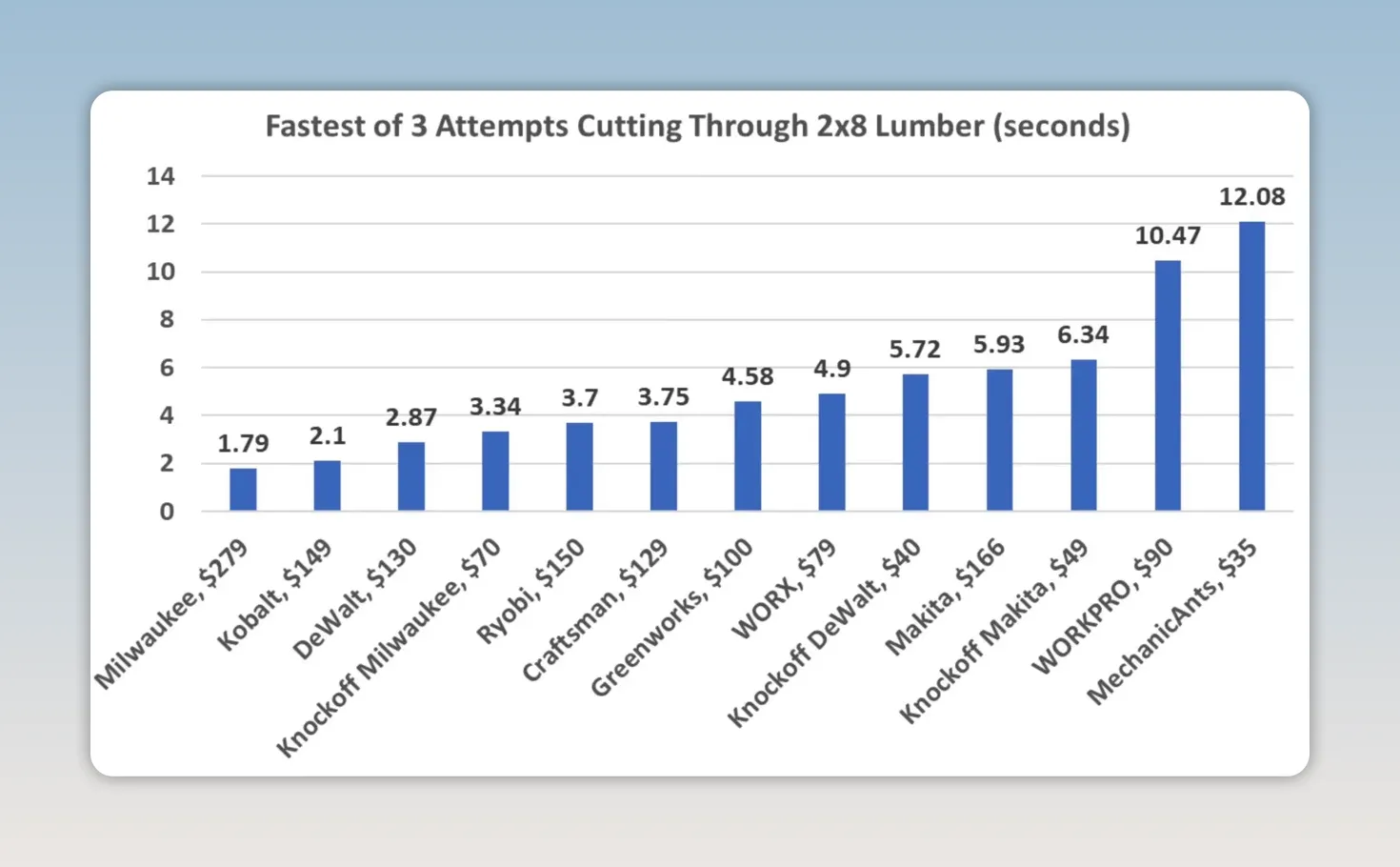
Here are the fastest softwood cuts, from quickest to slowest:
- Milwaukee: 1.79 seconds.
- Kobalt with a 4 Ah battery: 2.10 seconds.
- DeWalt: 2.87 seconds.
- Knockoff Milwaukee: 3.34 seconds.
- Ryobi: 3.70 seconds.
- Craftsman with a 4 Ah battery: 3.75 seconds.
- Greenworks: 4.58 seconds.
- WORX: 4.90 seconds.
- Knockoff DeWalt: 5.72 seconds.
- Makita: 5.93 seconds.
- Knockoff Makita: 6.34 seconds.
- WORKPRO: 10.47 seconds.
- MechanicAnts: 12.08 seconds.
The $35 MechanicAnts beat the handsaw on its best attempt, but it did not have much power in reserve. Its other cuts took 14.65 and 13.67 seconds. WORKPRO also struggled, powering down twice during its first attempt.
The inexpensive DeWalt-compatible and Makita-compatible saws cut relatively smoothly. The knockoff Milwaukee was in another class, improving from 4.17 to 3.84 and finally 3.34 seconds. Very impressive for the price.
The genuine Makita had good unloaded speed but little resistance to stalling. Its first cut took 8.93 seconds after a stall, followed by two 5.93-second cuts. Milwaukee, by comparison, completed all three cuts in 1.89 seconds or less.
A Bigger Battery Can Improve More Than Runtime
Craftsman’s best cut with the included 2 Ah battery was 4.84 seconds. With a 4 Ah battery, that dropped to 3.75 seconds, and it held better speed under load. It still vibrated more than many of the other saws.
Kobalt was already fast with its included 2 Ah battery, recording cuts of 2.82, 2.72, and 2.92 seconds. With the 4 Ah battery, its best time improved to 2.10 seconds. Battery choice clearly affected cutting performance in these two saws.
Check That the Automatic Oiler Actually Works
The knockoff Milwaukee, Kobalt, Makita, and Milwaukee all visibly delivered oil to the chain. The DeWalt initially did not, even after running for a couple of minutes.
I removed the bar and chain, and oil finally began flowing. An air pocket or obstruction may have interrupted delivery, but I could not confirm the cause. The important point is to verify lubrication rather than assuming a full reservoir means oil is reaching the chain.
The Chainsaw Dyno: Which Saw Resists Stalling?
Next, I used a chainsaw dyno setup to compare how much downward force each saw could tolerate. I checked the scale with 10 pounds of weights before testing.
This is a practical comparison of load-handling ability. The readings are pounds of force in this fixture, not conventional torque measurements in pound-feet.
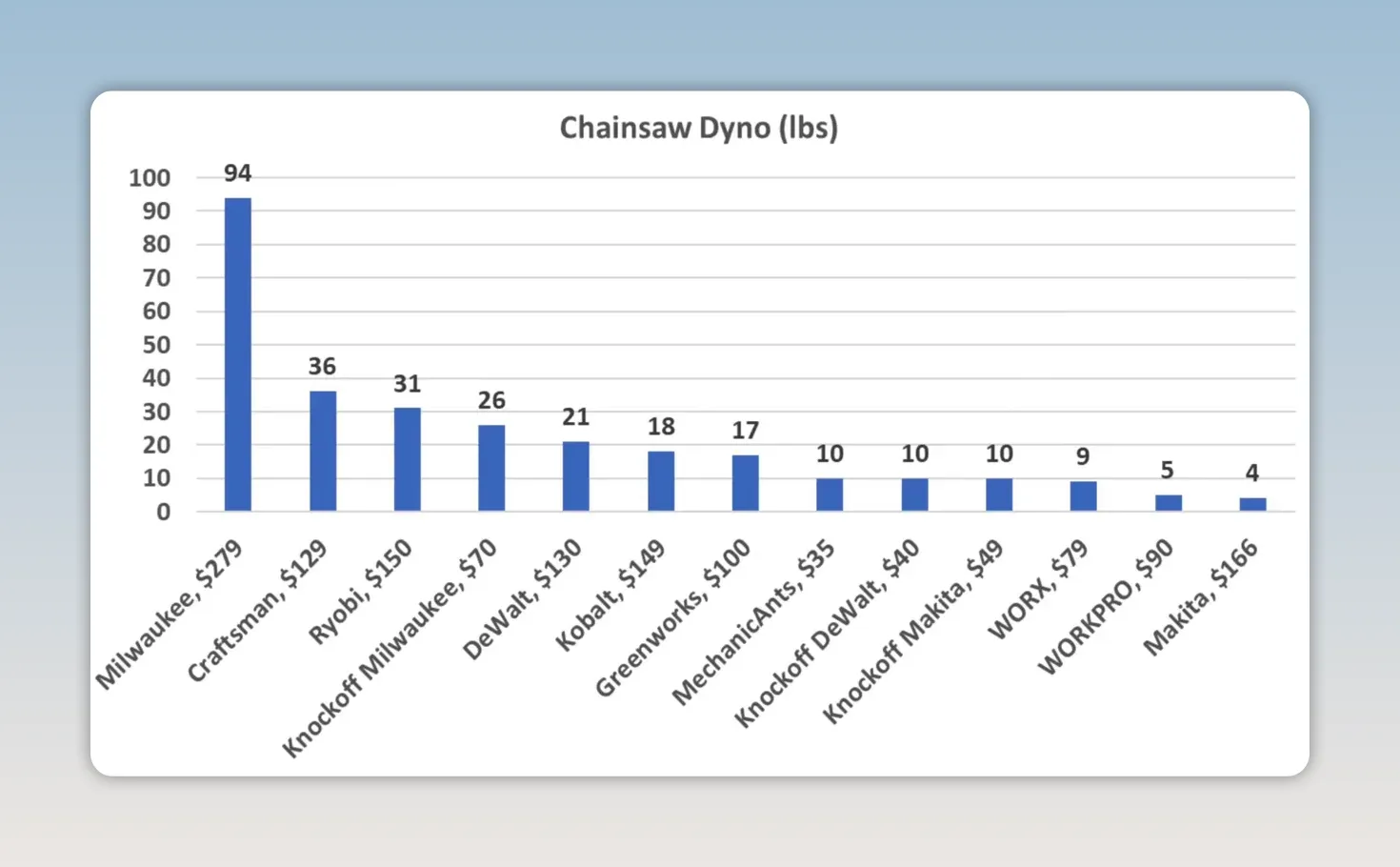
- Milwaukee: Still running at 94 pounds.
- Craftsman: 36 pounds.
- Ryobi: 31 pounds.
- Knockoff Milwaukee: 26 pounds.
- DeWalt: 21 pounds.
- Kobalt: 18 pounds.
- Greenworks: 17 pounds.
- MechanicAnts, knockoff DeWalt, and knockoff Makita: 10 pounds each.
- WORX: 9 pounds.
- WORKPRO: 5 pounds.
- Makita: 4 pounds.
Craftsman and Ryobi lacked unloaded speed, but both had plenty of pulling power. DeWalt offered a useful combination of speed and load resistance. The knockoff Milwaukee once again performed well above its price.
The genuine Milwaukee was the standout. I made several attempts and simply could not stall it at the maximum 94-pound reading reached during this test.
Hardwood Cutting: Osage Orange Separates the Field
Osage orange, also called hedge apple, takes considerably more power to cut than softwood lumber. There is plenty of it on my property, so it makes a very practical challenge for a pruning saw.
This comparison has an important limitation: the log gradually tapered. The cuts were not through perfectly identical sections, so small differences deserve some caution. The larger performance gaps were still very clear.
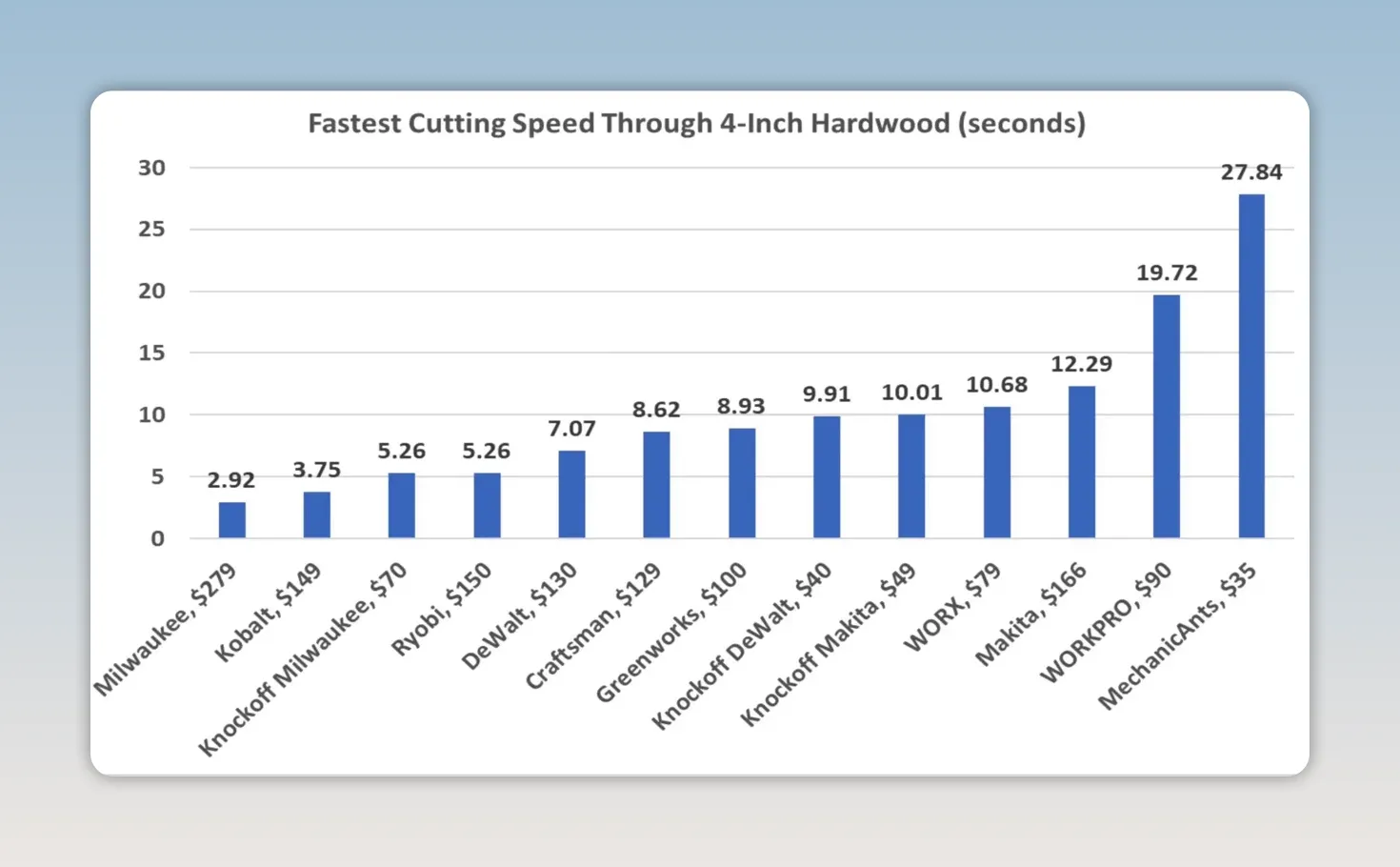
The hardwood results were:
- Milwaukee: 3.13 and 2.92 seconds. It had no trouble making power in the hardwood.
- Kobalt: 3.39 and 3.75 seconds in the individual cuts. The final comparison chart lists 3.75 seconds, and it remained second behind Milwaukee.
- Knockoff Milwaukee: 5.26 and 5.93 seconds. Another very strong performance for a low-cost tool.
- Ryobi: 5.26 and 5.31 seconds. Its pulling power helped compensate for its slower chain movement.
- DeWalt: Just over 10 seconds after two shutdowns on the first attempt, then a much smoother 7.07 seconds.
- Craftsman: 8.62 and 9.03 seconds. It had the power, but more speed would have helped.
- Greenworks: 8.93 and 9.39 seconds. Its high unloaded speed did not fully compensate for limited load-handling ability.
- Knockoff DeWalt: 9.91 and 11.00 seconds.
- Knockoff Makita: 10.58 and 10.01 seconds.
- WORX: 16.36 seconds after a shutdown, then 10.68 seconds.
- Makita: 12.29 and 12.65 seconds. This particular saw struggled with the dense hardwood.
- WORKPRO: Almost 23 seconds, followed by 19.72 seconds.
- MechanicAnts: 27.84 seconds. One attempt was enough to establish that this was a difficult job for it.
Using the best recorded cuts, the knockoff Milwaukee and Ryobi tied at 5.26 seconds behind Milwaukee and Kobalt. The genuine Makita trailed both inexpensive battery-compatible alternatives in this hardwood test.
Back-to-Back Cuts: Heat, Shutdowns, and Battery Life
For the endurance test, I kept making cuts until each saw overheated or exhausted its battery. Matching battery capacities were not available for every platform, so raw runtime alone is not a fair efficiency ranking.
These were demanding continuous-use conditions, not a long-term ownership test. Where a saw overheated, I allowed it to cool before continuing.
- MechanicAnts, 1.5 Ah: Ran for 4 minutes, 46 seconds. It smelled very hot but exhausted the battery before any damage was apparent.
- Knockoff DeWalt, 5 Ah: Overheated at about 4 minutes, 10 seconds. After cooling, it reached a total cutting runtime of 8 minutes, 35 seconds.
- Knockoff Makita, 5 Ah: Overheated after about 4 minutes. After cooling, total runtime reached 8 minutes, 37 seconds.
- Knockoff Milwaukee, 3 Ah: Ran for 5 minutes, 44 seconds without overheating.
- WORX, 4 Ah: Lasted 6 minutes, 38 seconds, although it struggled to cut the hardwood without powering down.
- WORKPRO, one included battery: Lasted 2 minutes, 44 seconds and struggled throughout the test. The second supplied battery was not used.
- Greenworks, 24-volt 2 Ah: Lasted 5 minutes, 17 seconds. It powered down several times and would not tolerate as much pressure as the knockoff saws.
- Craftsman, 4 Ah: Ran for just over 7.5 minutes, with plenty of power for the hardwood.
- DeWalt, 5 Ah: Ran for 6 minutes, 54 seconds.
- Kobalt, 4 Ah: Ran for 7 minutes, 10 seconds, combining good speed with smooth cutting.
- Ryobi, 4 Ah: Ran for just over 7.5 minutes and had more than enough pulling power for the log.
- Makita, 5 Ah: Ran for about 10 minutes, but made slow progress through the wood.
- Milwaukee, 3 Ah: Ran for about 6.5 minutes and seemed unfazed by the hardwood.
Completed Work Matters More Than Minutes of Runtime
Dividing runtime by battery amp-hour capacity puts the MechanicAnts at about 3.17 minutes per Ah, Greenworks at 2.64, and Milwaukee at 2.17. That makes the little MechanicAnts look very economical, but it was also cutting much more slowly.
A more useful question is how much work each saw completes before the battery is empty.
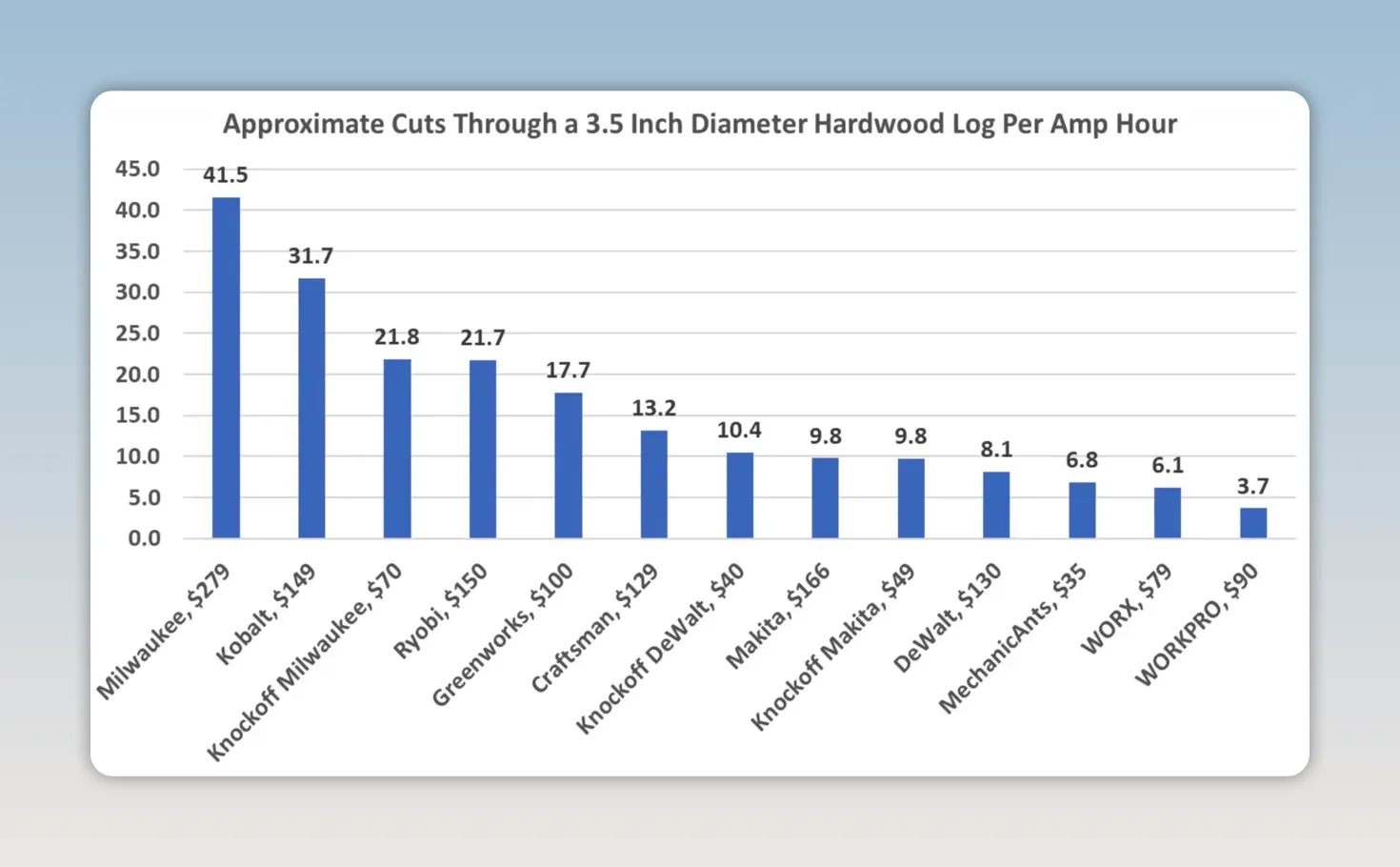
For approximate cuts through a 3.5-inch hardwood log per amp-hour, the leaders were:
- Milwaukee: 41.5 cuts per Ah.
- Kobalt: 31.7 cuts per Ah.
- Knockoff Milwaukee: 21.8 cuts per Ah.
Milwaukee did not merely cut quickly. It also completed the most work per amp-hour in this comparison. These figures remain specific to the tested batteries and conditions. Since the platforms use different voltages, amp-hours alone are not an equal-energy comparison across every saw.
Noise Test: Battery Powered Does Not Mean Quiet
I measured noise 24 inches from each running saw. WORX was the least noisy at 90.3 decibels, followed by MechanicAnts at 91.7. Milwaukee combined its strong cutting performance with a below-average reading of 94 decibels.
From least to most noisy, the measurements were:
- WORX: 90.3 dB.
- MechanicAnts: 91.7 dB.
- Milwaukee: 94.0 dB.
- Ryobi: 94.7 dB.
- Craftsman: 95.2 dB.
- WORKPRO: 97.0 dB.
- DeWalt: 97.2 dB.
- Kobalt: 97.3 dB.
- Knockoff Makita: 97.9 dB.
- Makita: 98.0 dB.
- Knockoff Milwaukee: 99.5 dB.
- Knockoff DeWalt: 101.2 dB.
- Greenworks: 103.1 dB.
“Least noisy” is relative. None of these is a quiet hand tool. The NIOSH guidance on noise and hearing loss provides useful context for choosing hearing protection and limiting exposure.
Which Compact Battery Chainsaw Is Best?
Across the graded events, Milwaukee earned the best average finishing position at 1.5. Kobalt followed at 3.5, and the knockoff Milwaukee finished close behind at 3.75. Those are average event placements, not scores out of five.
Best Overall Performance: Milwaukee M18 FUEL
The genuine Milwaukee ran circles around most of the competition. It was fastest through the softwood, fastest through the hardwood, strongest on the dyno, and best for completed cuts per amp-hour.
The trade-offs are price and weight. At $279 for the tested kit and 7.3 pounds with its 6 Ah battery, it is neither the cheapest nor the lightest option. But if cutting performance is the priority, this was the clear winner.
Strong Name-Brand Value: Kobalt
Kobalt delivered excellent cutting performance at a much lower kit price. Its automatic oiler, easy chain adjustment, and manageable tested weight made it a very practical package.
It was already fast with the included 2 Ah battery and improved further with a 4 Ah battery. For someone starting without an existing battery platform, the $149 tested kit made a strong case.
The Surprise: Knockoff Milwaukee
The knockoff Milwaukee was the bargain that impressed me most. It cut the lumber in 3.34 seconds, tied Ryobi’s best hardwood result at 5.26 seconds, tolerated 26 pounds in the dyno fixture, and completed the endurance test without overheating.
It is definitely not as rugged or as well built as some of the genuine name-brand saws. This testing also does not establish years of reliability. Still, considering its $54 coupon price, features, and performance, it looks like a very capable option for occasional use, especially for someone who already has a compatible battery.
What About the Other Saws?
DeWalt was a fast cutter and finished third in softwood. Ryobi and Craftsman had considerably more load-handling ability than their unloaded speeds suggested. Greenworks was light and quick through lumber, but less comfortable under heavy pressure and the loudest saw tested.
WORX was the least noisy, though its limited pulling power showed up in hardwood. The genuine Makita had a durable-looking mounting system and good unloaded speed, but stalled easily in these tests. WORKPRO and MechanicAnts were light and inexpensive, but neither was a good match for repeated dense-hardwood cuts.
Compact pruning saws have improved considerably. For maintaining woods, trimming branches, and dealing with small material, a capable battery saw can save a lot of handsaw work. Just do not confuse compact size with low risk: follow the tool’s operating instructions, use the specified grip and protective equipment, and keep hands clear of the cutting path. OSHA’s chainsaw safety guidance is a useful additional reference.
For maximum performance, Milwaukee wins. For a lower-priced name-brand kit, Kobalt performed very well. And for occasional-use performance on a tight budget, the knockoff Milwaukee was the real surprise.


