Picking a drywall anchor ought to be simple. Find one with a weight rating higher than the object you want to hang, install it, and call it good. But the hardware aisle is full of different designs, and those numbers on the packages raise a few questions.
Do the anchors actually hold their rated weight? What happens when a shelf or towel rack pulls outward instead of straight down? And if an anchor fails, how much sheetrock repair are you going to be doing?
I tested seven different drywall anchors to find out. The Toggler Snaptoggle BA delivered the greatest strength, but the E-Z Ancor Drywall Toggle was my favorite overall for its combination of easy installation, reasonable cost, and strong performance. There were also some big differences in the damage left behind.
Key Takeaways
- The E-Z Ancor Drywall Toggle offered my preferred balance of easy installation, cost, and strength.
- The Toggler Snaptoggle BA delivered the highest strength in both loading directions.
- Direct outward pulling substantially reduced holding strength compared with vertical-wall loading for several anchors.
- Initial movement occurred before complete failure, so ultimate strength is not a usable load recommendation.
How I Tested the Drywall Anchors
For a fair comparison, I started with brand-new, dry, 1/2-inch drywall from the same stack. Each test panel measured 16 inches by 16 inches, with an X marking the center so every anchor went into the same relative location.
Each panel was secured to a 2-by-4 frame with 12 drywall screws in approximately the same positions. The frame then fit into a rigid test jig and was held in place with four pins. The idea was to make the anchor and drywall do the work, not allow a loose frame to affect the results.
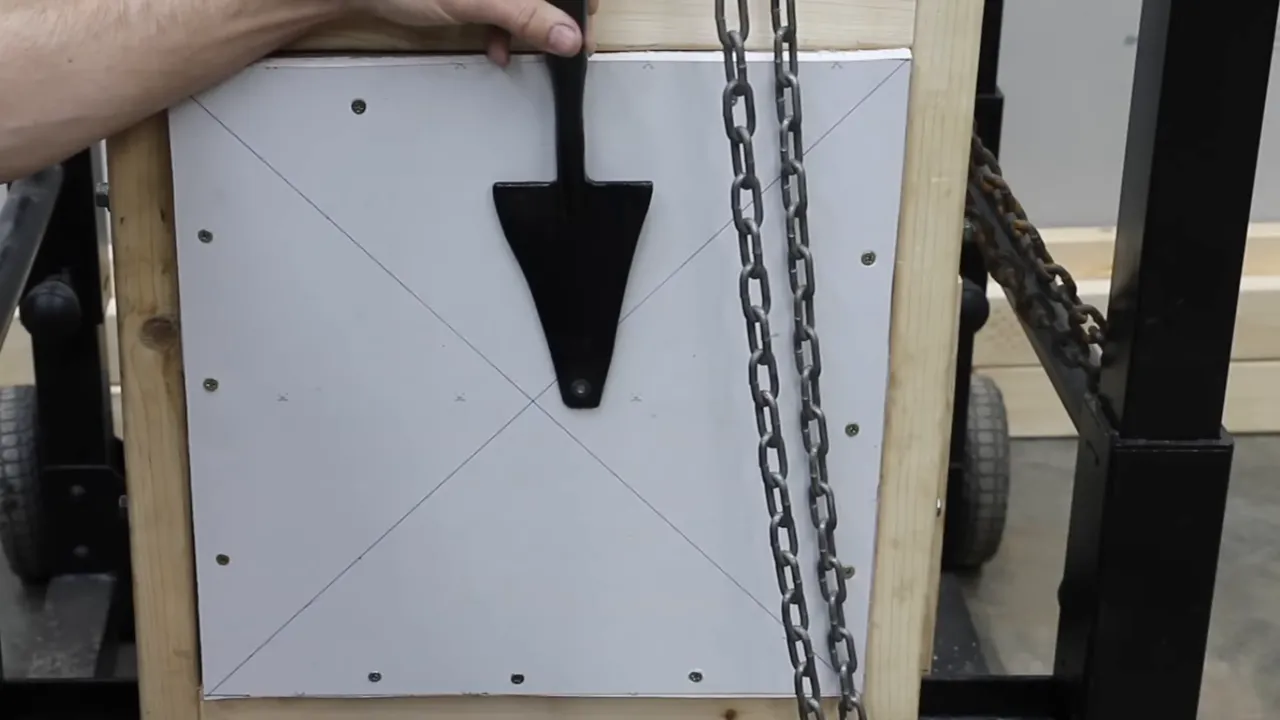
I tested each anchor three times in each of two orientations:
- Vertical-wall loading: With the panel upright, I applied force along the face of the drywall and recorded when the anchor began moving, then continued until complete failure.
- Direct outward pulling: With the panel horizontal, I pulled upward, perpendicular to its surface, until the anchor pulled out.
That distinction matters. An anchor beginning to move is not the same as an anchor tearing completely out of the wall. Identifying the exact start of movement required close examination of the test footage, and there is some judgment involved. Complete pullout is a lot less subtle!
These are comparative failure tests, not recommended working loads. The drywall was fresh, the mounting was consistent, and the force was applied directly. A shelf or bracket extending away from a wall can put considerably more leverage on an anchor.
The Seven Drywall Anchors and How They Install
1. E-Z Ancor Drywall & Stud Anchor: Rated for 50 Pounds
This self-drilling metal anchor installs with a Phillips screwdriver. Press the tip against the drywall and turn it clockwise until it is seated. It is a straightforward installation, but you do not want to overtighten it.
The 50-pound rating applies to 1/2-inch drywall, which matched the material used in the tests.
Under vertical loading, this anchor tore out a noticeable section of drywall when it finally failed. Direct outward pulling left much less damage: approximately a 1/2-inch-wide hole, with very little damage on the back of the panel.
2. Toggler Alligator All-Purpose Anchor: Rated for 69 Pounds in Drywall
The Toggler high-performance all-purpose anchor requires a 1/4-inch drilled hole. After inserting the anchor, driving the screw expands it and locks it into position.
The package lists very different capacities for different materials: 675 pounds in concrete, but 69 pounds in 1/2-inch drywall. That is a good reminder to read the rating for the material you actually have, not just the largest number on the package.
In the vertical-wall test, it left less damage than the first metal anchor. Under direct outward pulling, the damage was similarly modest compared with the larger expanding and toggle designs.
3. Toggler SnapSkru: Rated for 79 Pounds
The SnapSkru combines a self-drilling threaded body with an expanding action when the screw is installed.
Installation follows a few simple steps:
- Press the anchor tip into the drywall using a No. 2 Phillips screwdriver or screw gun.
- Turn clockwise until the anchor is flush with the wall surface.
- Position the item over the anchor and insert a compatible fully threaded screw.
- Tighten the screw flush with the item. A popping sound indicates that the anchor has deployed.
Its 79-pound rating is for 1/2-inch drywall. It provided substantial vertical strength, but failure left a sizable hole. In the outward-pull test, the damaged area measured approximately 1-1/2 inches across and 1-1/2 inches high.
4. Everbilt Hollow Wall Anchor: Rated for 85 Pounds
The Everbilt hollow wall anchor uses a metal sleeve that spreads behind the drywall as the screw is tightened. The package for the tested version listed an 85-pound working load limit in 1/2-inch drywall.
Once tightened, its expanded metal sections provide support behind the panel. However, that support did not translate into especially impressive direct-pull performance in this comparison.
It also left significant damage when pulled out: a hole well over an inch across and approximately 1 to 1-1/2 inches tall. This was not a case where accepting a larger repair bought the greatest strength.
5. Blue Hawk Toggle Bolt: Rated for 70 Pounds
The Blue Hawk spring-toggle bolt requires a 5/8-inch hole. Fold the toggle wings, push them through the opening, and tighten the bolt after the wings open behind the drywall.
It starts with a fairly large installation hole. As the anchor moves under vertical loading, it can tear the opening farther along the wall.
Even so, its strength was impressive for a 70-pound-rated anchor, especially when pulled directly outward. It was one of only two anchors to exceed its listed vertical-wall rating during the outward-pull test.
6. E-Z Ancor Drywall Toggle Anchor: Rated for 100 Pounds
This self-drilling toggle installs without the separate large-hole drilling step required by the conventional spring toggle. Drive the anchor into the drywall, then tighten the screw to deploy the toggle and draw it against the back of the wall.
It is easy to install, and it offers a lot of support for its size and cost. Its toggle has less contact area against the sheetrock than the larger Snaptoggle channel, which helps explain why it could not match that anchor's ultimate strength.
Failure still leaves repair work. In the direct-pull test, the damaged area measured approximately 2-1/2 inches tall by 2 inches wide. Easy installation does not mean a tiny hole if the anchor gets overloaded.
7. Toggler Snaptoggle BA: Rated for 238 Pounds in Drywall
The Snaptoggle BA was the heavy-duty option in this group. Its package listed 238 pounds in 1/2-inch drywall and 802 pounds in concrete block, with a wall-thickness range of 3/8 inch to 3-5/8 inches. It is intended for materials including drywall, tile, concrete block, and plaster.
Installation takes more steps than a self-drilling anchor:
- Drill a 1/2-inch-diameter hole.
- Align the metal channel alongside the plastic straps and slide it through the opening.
- Pull the straps toward you until the metal channel rests flat against the back of the wall.
- Maintain tension while sliding the plastic cap down the straps until its flange is flush with the wall.
- Snap off the excess straps, position the item over the flange, and insert and tighten the bolt.
The metal channel provides a broad contact surface behind the drywall. It was the strongest anchor tested, but pulling it completely through the panel left substantial damage: a hole approximately 2 inches tall by 1/2 inch wide, surrounded by cratering roughly 4 inches by 4 inches.
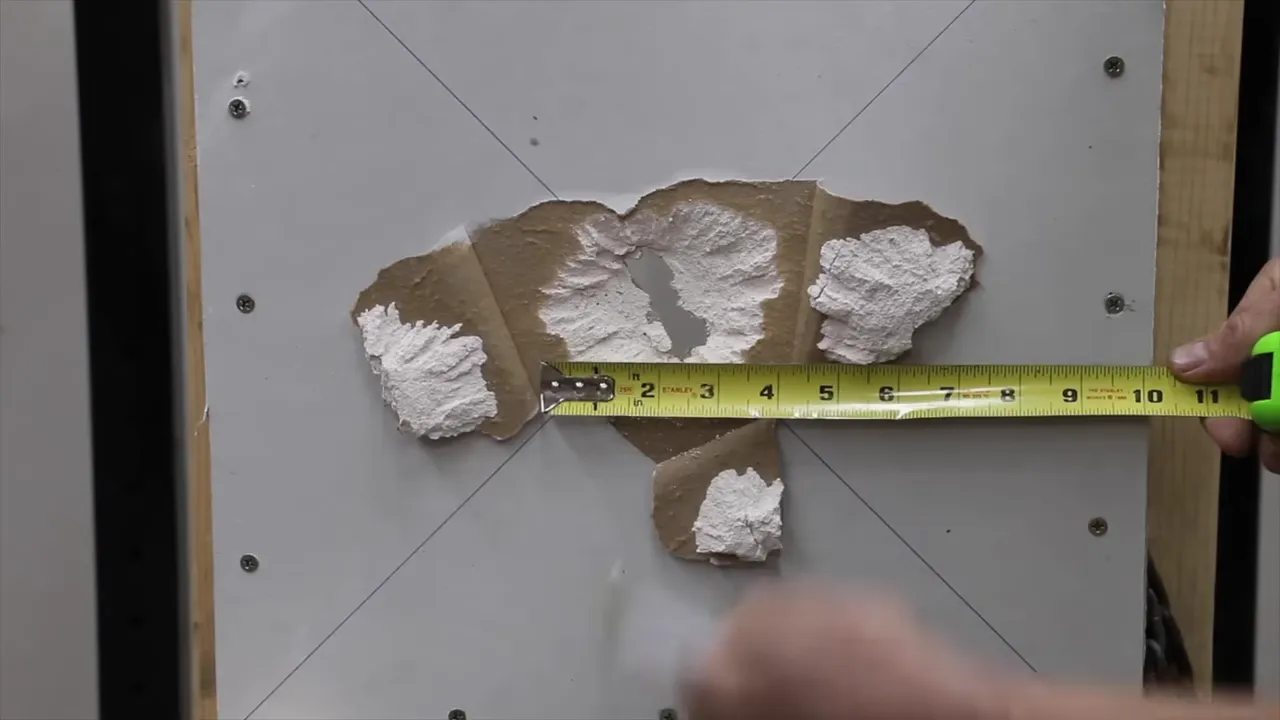
That is a pretty serious repair. A little touch-up paint is not going to take care of it.
Vertical-Wall Results: When Did the Anchors Start Moving?
Here are the rounded results shown in the comparison chart, alongside each anchor's listed drywall rating:
- E-Z Ancor Drywall & Stud: 50-pound rating; movement began at about 108 pounds.
- Toggler All-Purpose: 69-pound rating; movement began at about 77 pounds.
- Blue Hawk Toggle Bolt: 70-pound rating; movement began at about 91 pounds.
- Toggler SnapSkru: 79-pound rating; movement began at about 145 pounds.
- Everbilt Hollow Wall: 85-pound rating; movement began at about 89 pounds.
- E-Z Ancor Drywall Toggle: 100-pound rating; movement began at about 180 pounds.
- Toggler Snaptoggle BA: 238-pound rating; movement began at about 224 pounds.
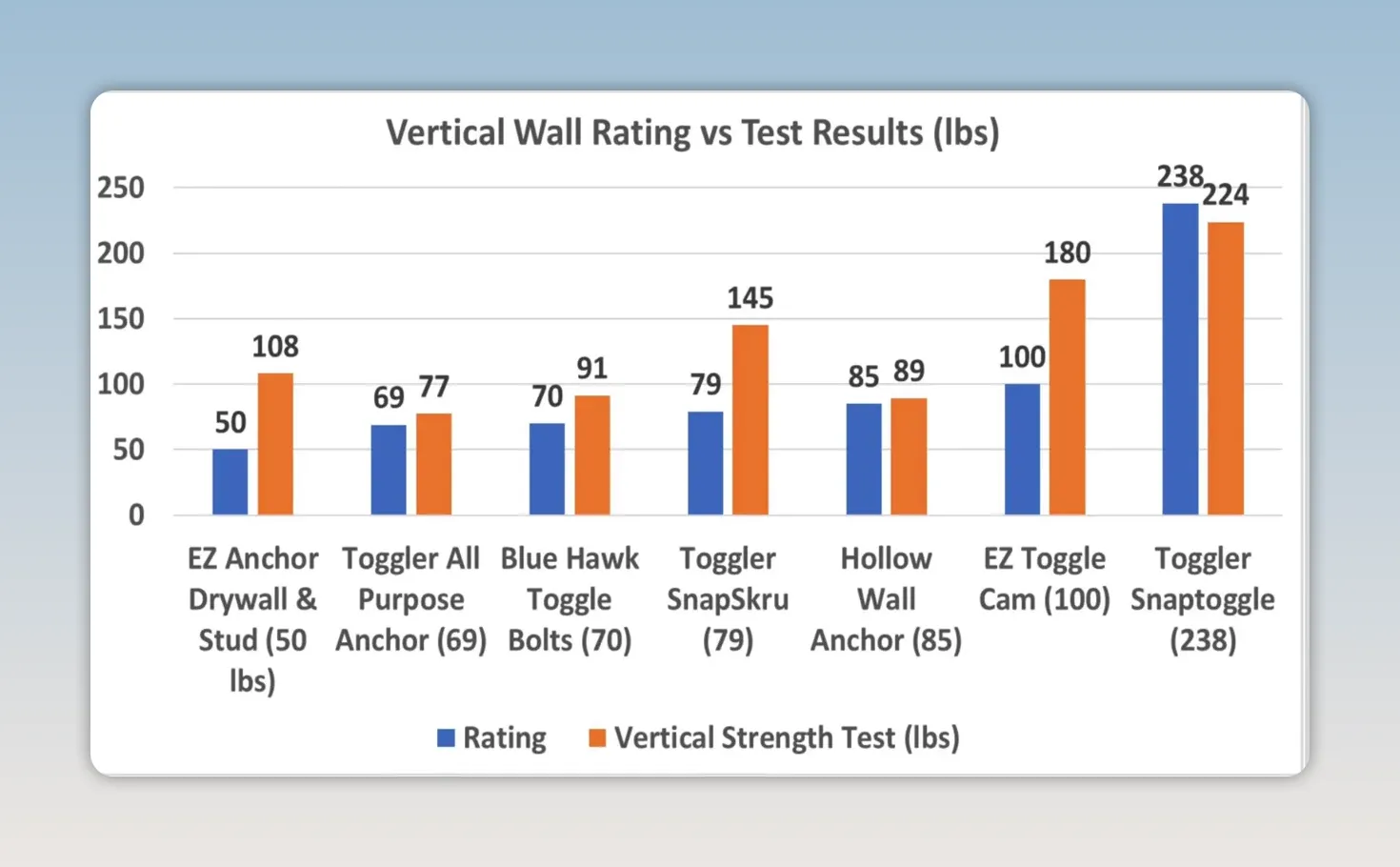
Every anchor except the Snaptoggle exceeded its listed rating before movement began. The Snaptoggle came close to its rating and still held the highest load of the group before moving.
The small metal E-Z Ancor did particularly well relative to its 50-pound rating, while the SnapSkru and E-Z Ancor toggle also exceeded their ratings by substantial margins. The hollow wall anchor and all-purpose plastic anchor had less margin before movement started.
Complete Failure Required More Force
Once the anchors started moving, they generally continued carrying load before tearing completely out. The rounded complete-failure results were:
- E-Z Ancor Drywall & Stud: 125 pounds.
- Toggler All-Purpose: 115 pounds.
- Blue Hawk Toggle Bolt: 222 pounds.
- Toggler SnapSkru: 166 pounds.
- Everbilt Hollow Wall: 146 pounds.
- E-Z Ancor Drywall Toggle: 240 pounds.
- Toggler Snaptoggle BA: 268 pounds.
All seven exceeded their listed capacities before complete failure. The Blue Hawk toggle showed a particularly large gap between initial movement and final pullout, while the Snaptoggle again finished with the highest absolute strength.
However, an anchor that is already moving is not a successful installation just because it has not fallen out yet. Ultimate failure strength and usable support are different things.
Direct Outward Pull: A Different Load Changes the Results
A shelf, bracket, or towel rack can experience force pulling away from the wall. To compare resistance to that force, I turned the panels horizontal and pulled the anchors directly upward.
The rounded outward-pull failure loads were:
- E-Z Ancor Drywall & Stud: 39 pounds.
- Toggler All-Purpose: 58 pounds.
- Blue Hawk Toggle Bolt: 142 pounds.
- Toggler SnapSkru: 61 pounds.
- Everbilt Hollow Wall: 52 pounds.
- E-Z Ancor Drywall Toggle: 119 pounds.
- Toggler Snaptoggle BA: 159 pounds.
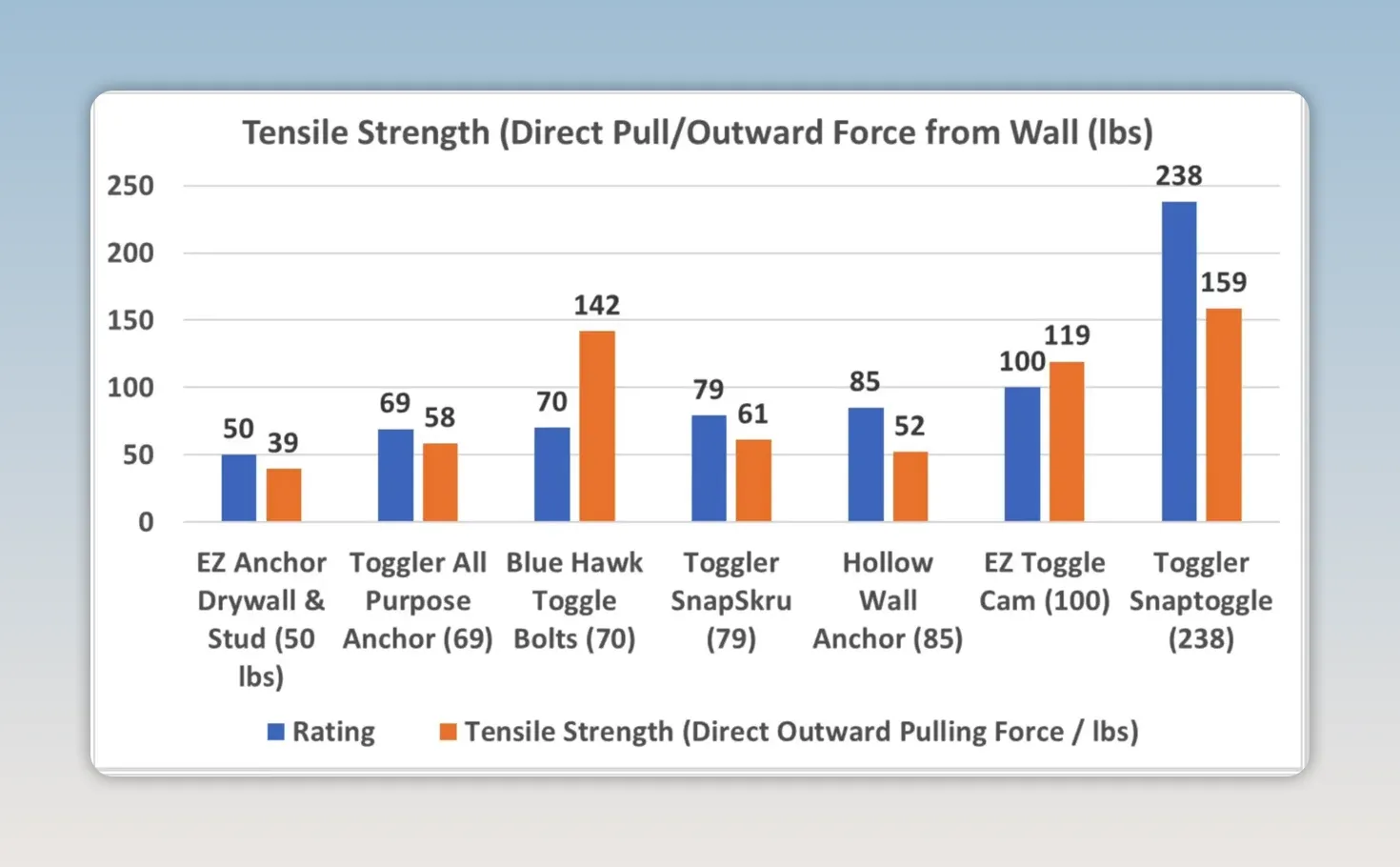
The Snaptoggle remained strongest at 159 pounds. The Blue Hawk toggle came next at 142 pounds, followed by the E-Z Ancor toggle at 119 pounds.
The Blue Hawk and E-Z Ancor toggles both exceeded their listed vertical-wall capacities even in this different loading direction. That is impressive. The other anchors pulled out below their listed vertical-wall ratings.
These anchors were not rated for the exact outward-pull test used here, so this is not a simple pass-or-fail comparison against the package. It does show why the direction of force matters. The 50-pound metal anchor, for example, resisted about 108 pounds before movement in the vertical test but pulled out at about 39 pounds under direct outward loading.
Cost, Strength, and the Repair Bill
At the time of testing, the approximate cost per anchor was:
- E-Z Ancor Drywall & Stud: $0.32.
- Toggler All-Purpose: $0.35.
- Blue Hawk Toggle Bolt: $0.37.
- Toggler SnapSkru: $0.39.
- Everbilt Hollow Wall: $0.74.
- E-Z Ancor Drywall Toggle: $1.10.
- Toggler Snaptoggle BA: $1.20.
Higher-rated anchors generally cost more, but purchase price is only part of the decision. Some less expensive anchors made installation holes comparable to stronger options without providing nearly as much support.
The Blue Hawk toggle offered a lot of strength for its price, provided you were willing to drill the 5/8-inch installation hole. The E-Z Ancor toggle cost more but made installation easier. The Snaptoggle delivered the greatest strength for only a little more than the E-Z Ancor toggle at the tested prices.
Damage also depends on how the anchor fails. The small metal and all-purpose plastic anchors left relatively modest holes under direct pull, while expanding bodies and toggles removed larger sections of drywall. None of that makes overloading a smaller anchor a good trade. Avoiding failure in the first place is a lot better than choosing which hole you would rather patch.
Which Drywall Anchor Would I Choose?
My overall pick is the E-Z Ancor Drywall Toggle. It is easy to install, reasonably priced, and has a lot of strength. It performed well in both test directions without requiring the installation process of the larger strap-toggle design.
For the greatest strength among these seven, the Toggler Snaptoggle BA wins. It carried the highest loads before initial movement, complete vertical failure, and direct outward pullout.
For low-cost holding strength, the Blue Hawk toggle deserves attention. Its outward-pull performance was especially strong, although it requires a large drilled hole from the start.
The biggest lesson is to choose for more than the number printed on the package. Match the rating to your drywall thickness, consider whether the fixture can pull outward or apply leverage, and select enough capacity for the application rather than relying on an overload test as a working limit.
I purchased the anchors and test supplies with my own funds, and none of these brands sponsored the testing. After making this many holes in perfectly good drywall, I would rather spend a little more on adequate support than spend my time repairing sheetrock.


