There’s no shortage of marketing hype when it comes to AA batteries. But when you’re buying them for everything from household devices to a camera microphone, the question is pretty simple: Is paying more actually worth it?
I use a lot of AA batteries, and I’d rather spend money on performance than packaging. Some of the cheapest batteries cost a fraction of what the big brands charge. That sounds like a bargain, but only if they deliver enough runtime.
To find out, I tested Amazon Basics, Energizer, Energizer lithium, Duracell, Duracell Quantum, Rayovac, Rayovac Fusion, Eveready Silver, Dollar General heavy-duty, and Harbor Freight Thunderbolt batteries at two discharge settings. The longest-lasting battery and the best value turned out to be two different products.
Key Takeaways
- Energizer lithium delivered the longest runtime at both discharge settings.
- Amazon Basics provided the most measured capacity per penny in both tests.
- Regular Energizer offered the balance of price and capacity I’d choose for everyday use.
- Dollar General heavy-duty and Harbor Freight Thunderbolt finished last for value despite their low prices.
First, Does the Battery Bounce Test Work?
Before measuring capacity, I tried a simple trick for distinguishing fresh alkaline batteries from well-used ones: the bounce test.
Drop a battery onto its flat, negative end. A fresh battery tends to bounce very little, while a well-used battery bounces noticeably more. In my comparison, the new Duracells measured about 1.61 to 1.62 volts. The used batteries measured about 1.20 to 1.22 volts.
The difference in bouncing was easy to see. The fresh battery settled quickly, while the used battery rebounded much higher.
This is a rough freshness check, not a capacity measurement. It won’t tell you exactly how much charge remains, and a battery that bounces isn’t necessarily completely exhausted. For a useful brand comparison, I needed something more precise.
How I Tested AA Battery Capacity
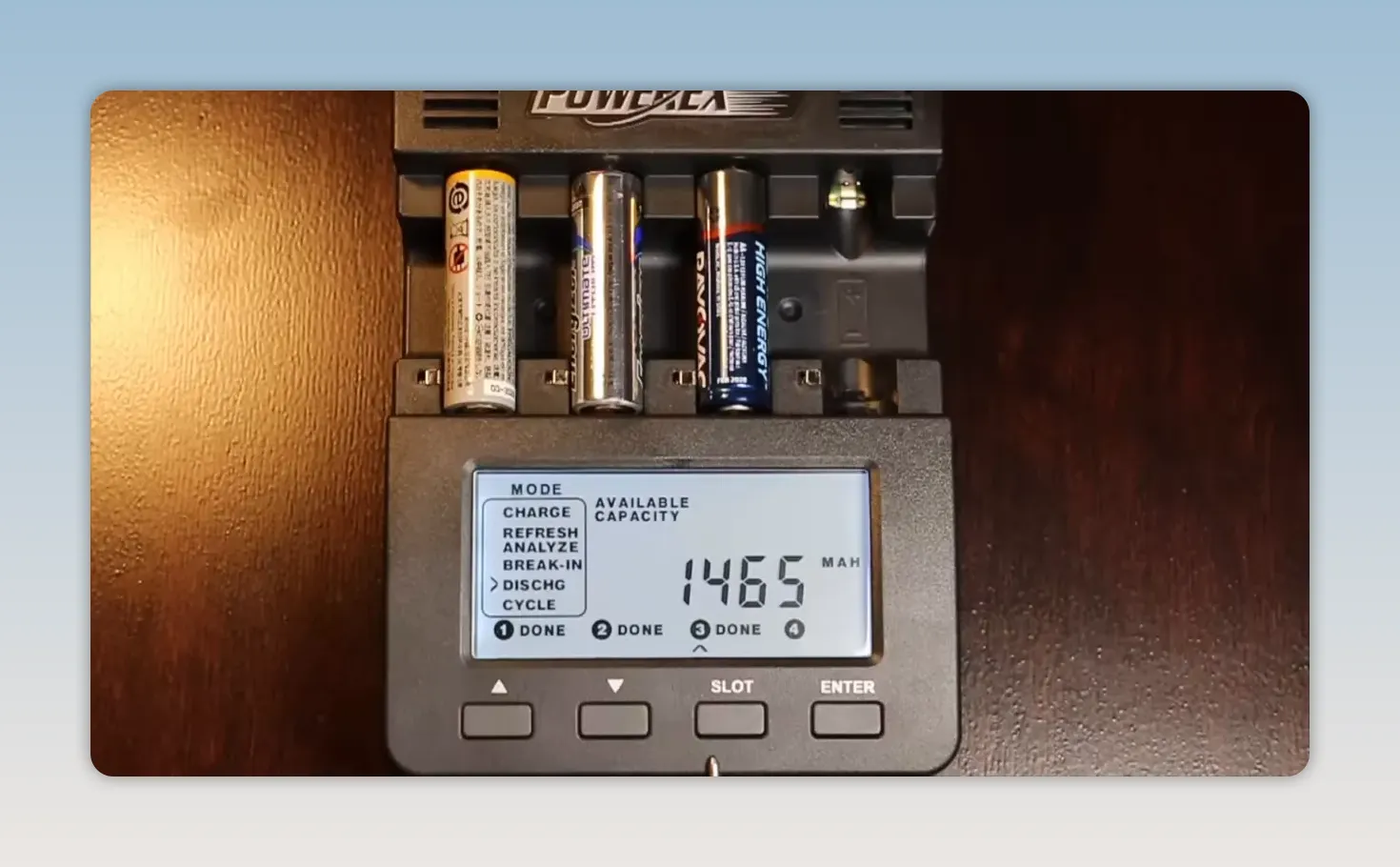
I purchased a charger-analyzer with a discharge mode. This wasn’t a sponsored test, and buying the equipment wasn’t an endorsement of its brand. The useful feature was its ability to drain each battery while recording runtime and delivered capacity.
I used two discharge settings:
- 300 milliamps, or 300 mA: The faster-drain test.
- 100 milliamps, or 100 mA: The slower-drain test.
The analyzer reported capacity in milliamp-hours, or mAh. That’s different from milliamps: mA describes the discharge current, while mAh describes the amount of charge delivered over time. These results compare the analyzer’s reported capacity, rather than energy measured in watt-hours.
I began with two Dollar General batteries and two regular Duracells to check how consistently the tester performed. After that, I tested one battery from each product in the comparison rounds. These are results for the samples tested, not a guarantee that every battery from a brand will produce exactly the same number.
For the value comparison, I divided the measured capacity by each battery’s cost in pennies. All prices and value rankings below reflect what I paid for these batteries at the time of testing.
The 300 mA Test: Cheap Batteries Run Out Quickly
Dollar General vs. Duracell
The Dollar General heavy-duty batteries cost $1 for eight, or roughly 13 cents each. Regular Duracells cost around 75 cents each. That’s a big price difference, but the performance gap was even bigger.
Within about eight or nine minutes, the Dollar General batteries were already below 1 volt. The Duracells were still around 1.34 volts under the test load.
- Dollar General, first battery: 26 minutes and 117 mAh.
- Dollar General, second battery: 35 minutes and 158 mAh.
- Duracell, first battery: 381 minutes and 1,747 mAh.
- Duracell, second battery: 380 minutes and 1,738 mAh.
The Duracells finished within one minute of each other. The Dollar General batteries varied more, but neither came close. Paying less per battery wasn’t looking like much of a bargain.
Amazon Basics, Duracell Quantum, Rayovac Fusion, and Thunderbolt
Next came an interesting matchup. Both Rayovac Fusion and Duracell Quantum carried claims that no alkaline battery lasted longer. I put them alongside Amazon Basics and Harbor Freight Thunderbolt.
- Rayovac Fusion: 410 minutes and 1,884 mAh.
- Duracell Quantum: 405 minutes and 1,850 mAh.
- Amazon Basics: 301 minutes and 1,382 mAh.
- Harbor Freight Thunderbolt: 28 minutes and 125 mAh.
Rayovac Fusion edged out Duracell Quantum, although those two finished very close together. Amazon Basics delivered less capacity, but it did fairly well considering its price.
The Thunderbolt was a different story. At just 28 minutes, it landed in the same disappointing territory as the Dollar General heavy-duty batteries.
Energizer Takes the Alkaline Lead, but Lithium Pulls Away
The next group included regular Rayovac, Eveready Silver, Energizer alkaline, and Energizer lithium.
The lithium batteries cost about $1.50 each, compared with roughly 55 cents for Eveready, 75 cents for Energizer alkaline, and around 70 cents for Rayovac. At that price, lithium needed to deliver a substantial improvement.
- Energizer lithium: 723 minutes and 3,317 mAh.
- Energizer alkaline: 411 minutes and 1,888 mAh.
- Rayovac: 347 minutes and 1,589 mAh.
- Eveready Silver: 303 minutes and 1,384 mAh.
I was impressed with the regular Energizer. It beat both Duracell products and narrowly topped Rayovac Fusion, although the leading alkaline batteries were very close.
Energizer lithium was the clear runtime winner. It lasted just over 12 hours in this test, compared with just under seven hours for the best alkaline result.
The chart uses rounded averages for the two initial samples: about 1,743 mAh for regular Duracell and 138 mAh for Dollar General.
The 100 mA Test: Does a Slower Drain Change the Ranking?
A faster discharge is only part of the picture. I reduced the setting to 100 mA to see how the batteries compared under a lighter load.
The cheapest products lasted longer than they had in the faster test, but they still finished far behind the stronger performers.
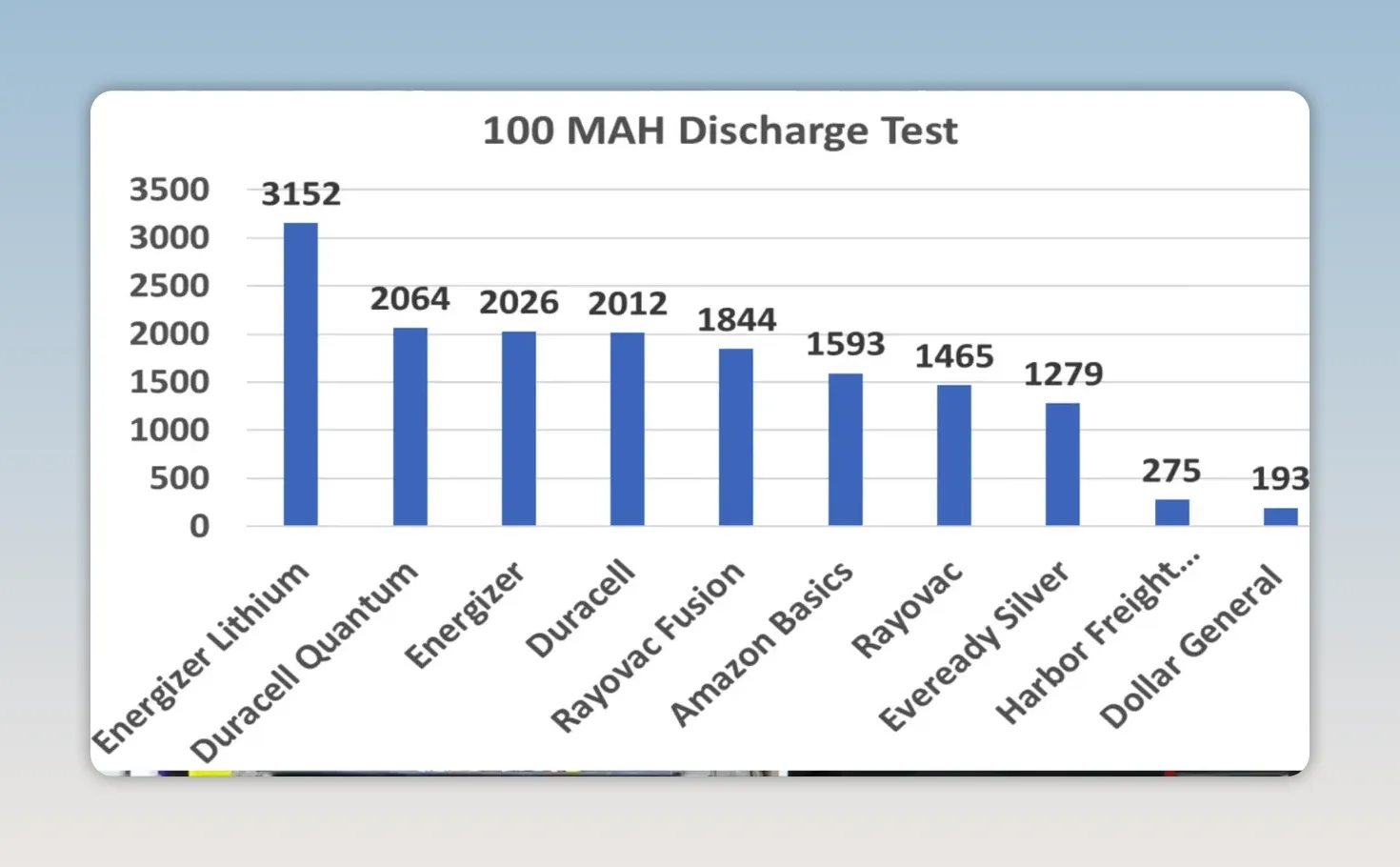
- Harbor Freight Thunderbolt: 181 minutes and 275 mAh.
- Dollar General heavy-duty: 128 minutes and 193 mAh.
- Eveready Silver: 837 minutes and 1,279 mAh.
Among the higher-capacity alkaline batteries, Duracell Quantum moved into first place.
- Duracell Quantum: 1,363 minutes and 2,064 mAh.
- Energizer alkaline: 1,329 minutes and 2,026 mAh.
- Duracell: 1,315 minutes and 2,012 mAh.
- Rayovac Fusion: 1,205 minutes and 1,844 mAh.
Duracell Quantum won the alkaline comparison, but not by much. Energizer and regular Duracell were both close behind.
I made a mistake during the first Amazon Basics run, so I repeated that test. In the next round, I also tested Energizer lithium and regular Rayovac.
- Energizer lithium: 2,081 minutes and 3,152 mAh.
- Amazon Basics: 1,043 minutes and 1,593 mAh.
- Rayovac: 958 minutes and 1,465 mAh.
Amazon Basics finished ahead of regular Rayovac and Eveready Silver, both of which cost more. That was a very good result for an affordable battery.
Lithium again lasted the longest, running for nearly 35 hours. It delivered about twice the capacity of Amazon Basics, although its advantage over the best alkaline battery was smaller.
Which AA Battery Offers the Best Value?
Maximum runtime is useful, but it doesn’t answer the whole buying question. A battery that lasts longer can still cost more for the capacity it delivers.
To compare value, I used mAh per penny. Higher is better: it means more measured capacity for the money.
Value at the Faster Discharge Setting
Amazon Basics delivered a little over 32 mAh per penny, putting it in first place. Energizer alkaline came next at nearly 26 mAh per penny.
That changes the way the capacity results look. Amazon Basics finished near the lower end of the main competition for runtime, but its lower price more than made up for that in this value calculation.
Energizer lithium delivered the most capacity from a single battery, but it wasn’t the best value. Dollar General and Harbor Freight Thunderbolt occupied the bottom two spots. Their low purchase prices couldn’t compensate for their very low output.
Value at the Slower Discharge Setting
The same two products led again:
- Amazon Basics: About 37 mAh per penny.
- Energizer alkaline: Nearly 28 mAh per penny.
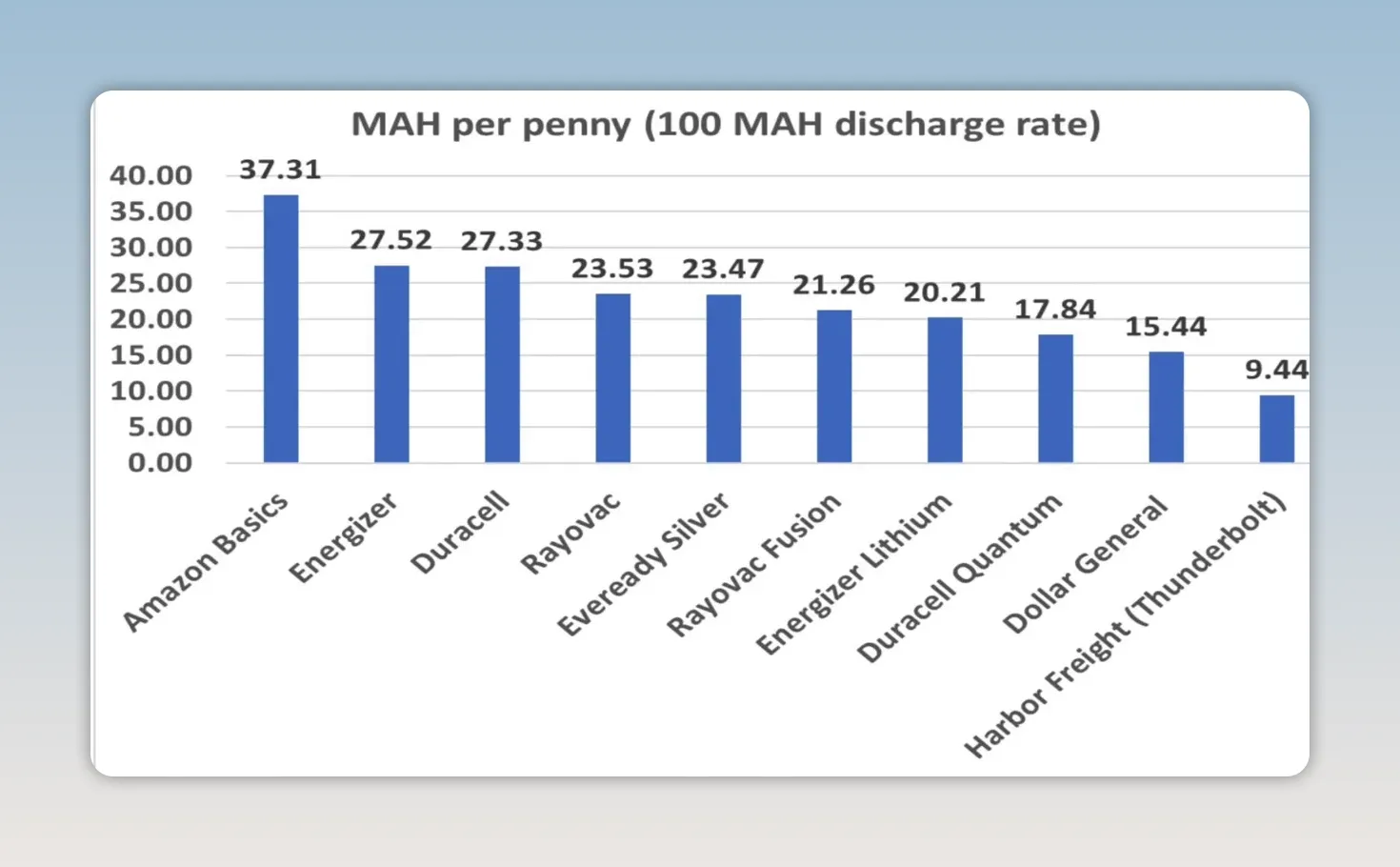
Once again, Dollar General and Thunderbolt finished in the last two positions. The cheapest battery at the checkout wasn’t the cheapest battery to use.
Which AA Battery Would I Buy?
Amazon Basics was the biggest surprise. Given its affordable price, I expected it to perform closer to the Dollar General or Harbor Freight batteries. Instead, it delivered useful capacity and won the value comparison at both discharge settings.
Even so, I’d likely buy regular Energizer alkaline. It offered a very good balance of price and capacity, finishing first among alkalines in the faster test and just behind Duracell Quantum in the slower test. It also placed second for value in both comparisons.
Here’s how I’d separate the choices:
- Best measured runtime: Energizer lithium. It comfortably outlasted every other battery in both tests.
- Best capacity for the money: Amazon Basics. It won both value comparisons at the prices paid.
- My overall pick: Energizer alkaline. Strong capacity without the lithium price premium.
- Best alkaline result at 100 mA: Duracell Quantum. It narrowly beat Energizer and regular Duracell.
- Products I wouldn’t recommend from this test: Dollar General heavy-duty and Harbor Freight Thunderbolt. Both delivered too little capacity to justify even their low prices.
I might buy Energizer lithium for an application where the extra runtime matters. But for something like my camera microphone, which doesn’t have a significant battery drain, the premium is more than I’d want to pay.
As for Dollar General and Thunderbolt, the only tempting application might be a noisy child’s toy when you’d really like the noise to stop quickly.
The practical lesson is simple: buy for the job. Lithium gives you the longest runtime, Amazon Basics stretches the battery budget furthest, and regular Energizer strikes the balance I’d choose for everyday use.


